


Table of Contents
- Dubai Visa Photo Size — Quick Answer
- Dubai Visa Photo Size in CM, MM, Inches & Pixels
- Dubai Visa Photo Background Requirements
- Face, Expression & Head Covering Rules
- Photo Recency Rule — How Old Can It Be?
- Why Rejections Have Increased in 2026 (Real Data)
- How to Take a Compliant Photo at Home
- Where to Get It Done in Dubai — Cost in AED & USD
- Common Rejection Reasons & How to Avoid Them
- Why Trust This Guide?
- Conclusion
2026 Update: UAE immigration authorities tightened automated photo-verification checks in May 2026 (formally notified 13 May), aligning them more closely with ICAO biometric standards. Trade reporting from July 2026 shows some visa specialists seeing more than 80% of first-attempt photo uploads rejected since the change. If your last approved Dubai visa photo is from 2026 or earlier, treat it as outdated and prepare a fresh one before you apply.
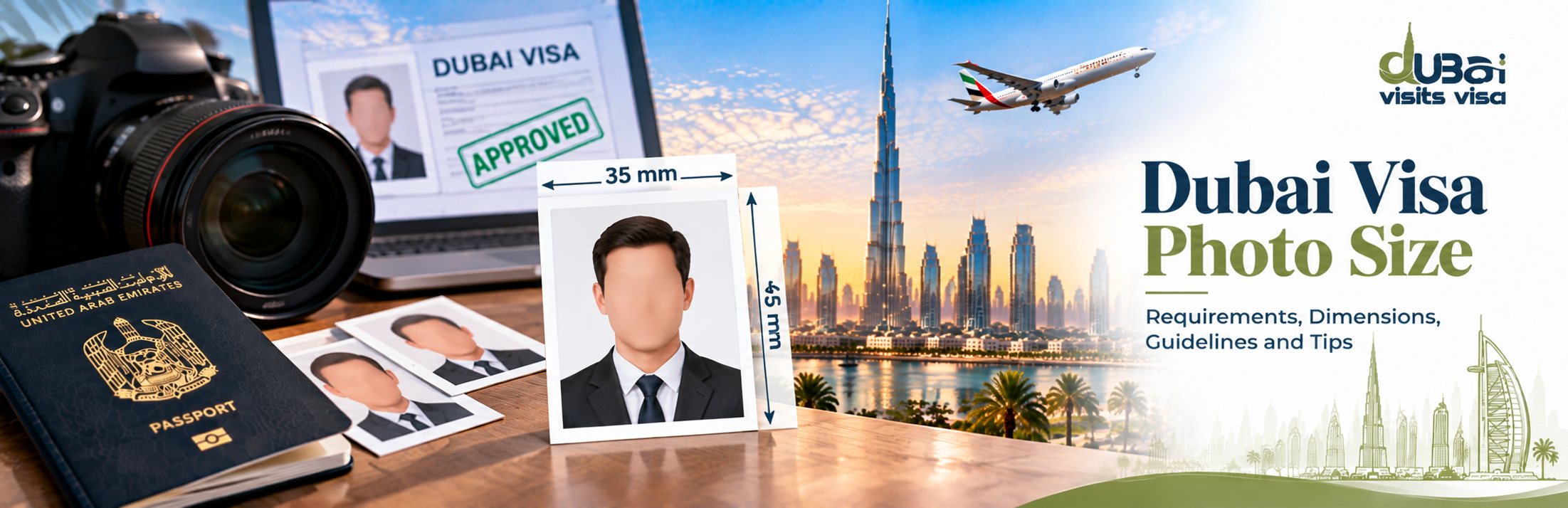
The correct Dubai visa photo size, as of July 2026, is 43mm × 55mm (4.3cm × 5.5cm) for print, 300 × 369 pixels for digital upload through GDRFA Dubai, or 1016 × 1300 pixels through ICP Smart Services for the other six emirates. This applies to every tourist, visit, and residence visa applicant. GDRFA tightened its automated photo checks in May 2026, so photos that passed in 2026 are now failing more often.
Most rejected Dubai visa applications aren't rejected because of the applicant — they're rejected because of a photo that's the wrong pixel size, the wrong file size, or slightly off-white in the background. Nationality guides, such as the Dubai visa for Moroccan citizens, list the photo spec beside the other documents. It's a small file, but it's the single most common reason an otherwise complete application gets bounced back. Alongside your photo, immigration also checks supporting documents like your confirmed return flight ticket, so it's worth getting every piece right the first time rather than resubmitting twice.
This guide covers the exact dubai visa photo dimensions in cm, mm, inches and pixels, the background and face rules that trip people up, why the GDRFA and ICP portals ask for different digital sizes, and what to do if your photo has already been rejected. Whether you're applying for a 30-day tourist entry or a longer-stay Dubai visit visa, the photo specification is identical. The photo is only one part of the file.
Understanding the Dubai visa photo requirements properly the first time is the difference between a same-week approval and a two-week back-and-forth with immigration.
Quick Summary — Dubai Visa Photo Size
| Print Size | 43mm × 55mm (4.3cm × 5.5cm) |
| GDRFA Digital Upload (Dubai) | 300 × 369 pixels, approx. 200–600 KB |
| ICP Digital Upload (Other Emirates) | 1016 × 1300 pixels, up to 15 MB |
| Background | Plain white, no shadows, no patterns, no border/margin |
| Face Coverage | 70–80% of the frame |
| Photo Age | Taken within the last 6 months |
| Studio Cost in Dubai | AED 15–40 (~USD 4–11) |
Dubai Visa Photo Size — Quick Answer
If you only need the numbers, here they are before anything else: your Dubai visa photo size must be 43mm × 55mm when printed, and 300 × 369 pixels when uploaded digitally through the GDRFA Dubai portal. If your application is going through ICP Smart Services (used by Abu Dhabi, Sharjah, Ajman, Ras Al Khaimah, Fujairah, and Umm Al Quwain), the digital file needs to be 1016 × 1300 pixels instead. Both require a plain white background, a recent photo, and a face that fills roughly 70–80% of the frame.
- Print size: 43mm × 55mm (4.3cm × 5.5cm)
- GDRFA digital upload: 300 × 369 pixels
- ICP digital upload: 1016 × 1300 pixels
- Background: plain white, no shadows, borderless
- Face coverage: 70–80% of the photo
- Photo age: within the last 6 months
Dubai Visa Photo Size in CM, MM, Inches & Pixels
The dubai visa photo dimensions get confusing fast because different official-sounding sources quote different numbers. Here's the full conversion in every unit you're likely to be asked for, so you don't have to do the maths yourself.
| Unit | Print Photo | Digital Upload (GDRFA) |
|---|---|---|
| Millimetres (mm) | 43mm × 55mm | — |
| Centimetres (cm) | 4.3cm × 5.5cm | — |
| Inches (approx.) | ~1.7in × 2.2in | — |
| Pixels | — | 300 × 369 px |
| File Size | — | Approx. 200–600 KB |
Sizes are cross-checked against current published guidance as of July 2026 and may be updated by GDRFA or ICP without notice. Always confirm before submitting.
Why You'll See Two Different Numbers
If you've searched around, you've probably also seen 35mm × 45mm quoted as the Dubai visa photo size, alongside 43mm × 55mm. Both genuinely appear across sources that look official. Here's the honest answer: 43 × 55mm is the more consistently cited UAE-specific figure across GDRFA-facing guidance, while 35 × 45mm is the more universal ICAO/passport-style standard that some ICP-linked services also accept. Rather than guess which one your specific portal wants, match the two things that stay consistent everywhere — the 70–80% face coverage and the white background — and use an auto-cropping tool or studio that specifically labels itself for "UAE visa photo," not just generic passport photo.
GDRFA Dubai vs. ICP — Digital Upload Specs Compared
Dubai visa photo requirements aren't identical across the UAE. GDRFA (General Directorate of Residency and Foreigners Affairs) handles Dubai. The other six emirates run through ICP (Federal Authority for Identity, Citizenship, Customs & Port Security) Smart Services. The print size and face rules are the same either way — only the digital upload spec changes.
| Portal | Covers | Digital Size | File Size |
|---|---|---|---|
| GDRFA | Dubai | 300 × 369 px | ~200–600 KB |
| ICP Smart Services | Abu Dhabi, Sharjah, Ajman, RAK, Fujairah, Umm Al Quwain | 1016 × 1300 px | 1–15 MB |
If you're not certain which portal your application will run through, prepare the higher-resolution ICP version first — it's straightforward to downsize a large, sharp image for GDRFA, but you can't upscale a small one without losing quality. And if you're still deciding between a stamped paper visa and a fully digital application, that choice doesn't change your photo requirement either way. Whichever portal applies to you, the file gets uploaded directly inside the online visit visa application form, so have it saved and ready before you start filling that in.
Dubai Visa Photo Background Requirements
The dubai visa photo background rule sounds simple — "use white" — but this is where a surprising number of otherwise-good photos fail. Off-white, cream, light grey, and light blue are all treated as non-compliant, even though they can look "close enough to white" on a phone screen.
- Background must be plain, pure white — no cream, grey, or blue tint
- No shadows behind the head or shoulders
- No patterns, textures, or visible wall marks
- No objects, furniture, or other people in frame
- The photo must be borderless — no white margin, frame, or edge added around it
That last point — borderless — catches people who edit their photo in a generic phone app that adds a thin white margin "for a clean look." Immigration systems read that margin as part of the image dimensions, which throws off the automated face-detection crop and can trigger a rejection with no explanation.
VFS Global's own published specification technically calls for a "plain light background" rather than specifying white outright. In practice, pure white remains the safest choice — any visible tint (cream, grey, light blue) is one of the most common ways this rule trips people up, so there's little upside to using anything other than white.
Face, Expression & Head Covering Rules
Beyond size and background, the biometric system checks how much of the frame your face occupies, your expression, and what you're wearing. These rules are consistent across GDRFA and ICP.
Face Coverage — the 70–80% Rule
Your face — measured from the top of the forehead to the bottom of the chin — should fill 70–80% of the photo height. Too far back and the system can't read facial landmarks clearly; too close and the crop cuts off the top of the head. VFS Global's own published specification puts this at roughly one inch (about 25mm) in height — use that as your target rather than eyeballing a percentage.
Skin Tone, Exposure & Print Quality
Two requirements that rarely get mentioned but are part of VFS Global's official specification: skin tone has to look natural, and if you're submitting a print, it needs to come from a proper photo studio. An over- or under-exposed photo — one where the skin reads as noticeably too dark or too light — is rejected on its own, separately from any background or sizing issue. And for print copies, Polaroid photos or anything run off an ordinary home or office printer aren't accepted; it needs continuous-tone output from a professional studio.
Head Coverings & Religious Exceptions
Head coverings worn for religious or medical reasons are permitted. The specific rule that trips people up: the covering must be a solid, dark colour that visibly contrasts against the white background, and it cannot cover any part of the face — forehead, cheeks, and chin must stay fully visible. A light-coloured hijab or scarf that blends into the white backdrop is one of the more common reasons this category of photo gets sent back.
Glasses, Smiling & Other Restrictions
- Glasses are generally not recommended; if medically necessary, lenses must be untinted with no glare
- Expression must be neutral — mouth closed, no smiling
- Eyes must be open and clearly visible, looking directly at the camera
- Head must be straight and centred, not tilted
- Photo must be in full colour, not black and white
Photo Recency Rule — How Old Can It Be?
Your photo must have been taken within the last 6 months — not 12, despite what some older guides still say. This isn't just a formality. If your appearance has changed noticeably (new beard, significant weight change, different hairstyle), immigration expects an updated photo regardless of the 6-month window, since the point of the rule is that the photo should match how you currently look on arrival.
Practical tip: reusing a passport photo from 2026 or 2024 because "it still looks like me" is one of the quieter causes of delay. If you can't remember exactly when a photo was taken, that's usually a sign it's time for a new one.
Why Rejections Have Increased in 2026 (Real Industry Data)
This isn't a generic warning — it's a real, current shift. In May 2026, UAE immigration authorities rolled out stricter automated photo-verification, tightening checks to align more closely with ICAO biometric standards, per an official VFS Global spokesperson. The numbers below come specifically from South African visa specialists, reported by Travel News — it's trade-level anecdotal data from one market rather than an official UAE-wide statistic, but it's the clearest picture available of how hard the new rules are biting in practice. Part of the pressure is simply volume: with regional unrest subsiding, travel demand to Dubai has picked up again, so specialists are processing more applications at the same time as more of those photos are failing.
"More than 80% of photos are an issue since the changes" — and it now takes significantly more back-and-forth with applicants to get one accepted.
Applicants should use "a high-resolution HD image taken on a phone rather than a selfie."
A third specialist quoted in the same report, Vanessa De Stefano of Thompsons Holidays, noted that rejection notices from Dubai Immigration typically give no explanation at all — they simply state the photo doesn't meet requirements, leaving agencies to troubleshoot by trial and error. That's precisely why getting the size, background, and recency right before you submit matters more in 2026 than it did even a year ago.
How to Take a Compliant Photo at Home
A studio photo is the safest route, but a phone photo can pass if you control three things precisely: distance, light direction, and camera settings. This is different from just "find a white wall" — here's the setup that actually matters.
- Distance: stand about 1.5 metres from a plain white wall, with the camera roughly 1 metre from you — this avoids the wall-shadow that close-range phone shots create
- Light direction: face a window with daylight, camera between you and the window — never light from directly overhead, which casts eye-socket shadows the system flags
- Camera settings: turn off any beauty filter, skin-smoothing, or portrait-mode background blur — these count as digital enhancement and can trigger rejection
- Who takes it: have someone else hold the phone; a genuine third-party shot avoids the angle distortion that selfies are now failing on
- Exposure: check the shot isn't over- or under-exposed — skin that reads as noticeably too dark or too light is its own rejection reason, separate from lighting direction
- Format: save as JPEG, then crop with a tool built specifically for UAE visa photos rather than a generic passport-photo cropper
- If printing: get it done at a professional photo studio — Polaroid prints or anything from a home/office printer will be rejected
Where to Get It Done in Dubai — Cost in AED & USD
If you'd rather not risk a rejection over lighting or cropping, typing centres and photo studios across Dubai handle UAE visa photos daily and already know the GDRFA specification by name — ask specifically for a "UAE visa photo," not a generic passport photo.
| Option | Price (AED) | Price (USD) | Notes |
|---|---|---|---|
| Typing centre / photo studio | AED 15–40 | USD 4–11 | Usually includes 4–6 prints plus a digital file |
| Mall photo kiosk | AED 25–50 | USD 7–14 | Faster, slightly higher cost |
| DIY at home (printed later) | AED 0–10 | USD 0–3 | Free if only a digital file is needed; small print cost otherwise |
Prices are indicative, based on typical Dubai typing-centre and studio rates as of mid-2026, and will vary by location and season. Always confirm the current price before paying.
Common Dubai Visa Photo Rejection Reasons & How to Avoid Them
These are the dubai visa photo rejection reasons that come up most often — specifically for the photo itself. If your application was rejected for something unrelated to the photo (documents, overstay history, form errors), our complete guide to Dubai visit visa rejection reasons covers the rest.
- Off-white, cream, or grey background instead of pure white
- Photo older than 6 months, or appearance has changed since it was taken
- File size or pixel dimensions outside the portal's accepted range
- Visible border or margin around the image
- Shadows behind the head or across the face
- Filters, beauty smoothing, or background blur applied
- Selfie-angle distortion or uneven lighting
- Glasses with glare, tinted lenses, or frames covering the eyes
- Head covering that matches or blends into the white background
- Over- or under-exposed photo, making the skin tone look too dark or too light
- Print submitted as a Polaroid or printed on an ordinary home/office printer instead of professional continuous-tone output
Myth vs. Reality
| Myth | Reality |
|---|---|
| "A selfie is fine if the lighting is good." | 2026 industry reporting shows selfies failing disproportionately due to angle distortion and uneven lighting — agencies now ask clients to have someone else take the photo. |
| "Any photo under a year old works." | The actual limit is 6 months, not 12. |
| "43×55mm and 35×45mm can't both be right." | Both genuinely circulate across guidance — match the face-coverage and background rules, which stay consistent either way. |
If your photo has already caused a rejection, don't just resubmit the same image with a different crop — our guide on reapplying after a Dubai visa rejection walks through the waiting period and what to fix first.
Why Trust This Guide?
dubaivisitsvisa.com is a licensed UAE visa agent, not a photo-editing app trying to sell you a template. The specifications on this page are cross-checked against current GDRFA and ICP guidance and against independent trade-press reporting on the May 2026 rule change, rather than copied from a single source. Where the industry genuinely disagrees — like the 43mm vs. 35mm question — we've said so directly instead of presenting a false single answer.
This page is reviewed and updated as portal rules change. If you'd rather not risk a resubmission, our team can check your photo against current GDRFA/ICP specs before you upload it.
Get your photo checked before you submit: WhatsApp +971 58 885 0205 or email support@dubaivisitsvisa.com — our licensed team will review it against current GDRFA/ICP specs before you upload.
Disclaimer: GDRFA and ICP can adjust photo-verification rules without a formal public announcement, and exact behaviour can vary by application channel. The specifications above are cross-checked against current published guidance and trade reporting as of July 2026, but they don't replace confirmation from GDRFA, ICP, or a certified UAE visa agent at the time you apply. If in doubt, have a licensed agent check your photo before you submit it.
Conclusion
Get the Dubai visa photo size right — 43mm × 55mm print, 300 × 369 pixels for GDRFA, 1016 × 1300 pixels for ICP — and you remove the single most common reason a visa application stalls in 2026. Pair it with a plain white background, a photo taken in the last 6 months, and a neutral expression, and you're covering everything the current biometric checks look for.
For the rest of the application — documents, timelines, and eligibility — our step-by-step Dubai visit visa guide covers what comes next. And once you've submitted, you can check your visa status using your passport number to track progress.
Not sure your photo will pass? Send it to our team before you upload — WhatsApp +971 58 885 0205 or email support@dubaivisitsvisa.com for a free check against current GDRFA/ICP specs.
Priyanshu is a travel and visa content specialist focused on visa requirements, travel procedures, and immigration information for international destinations. His work covers visa eligibility, documentation, application processes, entry requirements, transit rules, and practical travel guidance. He researches official updates and relevant industry information to create clear, accurate, and easy-to-understand content that helps travellers understand visa processes and plan their journeys with confidence.
Comments
0No comments yet — be the first to share your thoughts.
Leave a Comment
Your email address will not be published. Required fields are marked *
Frequently asked questions
43mm × 55mm for print, or 300 × 369 pixels for digital upload through GDRFA Dubai. ICP-administered emirates require 1016 × 1300 pixels instead.
4.3cm × 5.5cm. This is the same measurement as 43mm × 55mm, just expressed in centimetres.
Technically it can be uploaded, but 2026 industry data shows selfies failing at a noticeably higher rate due to angle distortion and lighting. Have someone else take the photo instead.
Glasses are generally not recommended. If medically necessary, lenses must be untinted with no glare and frames must not cover the eyes.
Yes, for religious reasons. It must be a solid, dark colour that contrasts with the white background, and it cannot cover the face.
For GDRFA Dubai, approximately 200–600 KB. For ICP Smart Services, up to 15 MB. Confirm on the specific portal you're using, since limits can vary slightly by channel.
No older than 6 months. If your appearance has changed noticeably in that window, take a new one regardless.
The system typically won't explain why. Check it against the size, background, recency, and border rules above, fix the specific issue, and resubmit through the same application.
The print size and face rules are identical. Only the digital upload spec differs: 300 × 369 pixels for GDRFA versus 1016 × 1300 pixels for ICP.
No. Expression must be neutral, with the mouth closed and both eyes open and clearly visible.
Typically AED 15–40 (~USD 4–11) at a typing centre or photo studio, usually including prints and a digital file.







Thanks! Your comment has been received and will appear after a quick review.