


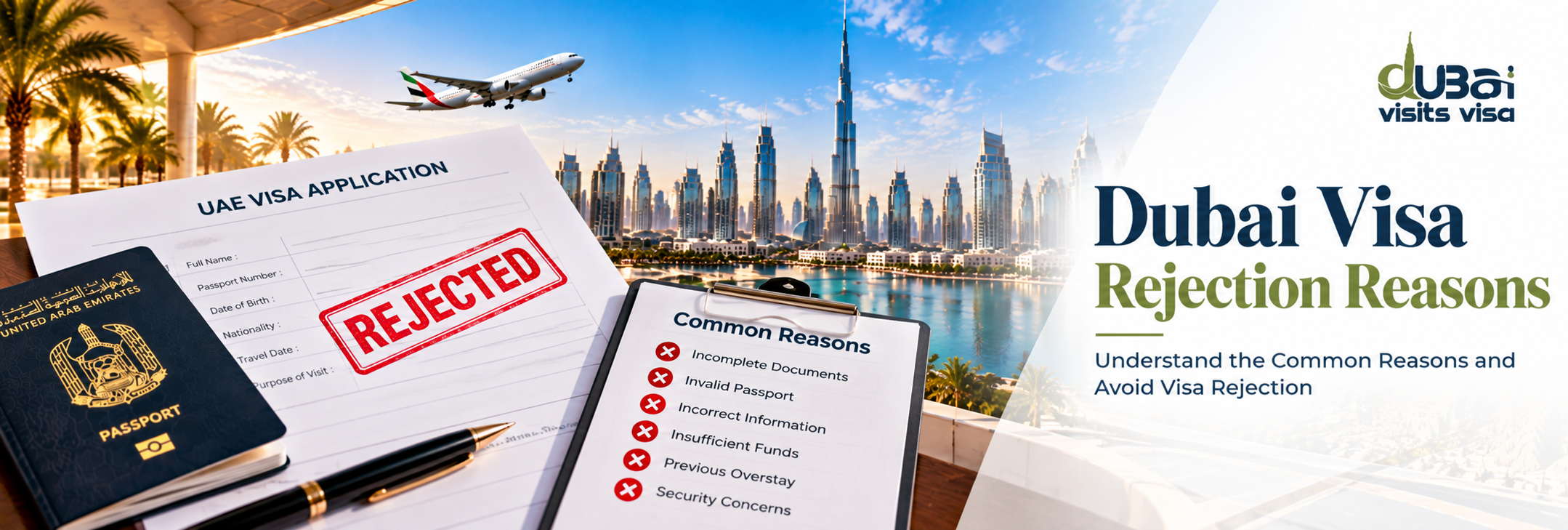
You filled out every field. You uploaded every document. You paid the fee and waited. Then — rejected. No real explanation, no callback, just a status update that flipped your entire trip plan upside down.
The hard truth is this: understanding the exact dubai visa rejection reasons before you reapply is the only thing that separates a second rejection from an approval. Most people skip this step. They wait a few days, resubmit the same file, and get the same result. This guide exists to make sure that does not happen to you. Whether you are dealing with a uae tourist visa rejection, a work permit denial, or a uae visa rejection medical flag, every real trigger — including the ones immigration portals never document — is covered here in full.
If you are still deciding which visa type fits your travel purpose, going through the breakdown of Dubai visit visa categories first will eliminate one of the most avoidable common dubai visa rejection reasons — applying under the wrong category entirely.
Quick Summary — Dubai Visa Rejection Reasons 2026
The most common dubai visa rejection reasons are document errors, weak financial proof, wrong visa category, travel history gaps, sponsor issues, medical fitness failures, and security-related flags. UAE tourist visa rejection rate for Indian applicants is approximately 5–6%. Employment and residency refusals follow separate criteria linked to employer status and medical screening. Identifying the exact reason for dubai visa rejection before reapplying is not optional — resubmitting the same file without fixing the cause produces the same outcome every time.
Dubai Visa Rejection Reasons — Tourist & Visit Visa (Complete 2026 List)
Tourist and visit visa applications carry the largest share of all Dubai refusals. These are the precise triggers flagged by GDRFA and ICP automated systems — including several that most published guides never mention.
1. No Confirmed Flight Booking or Hotel Reservation
This is the single most common reason for dubai visa rejection among first-time applicants. UAE immigration requires a confirmed return flight booking — not a search result, not a price comparison screenshot, and not a pending itinerary. The booking must carry a verifiable PNR (Passenger Name Record) reference. Hotel reservations must show the full property name, confirmed check-in and check-out dates, and a booking reference number that can be cross-checked. A typed accommodation letter, an unconfirmed Airbnb inquiry, or a forwarded travel agent email does not meet the standard.Missing either document is an automatic system flag.
2. Weak Financial Proof — Bank Statement Problems
Insufficient financial documentation is consistently one of the most cited common dubai visa rejection reasons across all nationality groups. UAE immigration needs to see that you can fund your entire stay without illegal employment. The minimum recommended average bank balance for a standard visit is around AED 5,000 (approximately USD 1,360) for a 60-day tourist visa. Thin balances, accounts opened days before application, or statements that show erratic deposits and sudden withdrawals all raise immediate red flags.
The most damaging mistake: transferring a large lump sum into your account just before applying. UAE immigration systems detect this pattern specifically. A sudden spike in balance with no prior consistent income history behind it is treated as a fabrication signal — not proof of financial strength. Three to six months of regular, consistent account activity carries far more weight than one impressive month with nothing behind it.
3. Passport Validity Below 6 Months from Travel Date
Your passport must be valid for at least 6 months from your intended travel date — not the date you submit the application. This distinction is where many applicants go wrong. Counting validity from the application date and not the departure date is one of the most frequently avoidable dubai visa rejection reasons. The GDRFA system flags this automatically. A new passport must be obtained and biometrics re-done before any reapplication can succeed.
4. Passport Scan Does Not Meet Technical Standards
A blurry phone photo of your passport is one of the easiest-to-avoid yet most frequently occurring reasons for dubai visa rejection. The full technical requirements that must be met:
- Minimum 300 DPI scan resolution — anything below cannot be machine-processed
- File size under 2MB in JPEG or PDF format
- The Machine Readable Zone (MRZ) — the two strips of coded text at the bottom of your passport photo page — must be fully visible, uncropped, and perfectly sharp
- No glare, shadows, cut-off corners, or missing portions of the data page
- Colour scan only — black-and-white scans are not accepted
The MRZ is how the immigration system automatically verifies your identity. If the MRZ cannot be read by the machine, identity verification fails and the application is rejected without any human review taking place.
5. Photograph Does Not Meet UAE Specifications
Photo non-compliance is a straightforward reason for dubai visa rejection that is entirely preventable. UAE visa photo requirements are stricter than most applicants expect:
- Pure white background — cream, off-white, light grey, or any other shade will fail
- Photo taken within the last 6 months — not 12 months
- No glasses, hats, or head coverings (religious exemptions require supporting documentation)
- Full face visible, ears visible, neutral expression — no smiling, no tilted head
- 35mm x 45mm dimensions, JPEG format, under 1MB file size
6. Wrong Visa Category Selected
Applying for a tourist visa while intending to attend business meetings, or selecting a transit visa while planning to exit the airport — these mismatches are a well-documented reason for dubai visa rejection. UAE immigration cross-references your stated purpose of visit against your travel profile, itinerary documents, and previous UAE visit patterns. If the stated purpose and actual travel intent do not align, the application is flagged. The Dubai visit visa type guide clarifies which category applies to each travel purpose — selecting the wrong one adds a rejection risk that has nothing to do with your documents.
7. Unskilled Profession Listed in Passport
This is a common dubai visa rejection reason that catches applicants completely off guard. Passports from India, Pakistan, Bangladesh, Nepal, and several other countries often list occupation fields such as "Labourer," "Daily Wage Worker," "Farmer," or "Housewife." UAE immigration applies heightened scrutiny to these profession categories — in many cases, automated systems flag the application before any human review occurs. Applicants with these occupation designations generally need to apply through a licensed UAE-based sponsor rather than a direct self-applied e-visa route to reduce this rejection risk.
8. No Evidence of Intent to Return Home
Every visa assessor reviewing a tourist application is looking for one underlying signal: a credible reason why this applicant will leave Dubai when their visa expires. Applications carrying no indicators of strong ties to the home country — no stable employment, no property ownership, no dependants, no financial obligations — read as elevated overstay risk profiles. Documents that directly address this dubai visa rejection reason: a current employer letter with salary details, three months of salary slips, property ownership documentation, a marriage certificate, and a national ID showing a fixed home address.
9. Problematic or Inconsistent Travel History
UAE immigration has shared access to GCC border data. A deportation from Saudi Arabia, Oman, Bahrain, or Kuwait is visible on your file when you apply for a UAE visa. Frequent short UAE trips with no clear documented purpose, large unexplained gaps in your passport travel stamps, or a history of overstays in multiple countries all contribute to a risk profile that the system flags. This is a less-discussed but real reason for dubai visa rejection that cannot be corrected with documents — only a clean ongoing travel record changes it over time.
10. Previous UAE Overstay Fine Not Settled
An unpaid UAE overstay fine sits in the GDRFA system permanently until cleared — it does not expire with time. A new visa application submitted with an outstanding fine on record will be rejected regardless of how otherwise complete the application is. Knowing the specific UAE overstay fine amounts and the exact clearance process is the mandatory first step before any reapplication in this scenario.
11. Previous UAE Residence Visa Never Formally Cancelled
If you held a UAE residence visa through a previous employer and it was never formally cancelled in the system, it may still appear as "active" — even if you physically left the UAE years ago. A new tourist visa application cannot be processed while an active residence record exists under your passport identity. A formal cancellation through GDRFA or ICP must be completed — and confirmed as reflected in the system — before a new application can succeed.
12. Unused Tourist Visa Still Active in System
Separate from the residence visa situation — and frequently missed as a dubai visa rejection reason. If you were issued a tourist visa, never actually travelled to Dubai, and never cancelled that visa, it may still show as active in the portal. The system will not issue a second visa while a first one is technically open under your passport. Contacting the issuing agent or the GDRFA directly to formally close the unused visa is the fix — but it must reflect in the system before any new submission.
13. Multiple Applications Filed at the Same Time
When processing takes longer than expected, some applicants submit a second application through a different agent — or resubmit on the same portal. This is one of the most preventable common dubai visa rejection reasons. UAE systems detect multiple active applications under the same passport number and reject all of them automatically. Only one active application can exist per passport at any time. Patience and one properly prepared application file is always the correct approach.
14. Female Solo Travellers Under 25
This is a real reason for dubai visa rejection — not a rumour or an unofficial policy. UAE immigration applies additional scrutiny to applications from women under 25 travelling alone from certain countries. The solution is a stronger overall application file — confirmed booking at a well-known hotel property, a detailed day-by-day itinerary, solid financial proof showing consistent income, and an employment letter with current salary and company letterhead. A comprehensive file addresses the scrutiny at the document assessment stage.
15. Sponsor or Host Information Does Not Match System Records
For family visit and sponsored visa applications, every detail about the UAE-based host must match exactly what appears in the immigration database. If your sponsor's Emirates ID number, name spelling, current visa status, or salary details have changed and your application reflects outdated information, the mismatch is flagged automatically. Confirming your sponsor's current eligibility and system details before submission eliminates this rejection trigger entirely.
16. Sponsor Flagged or Under Immigration Hold
Even with a personally clean record, a sponsor who is flagged in the UAE immigration system — for unpaid employee wages, labour violations, or legal infractions — causes the application to be rejected automatically. The applicant's clean status does not override the sponsor's flagged standing. This hidden dubai visa rejection reason is particularly common for applicants from South Asia who list a former UAE employer as a host or contact on their application.
17. First-Time Applicant with No International Travel Record
UAE immigration uses travel history as a trust and compliance indicator. An applicant who has never held a foreign visa or travelled internationally before carries an unknown compliance profile — the system has no data to assess how this person has historically followed visa terms. Building a travel record through visa-on-arrival accessible countries — Thailand, Turkey, Malaysia, Kenya — before applying for a UAE visa measurably improves the approval profile. This is a genuine and often unspoken reason for dubai visa rejection for new travellers applying directly for a UAE visa as their first international trip.
18. Application Submitted Too Close to Travel Date
UAE tourist e-visa processing under normal conditions takes 4–5 working days. Applying 1–2 days before your travel date creates a timing mismatch — some automated systems flag applications where the stated travel date is before processing can feasibly be completed. The standard guidance: submit at least 7–10 working days before travel. During Ramadan, peak December–January holiday periods, and summer school holidays, allow a minimum of 14 working days to avoid this dubai visa rejection reason.
19. Children Travelling Without Proper Guardian Documentation
Minor applicants — children under 18 — travelling without both parents present face specific additional documentary requirements. If one parent is not travelling, a notarised No Objection Certificate (NOC) from the absent parent is required as part of the application. Unaccompanied minors require a full guardianship letter. Missing these specific documents is a reason for dubai visa rejection that applies exclusively to family applications and is entirely preventable with the correct paperwork prepared in advance.
20. Name Similarity or Name Mismatch Flag
Applicants whose full names closely match names in the UAE security or immigration database receive an automatic secondary review flag. This is especially common for applicants from South Asia, parts of Africa, and the Arab world, where certain names occur with very high frequency. It is not a permanent block — but it requires specific handling. A notarised identity affidavit from the applicant's home country authorities, combined with a police clearance certificate confirming the applicant's clean record, is the standard resolution path. Reapplying without addressing this flag produces an immediate second rejection on the same grounds.
💬 Dubai Visa Specialist Note
"Three rejections logged in a short period create a compounding problem on your file. Each refusal is recorded against your identity — not your passport number. Getting a new passport does not clear your dubai visa rejection history. The UAE immigration database is identity-linked and biometrically indexed. Fix the actual cause of each rejection before reapplying — every time, without exception." — UAE Immigration Processing Specialist, 14 years' experience
UAE Tourist Visa Rejection Reasons — Specific E-Visa Triggers
Beyond the general list above, uae tourist visa rejection through the online e-visa route carries some specific triggers that differ from sponsored or airline-processed applications.
Nationality-Level Scrutiny Applied to Certain Passport Groups
Applicants from specific passport-issuing countries face a statistically higher uae tourist visa rejection rate — not because of anything specific in their individual file, but because of policy-level scrutiny applied to their nationality group as a whole. This is not published officially, but it is a recognised pattern among visa processing professionals. The practical response: a more comprehensive supporting document file that goes beyond the minimum required. Including police clearance certificates, additional income proof, and a detailed personal cover letter explaining the trip significantly strengthens the application for these nationality groups.
Self-Employed Applicants — Income Documentation Gaps
Salaried applicants can evidence income with an employer letter and salary slips. Self-employed applicants face a harder standard, and insufficient proof is a frequent uae tourist visa rejection trigger in this group. Bank statements alone are rarely sufficient. A complete self-employed application includes: business registration documents, a 6-month business account bank statement, a personal account showing regular transfers from the business, and a CA-certified income declaration or professional income confirmation letter. Without these, self-employment income reads as unverifiable — and unverifiable income is a consistent reason for dubai visa rejection.
Group or Family Applications — Itinerary Inconsistencies
When a family or group applies together, the hotel booking dates, return flight dates, and stated travel purpose must be fully consistent across every member. A single member showing a different hotel check-out date or a return flight that does not match the group's stated travel window flags the entire application batch. Group and family uae tourist visa rejection outcomes often affect every member simultaneously — not just the individual with the inconsistency.
Travel Insurance — An Increasingly Expected Supporting Document
While not always listed as formally mandatory, travel insurance has become an increasingly expected supporting document in tourist visa applications. Applications from higher-scrutiny nationality groups that include a valid travel insurance policy covering the full duration of stay demonstrate a stronger intent profile. Its absence does not formally trigger dubai visa rejection reasons on its own — but its presence meaningfully strengthens borderline applications.
UAE Employment Visa Rejection Reasons
UAE employment visa rejection follows completely different logic from tourist visa refusals. Work permit applications are assessed against both the applicant's personal profile and the employer's standing in the UAE system simultaneously — and the employer's status is often the blocking factor.
Employer-Side Issues That Cause Work Visa Rejection
| Employer-Side Issue | Direct Effect on the Work Visa Application |
|---|---|
| Expired or lapsed trade licence | All sponsorship applications blocked until licence renewed |
| Foreign worker quota filled | No new work visas can be issued to the company until quota is expanded with MoHRE |
| Company under MoHRE investigation | All pending sponsorships frozen for the duration of the investigation |
| Wage Protection System (WPS) violations | Company flagged — new visa processing blocked until WPS compliance restored |
| Company recently deregistered or downgraded | Sponsorship eligibility revoked — all new applications rejected |
Many applicants assume a uae employment visa rejection reflects something in their personal profile — when the blocking factor is entirely on the employer's side. Asking the employer to confirm their MoHRE quota availability, WPS compliance status, and trade licence validity before submitting saves significant time and application fees.
Applicant-Side Employment Visa Rejection Triggers
- Contract does not match the job offer: Any discrepancy between the signed offer letter and the MoHRE-submitted contract — different salary figure, different job title, different working hours — flags the application as a potential misrepresentation case
- Salary below the UAE minimum for the category: Different visa categories carry different minimum salary thresholds; applications below the floor for the stated category are rejected automatically
- Unverifiable employment contract: Contracts that cannot be authenticated through the MoHRE verification system are rejected as non-compliant documents
- Unskilled profession category: Certain job designations from specific nationality groups face periodic processing holds or bans under UAE labour policy — a direct uae employment visa rejection trigger
- Medical fitness test failure: Every employment visa applicant must pass a UAE MOHAP-approved medical fitness test — a failed test is an automatic block on the application
- Absconding flag from a previous UAE employer: Leaving a previous UAE employer without completing the proper exit process leaves an absconding flag on record that blocks new work visa processing
- Qualification mismatch: The submitted academic or professional credential does not match the job role category applied for under UAE's classification system
The broader context of what happens when work contracts are forged or misrepresented — and the legal consequences beyond uae employment visa rejection — is covered in the UAE employment visa and labour fraud guide.
UAE Visa Rejection — Medical Reasons
UAE visa rejection medical reasons apply primarily to employment visa and long-term residence visa applicants. Tourist visa applicants are not routinely subjected to medical screening — but the medical fitness system is a standard component of all work and residency visa processing.
Medical Conditions That Trigger UAE Visa Refusal
| Medical Condition | UAE Immigration Response |
|---|---|
| Active Tuberculosis (TB) | Automatic rejection — treatment must be completed and clearance retested |
| HIV Positive | Rejected for employment and residency visas; tourist assessed case by case |
| Hepatitis B or C (active/infectious) | UAE visa rejection medical outcome depending on test results and infectivity |
| Any communicable disease flagged by MOHAP | MOHAP-approved centres report results directly to the immigration system |
| Leprosy | Automatic rejection — classified as a public health flag |
Medical Testing — The Non-Approved Facility Trap
A uae visa rejection medical outcome does not only happen when you are genuinely unfit. It also happens when the medical test is conducted at a non-approved facility. All UAE visa medical fitness tests must be done at MOHAP-approved centres. Tests from private clinics, general hospitals, or unapproved facilities are not recognised — and the application will be rejected on documentary grounds even if you are completely healthy. Always confirm the testing centre's MOHAP approval status before booking your medical appointment.
If a medical condition results in a rejection, a waiting period applies before reapplication. For infectious disease flags such as active TB, a medical clearance certificate confirming successful treatment completion is required before any new application is accepted. For other flagged conditions, a clean retest result from an approved centre is the standard path forward.
Nationality-Wise Dubai Visa Rejection Rate — Data
Understanding where your application sits statistically relative to your nationality group helps calibrate how much supporting documentation is genuinely needed.
| Applicant Nationality | Approximate Rejection Rate | Most Common Rejection Trigger |
|---|---|---|
| Indian nationals | 5–6% | Financial proof, profession listing, purpose mismatch |
| Pakistani nationals | Above average | Security screening, unskilled profession flag |
| Bangladeshi nationals | Above average | Profession listing, need for sponsor-route application |
| Sub-Saharan African nationals | Variable — country dependent | Name flags, travel history, financial proof |
| Western European / North American | Very low | Document errors when rejections do occur |
For Indian applicants — the largest single group applying for UAE tourist visas — the overall approval rate sits at approximately 94–95%. The common dubai visa rejection reasons in this group are almost entirely document-related or financial proof issues, which are correctable with the right preparation. Moroccan applications are most often delayed by a name typed differently from the passport's machine-readable zone — see the name-mismatch pattern in our Moroccan citizens guide .
Sponsored Visa vs Self-Applied E-Visa — Different Rejection Risk Profiles
The reasons for dubai visa rejection differ depending on which application route is used. Most applicants treat these as the same process — they are not, and the rejection triggers differ significantly between them.
| Factor | Sponsored Visa (Via UAE Resident) | Self-Applied E-Visa (Portal / Agent) |
|---|---|---|
| Processing authority | GDRFA — sponsor eligibility verified first | ICP or airline portal |
| Main rejection triggers | Sponsor status, relationship proof, host data mismatch | Document quality, financial proof, travel history |
| If sponsor has violations | Applicant's file is affected regardless of personal record | Not applicable — no sponsor involved in this route |
| Unskilled profession risk | Sponsor can partially offset this rejection risk | High rejection risk without any sponsor buffer |
| Standard processing time | 3–7 working days | 4–5 working days |
Multiple Rejections — Why Each One Makes the Next Application Harder
A single dubai visa rejection is a correctable situation in the vast majority of cases. Multiple rejections without addressing the underlying cause create a compounding record problem that becomes progressively harder to resolve.
- First rejection: Identify the cause, apply the correct fix — straightforward reapplication path
- Second rejection: Each refusal is permanently logged against your identity. A second rejection on the same underlying cause signals to the system that the applicant is not engaging genuinely with the requirement
- Third rejection or more: Processing scrutiny level on your file increases substantially — the system pattern-matches repeat rejections as a behavioural flag
- Pattern of rejections: Repeated applications without genuine corrections are treated as system abuse rather than persistent legitimate intent
The rule is simple: never reapply until you can specifically identify which dubai visa rejection reason applied to your file and demonstrate exactly how you have corrected it. The complete step-by-step reapplication process — including waiting periods by rejection type, how to read and act on your rejection letter, and how to decide between appeal and fresh application — is covered in the Dubai visa rejected reapply guide.
Myth vs Reality — Dubai Visa Rejection Misconceptions
Incorrect information about dubai visa rejection reasons and their consequences is widespread. These are the most damaging myths — and what is actually true.
| What People Believe | What Is Actually True |
|---|---|
| Using multiple agents simultaneously improves approval chances | Multiple active applications under one passport trigger automatic rejection of all of them |
| A large bank deposit just before applying proves financial strength | Sudden spikes in balance are a fraud indicator — 3–6 months of consistent activity is what the system looks for |
| A UAE rejection only affects your Dubai visa — other countries don't know | Many countries' visa forms ask whether you have been refused a visa — UAE rejections must be disclosed honestly |
| A premium-fee agent guarantees better approval results | Every agent submits to the same GDRFA/ICP system. Document quality determines the outcome — not the agent's fee level |
| A tourist visa rejection means you cannot get UAE residency | Tourist and residency applications are assessed under completely different criteria — many people with tourist visa rejections have obtained UAE residency through employment or investment |
| Adding more documents always strengthens an application | Irrelevant documents create processing complications and sometimes raise additional questions — submit exactly what is required, correctly |
| Applying through a different emirate bypasses a rejection record | ICP and GDRFA share data across all UAE entry points — your rejection history is visible system-wide |
| Fake hotel bookings are easy to use and hard to detect | UAE immigration cross-checks hotel booking references against property databases directly — fake bookings are one of the most consistently detected frauds in the system |
Document Checklist — Building an Application That Does Not Get Rejected
After understanding which dubai visa rejection reasons apply to your profile, the practical next step is assembling every document correctly. Use this checklist before submitting any application.
| Document | What It Must Show | Rejection-Causing Mistake |
|---|---|---|
| Passport scan | 300 DPI minimum, colour, full page, MRZ fully readable, under 2MB | Phone camera photo — MRZ partially cropped or unreadable |
| Visa photograph | Pure white background, taken within 6 months, no glasses, ears visible | Cream or off-white background, old photo reused, glasses worn |
| Bank statement | 3–6 months, bank-stamped, consistent balance showing AED 5,000+ / USD 1,360+ | Single month only, large lump deposit in final week, no bank stamp |
| Return flight booking | Confirmed booking with PNR reference, both inbound and return legs | Price comparison screenshot, pending itinerary, one-way booking only |
| Hotel reservation | Confirmed booking with property name, full dates, booking reference | Unconfirmed Airbnb inquiry, typed accommodation letter, no reference |
| Employment / income proof | Current employer letter on company letterhead, signed and stamped, with salary stated | Self-employed with no business documentation, old employment letter |
| Passport validity | Minimum 6 months valid from the travel date — not the application date | Calculating from application date; passport expiring within 6 months of departure |
| Travel insurance (recommended) | Valid policy covering full stay duration, UAE-applicable | Omitted entirely for applications in higher-scrutiny nationality groups |
What To Do Right After a Dubai Visa Rejection
The first action after receiving a dubai visa rejection is not reapplying — it is identifying the exact cause with documentation in hand.
Get your formal rejection letter from your agent or directly from the GDRFA or ICP portal using your application reference number. The rejection code in that letter is the specific indicator telling you which dubai visa rejection reason was triggered. Do not guess, do not assume based on what your agent tells you verbally — read the code. Once the cause is identified, fix that specific issue completely before opening a new application file. The complete step-by-step process — including how to calculate the correct waiting period for your rejection type, how to decide whether to appeal or apply fresh, and how to check your visa status and outstanding fines using your passport number — is all covered in the Dubai visa rejected reapply complete guide.
Pre-Application Checklist — Before You Submit
Passport valid 6+ months from travel date (not application date)
Passport scanned at 300 DPI minimum, colour, full page, MRZ fully visible
Photo: pure white background, taken within 6 months, no glasses, ears visible
Bank statement: 3–6 months bank-stamped, consistent balance of AED 5,000 / USD 1,360+
Return flight booking confirmed with PNR reference — not a price quote
Hotel reservation confirmed with full dates and booking reference
No duplicate or simultaneous applications active under your passport
Previous UAE overstay fines cleared and reflected in system
Previous UAE residence or tourist visas formally cancelled
Sponsor eligibility and system status confirmed (sponsored applications only)
Disclaimer: Visa fees, processing times, and UAE immigration rules are subject to change without prior notice. Always verify current requirements directly on the official GDRFA or ICP portals before submitting any application.
Final Words
Once you have identified and corrected the specific dubai visa rejection reason that applied to your file, the full reapplication process — from correct waiting periods by rejection type, to appeal versus fresh application decisions, to rebuilding a stronger supporting file — is covered step by step in the complete Dubai visa reapplication guide. And if you are starting fresh and want to understand the full Dubai visit visa process from the beginning, that guide covers 2026 updated requirements and current processing timelines across all visa categories.

Priyanshu is a travel and visa content specialist focused on visa requirements, travel procedures, and immigration information for international destinations. His work covers visa eligibility, documentation, application processes, entry requirements, transit rules, and practical travel guidance. He researches official updates and relevant industry information to create clear, accurate, and easy-to-understand content that helps travellers understand visa processes and plan their journeys with confidence.
Comments
0No comments yet — be the first to share your thoughts.
Leave a Comment
Your email address will not be published. Required fields are marked *
Frequently asked questions
UAE immigration cross-checks hotel booking references directly against property reservation databases. Fake bookings from non-existent properties or copied references from real bookings are caught at the document verification stage. Bank statements are assessed for internal numerical consistency — fabricated statements with impossible transaction sequences, formatting irregularities, or balances that do not match transaction histories are flagged. Beyond dubai visa rejection, submitting forged documents carries legal consequences under UAE federal law.
No — "Returned" is not a rejection. It means your documents were incomplete or incorrectly uploaded, and the authority has sent the application back for correction. You do not need to pay for a new application — fix the specific document issue and resubmit to the same file. Confusing "Returned" with "Rejected" and paying for a fresh application is one of the most common and unnecessary errors applicants make.
Yes — but the application needs to be stronger than the minimum to compensate for the absence of a travel history record. Strong financial proof, a current employment letter, confirmed bookings, a well-documented purpose of visit, and in some cases a police clearance certificate from your home country all help. First-time international travel is a noted reason for dubai visa rejection in borderline cases, but it is not an automatic block with a properly prepared supporting file.
UAE visa rejections are not automatically transmitted to Schengen or US immigration databases. However, many countries' visa application forms include a question asking whether you have ever been refused a visa or entry anywhere — UAE rejections must be disclosed honestly when that question is asked. Concealing a known rejection constitutes misrepresentation and carries its own consequences with the country being applied to.
UAE visa rejection medical reasons apply mainly to employment and residency applications. The primary triggers are: active tuberculosis (TB), HIV positive status for work and residency visas, active Hepatitis B or C, leprosy, or any communicable disease flagged at a MOHAP-approved test centre. A uae visa rejection medical outcome also occurs when the test is conducted at a non-approved facility — even when the applicant is completely healthy.
Yes — significantly. UAE tourist visa rejection is typically driven by document quality, financial proof gaps, and travel history issues. UAE employment visa rejection involves both the applicant's personal profile and the employer's standing in the MoHRE system — including trade licence validity, worker quota availability, and WPS payment compliance. A tourist visa rejection does not affect employment visa eligibility, and the assessment criteria are entirely separate.
The most common dubai visa rejection reasons are: no confirmed return flight or hotel booking, weak bank balance or inconsistent financial history, passport validity below 6 months from travel date, non-compliant passport scan with unreadable MRZ, wrong visa category selected, unskilled profession listing in passport, and previous UAE overstay fine not cleared. These seven triggers account for the majority of tourist and visit visa refusals across all nationality groups.
Government visa processing fees are non-refundable after rejection. Reapplying means paying the full fee again as a completely fresh application — there is no discounted reapplication rate. Standard government fees range from AED 270–AED 550 (approximately USD 73–USD 150) depending on visa type and duration. Agent service fees are separate and vary by provider.







Thanks! Your comment has been received and will appear after a quick review.