


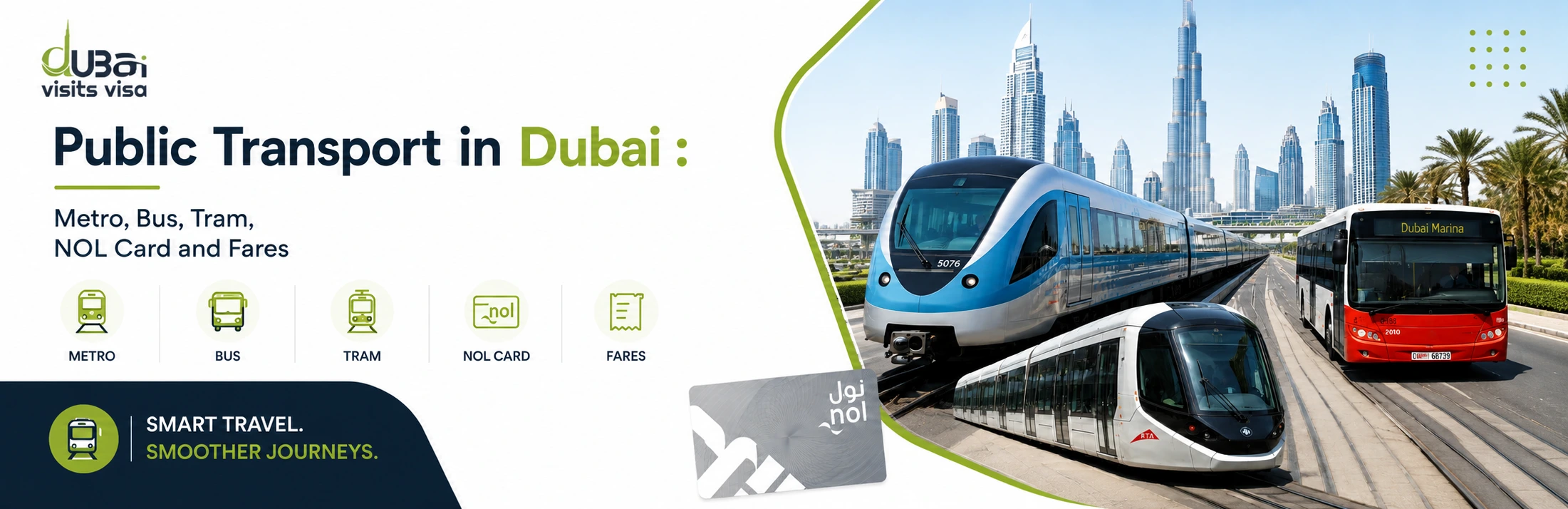
Most tourists land in Dubai expecting to spend a fortune on taxis. What they don't realise is that public transport in Dubai is one of the most efficient, affordable, and well-connected systems in the entire Middle East — and it covers almost every major destination in the city. If you're planning a budget-friendly trip to Dubai, using it instead of taxis can save you hundreds of dirhams on even a short visit. Whether you're heading to the mall, the marina, or the museum, this network has a route for you.
Quick answer: Public transport in Dubai runs on a single smartcard — the NOL card (from AED 25) — across metro, bus, tram, and water bus. Metro and bus fares range from AED 3 to AED 7.50 per trip depending on zones crossed, with a daily spending cap of AED 14. Buy a NOL card at any metro station, or at Terminal 1 or Terminal 3 on arrival.
Dubai's Roads and Transport Authority (RTA) runs the metro, buses, trams, abras, and ferries under one unified system. The metro network alone spans 90 kilometres of track across 55 stations on the Red and Green lines, backed by more than 150 bus routes across the emirate. On an average day in 2026, the metro carries upwards of 750,000 riders.
This guide covers everything about public transport in Dubai — fares in AED and USD, zone tables, NOL card costs for tourists, Dubai tram stops and hours, Sharjah to Dubai bus fare, Ajman to Dubai bus fare, airport connections, and the apps you actually need. No vague information, no recycled content — just what works on the ground, checked against current RTA figures.
What Makes Public Transport in Dubai Worth Using
Before we go into routes and fares, it helps to understand why this system is worth your attention — especially if you're visiting for the first time. It's fully integrated, meaning one card and one app handles everything.
- All metro, bus, tram, and water transport runs under one NOL card — no separate tickets
- Metro stations are air-conditioned end to end, including platform waiting areas
- Buses are fully air-conditioned with real-time tracking via the S'hail app
- Women and children get dedicated cabins on the metro at no extra charge
- Metro, bus, and tram are entirely cashless — the one exception is the traditional abra, covered in the water transport section below
RTA — The Authority Behind It All
The Roads and Transport Authority (RTA) was established in 2005 and manages everything from the metro to marine transport — effectively running all of public transport in Dubai under one roof. Every mode of travel — metro, bus, or tram — feeds into the same NOL card account, and the RTA Journey Planner and the S'hail app are both official tools for trip planning. Fares and schedules change from time to time, so every figure in this guide has been checked against RTA's published fares — always confirm current numbers before you travel.
NOL Card for Tourists: Types, Cost and How It Works
The NOL card is your single access key to public transport in Dubai. Without one, you cannot board a bus or a tram. For the metro, paper Red Tickets exist but cost more per trip than a reloadable card. Every visitor planning more than a couple of rides should get a NOL card on arrival.
NOL Card Types and Prices
| Card Type | Purchase Price (AED) | Purchase Price (USD) | Minimum Balance | Best For |
|---|---|---|---|---|
| Red Ticket (paper) | AED 2 (card only) | ~USD 0.55 | Load as needed | One-time or rare users |
| Silver NOL Card | AED 25 (includes AED 19 credit) | ~USD 6.80 | AED 7.50 | Tourists, short-term visitors |
| Gold NOL Card | AED 25 (includes AED 19 credit) | ~USD 6.80 | AED 7.50 | Gold-class metro travel (2x fare) |
| Blue NOL Card | AED 70 (personalised, registered) | ~USD 19 | AED 7.50 | Students, seniors, People of Determination (~50% off fares) |
Disclaimer: Card prices and credit amounts are set by RTA and may change. Always verify current figures on RTA's nol fares page before purchasing.
The Silver NOL card is the right choice for most tourists. It works on the metro, buses, trams, and water buses. It does not work on the Palm Monorail, which is privately operated by Nakheel on separate ticketing — more on that in the tram section below. The Silver card is valid for 5 years, so it doesn't expire during a normal holiday, and it doubles as your metro card, bus card, and tram card in one — no separate tickets for any mode.
Getting Your NOL Card in 3 Steps
- Go to any metro station vending machine, the Terminal 1 or Terminal 3 metro station on arrival, or a Carrefour, ENOC, or EPPCO outlet.
- Choose Silver (standard) or Gold (premium cabin access) and pay AED 25 — this includes AED 19 of starting travel credit.
- Top up in AED 10+ increments at any station, through the RTA app, or at partner retailers whenever your balance runs low.
Lost card? You can recover the balance on a registered Silver or Gold card by visiting any RTA customer service centre with your Emirates ID or passport.
Tap In, Tap Out — The Rule Everyone Forgets
This is the single most common and costly mistake tourists make. On the metro, you must tap your NOL card both when entering the station gate and when exiting. If you forget to tap out, the system charges you the maximum fare for that journey — regardless of how far you actually travelled. On buses and the tram, tap once when boarding. No tap means no travel, and inspectors do check.
There is also a 30-minute free transfer window: tap out of the metro and into a connecting bus or tram within 30 minutes, and the transfer fare is discounted. This is one of the biggest advantages of using the network over paying for individual taxi rides.
What Are Dubai Metro and Tram Operating Hours?
Metro and tram timings shifted when the UAE moved to a Monday–Friday working week in January 2022 — Sunday, not Friday, is now the shorter, later-starting day. These are RTA's current published hours:
| Day | Metro Hours | Tram Hours |
|---|---|---|
| Monday – Thursday | 5:00 AM – 12:00 Midnight | 6:00 AM – 1:00 AM (next day) |
| Friday | 5:00 AM – 1:00 AM (next day) | 6:00 AM – 1:00 AM (next day) |
| Saturday | 5:00 AM – 12:00 Midnight | 6:00 AM – 1:00 AM (next day) |
| Sunday | 8:00 AM – 12:00 Midnight | 9:00 AM – 1:00 AM (next day) |
Disclaimer: Hours are extended during Ramadan and public holidays. Confirm live timings on the RTA app or S'hail before you travel.
Dubai Metro: Zones, Fares and Lines
The Dubai Metro is the backbone of public transport in Dubai. It operates two lines — the Red Line and the Green Line — across 55 stations spanning 90 kilometres. It's driverless, fully automated, and consistently on time. Understanding metro fares starts with the zone system — every trip is priced by how many fare zones you cross, not by distance alone.
Red Line and Green Line Overview
- Red Line: Runs from Rashidiya (near Dubai International Airport) through Deira, Downtown Dubai, Business Bay, Dubai Marina, and out to Expo City / UAE Exchange. This is the line most tourists use.
- Green Line: Covers Al Qusais, Deira, and Bur Dubai, connecting to the Red Line at Union and BurJuman — both interchange stations serving both lines.
- Gold Class: The first cabin on every train is Gold Class — a quieter, less crowded option for Gold NOL card holders. Fares are double the standard rate.
- Women and Children's Cabin: The last cabin is reserved for women and children at no extra cost.
Dubai Metro Fare Zones Table
The city is divided into seven fare zones, and your fare depends on how many you cross during a journey. The table below applies to Silver NOL card holders; Gold class fares are exactly double, and Blue (concession) card holders pay roughly half.
| Zones Crossed | Silver NOL Fare (AED) | Silver NOL Fare (USD) | Example Journey |
|---|---|---|---|
| 1 Zone | AED 3.00 | ~USD 0.82 | Short hop within the same zone |
| 2 Zones | AED 5.00 | ~USD 1.36 | Union to BurJuman |
| 3 or More Zones (Max Fare) | AED 7.50 | ~USD 2.04 | Airport to Downtown Dubai; full Red Line journey |
Disclaimer: Metro fares are set by RTA and may change without prior notice. Confirm current fares on RTA's nol fares page before travel.
Metro from Dubai Airport
Getting from the airport into Dubai by metro is straightforward — but the terminal matters. Terminal 1 and Terminal 3 each have their own dedicated Red Line station inside the terminal building, so you can walk straight from arrivals to a train. Terminal 2 has no metro station at all — see the "Common Mistakes" section below for how to get there instead.
The metro fare from either airport terminal to Downtown Dubai (Financial Centre station) is approximately AED 7.50 (~USD 2.04), since the journey crosses 3 or more zones. The same trip by taxi costs roughly AED 50–80 (~USD 14–22) depending on traffic. If you want to understand all your options from the airport, the Dubai airport guide covers transport, lounges, and terminal layouts in detail.
Dubai Bus: Routes, Fares and Rules
The bus network is massive — over 150 routes connect areas the metro doesn't reach. For residents living in areas like Al Quoz, Karama, Satwa, or Mirdif, the bus is the primary way to get around. For tourists, buses are useful for reaching beaches, souks, and residential neighbourhoods off the metro map. The entire network runs on the same NOL card as the metro and tram — all part of one connected public transport in Dubai system.
Dubai Bus Fare and How to Pay
Bus fares follow the same zone-based structure as the metro: AED 3 (~USD 0.82) for a single-zone journey, rising to AED 7.50 (~USD 2.04) for longer, cross-zone routes. There's a daily spending cap of AED 14 (~USD 3.81) on Silver and Blue NOL cards — once you hit it, further rides that day are free.
Your NOL card is the only accepted form of payment on buses; there is no cash option on any RTA bus. If you board without a loaded card, you will not be able to travel, so buy or recharge before you board, not after.
Disclaimer: Bus fares and the daily cap are set by RTA and subject to revision. Always check the latest figures on RTA's nol fares page or via the S'hail app.
Bus Rules and Etiquette
Dubai buses have a clear set of rules that are enforced. Ignoring them leads to fines.
- No eating or drinking on any RTA bus — fine of AED 100
- Women-only sections exist on some intercity and longer routes — usually the front rows
- Queue at bus stops — jumping the queue is considered disrespectful and may attract attention from inspectors
- Priority seating near the front is reserved for elderly, pregnant women, and people of determination
- Noise rules — phone calls on speaker and loud music are not acceptable on public buses
Dubai Trams: Everything You Need to Know
The tram is a dedicated surface rail line running through one of the most scenic parts of the city — and it's one of the most underused parts of public transport in Dubai among tourists. If you're staying in or near Dubai Marina, JBR, or Al Sufouh, the tram is your easiest and most pleasant way to get around without a car or taxi. Many visitors skip it entirely and pay AED 30–50 in taxis for distances the tram covers for AED 3.
The tram runs across all 11 stations along a 10.6-kilometre route from JBR in the north to Al Sufouh in the south. It connects to the Metro Red Line at two points — Sobha Realty station (via the Dubai Marina tram stop) and DMCC station (via the Jumeirah Lakes Towers tram stop) — and reaches the Palm Jumeirah tram stop, from which the Palm Monorail is a short walk across a footbridge. The tram itself runs on the same NOL card as the metro; the Palm Monorail does not (see below).
Tram Stations, in Order
| # | Tram Station | Key Connection / Nearby Landmark |
|---|---|---|
| 1 | Jumeirah Beach Residence 1 | JBR The Walk, beach access |
| 2 | Jumeirah Beach Residence 2 | The Beach mall, restaurants |
| 3 | Jumeirah Lakes Towers (JLT) | Metro Red Line interchange — footbridge to DMCC station |
| 4 | Dubai Marina Mall | Dubai Marina Mall, waterfront dining |
| 5 | Dubai Marina | Metro Red Line interchange — footbridge to Sobha Realty station |
| 6 | Marina Towers | Northern Marina residential towers, Marina Walk |
| 7 | Mina Seyahi | Beachfront resorts, water sports |
| 8 | Media City | Dubai Media City and Dubai Internet City offices |
| 9 | Palm Jumeirah | Palm Monorail footbridge — separate ticket needed, access to Atlantis, Nakheel Mall |
| 10 | Knowledge Village | Dubai Knowledge Park, universities |
| 11 | Al Sufouh | Southern terminus |
Tram fares follow the same NOL system as the metro. The entire tram route sits within a single fare zone, so a standard Silver NOL journey costs a flat AED 3.00 (~USD 0.82) — tap in, tap out, exactly as on the metro.
The Palm Monorail, run separately by Nakheel, is not part of the NOL network — you'll need to buy a monorail ticket online or at the station counter rather than tap your NOL card. The monorail reopened in mid-2026 after a maintenance closure; check current hours before you go.
During Ramadan and public holidays (Eid, UAE National Day), tram timings are extended. Always check the RTA app or S'hail for current schedules. If you're staying nearby and want to make the most of the area, the Dubai stopover guide has a full day itinerary built around the Marina zone.
Disclaimer: Tram operating hours and fares are set by RTA and may be adjusted. Verify current information on RTA's website.
Water Transport in Dubai
Dubai has a functioning marine transport network that most tourists completely overlook — yet it's very much part of public transport in Dubai. Traditional wooden abras cross the Dubai Creek between Bur Dubai and Deira for just AED 1 (~USD 0.27) per ride — one of the cheapest and most iconic ways to experience old Dubai. Air-conditioned and petrol-powered abras on the same crossing cost a little more, around AED 2 (~USD 0.55).
The NOL card works on RTA water buses and the Dubai Ferry, but traditional and petrol abras are cash-only — they're the single exception to the network's otherwise cashless rule. For a detailed breakdown of all marine routes, fares, and the difference between abras, water buses, and ferries, the Dubai water taxis guide covers everything you need to plan a full marine day in the city.
Best Apps for Public Transport in Dubai
Knowing the routes is only half the job. These four apps make navigating the network significantly easier in practice.
| App | What It Does | Best For |
|---|---|---|
| S'hail | Official RTA multi-modal trip planner — metro, bus, tram, water bus routes and real-time tracking | All public transport users |
| RTA Dubai App | NOL balance check, recharge, taxi booking, vehicle registration | NOL card management |
| Google Maps | Integrated public transit routes with walking directions and live bus times | Tourists and first-time visitors |
| Careem | Ride-hailing for journeys where public transport doesn't reach | Late-night or off-route travel |
The S'hail app is particularly useful for checking real-time bus arrival times and confirming the exact fare for your route before you travel — it will show you the route, the fare, and the expected waiting time in one screen.
Metro, Bus, Tram or Taxi — Which Should You Use?
Not sure which mode of public transport in Dubai suits your situation? This table breaks it down clearly.
| Factor | Metro | Bus | Tram | Taxi / Careem |
|---|---|---|---|---|
| Cost | AED 3–7.50 | AED 3–7.50 | AED 3 (flat) | AED 12–80+ |
| Speed | Fast, no traffic | Moderate | Slow but scenic | Depends on traffic |
| Coverage | Major corridors | City-wide | Marina / JBR / Al Sufouh only | Door to door |
| Payment | NOL card / Red Ticket | NOL card only | NOL card only | Cash / card / app |
| Best For | Airport, malls, Downtown | Areas off the metro map | Marina / Palm access | Groups, luggage, night |
Disclaimer: Taxi fares are metered and subject to RTA rate revisions. Figures above are approximate ranges.
Final Word
Public transport in Dubai is one of the most advanced networks in the Arab world — and most visitors barely use it. A NOL card, the S'hail app, and basic knowledge of which metro line goes where will get you through almost every major destination in the city for a fraction of what taxis cost.
Whether you're commuting from Sharjah on Route E303, riding in from Ajman on Route E400, taking the tram through the Marina, or just checking fares before you board, RTA's system genuinely works. Use it confidently. If you're still planning your overall trip and figuring out what to do and see, the best places to visit in Dubai guide will help you map out your itinerary around the transport network — so every trip you take actually leads somewhere worth going.
Comments
0No comments yet — be the first to share your thoughts.
Leave a Comment
Your email address will not be published. Required fields are marked *
Frequently asked questions
The Silver NOL card — which is the recommended dubai nol card for tourists — costs AED 25 (~USD 6.80), which includes AED 19 in pre-loaded travel credit. It works on metro, buses, trams, and water buses and acts as your dubai bus card for all modes of dubai public transport.
The sharjah to dubai bus fare on Route E303 is AED 5.00 (~USD 1.36) using a NOL card. The bus runs between Al Jubail Bus Station in Sharjah and Union Metro Station in Dubai, connecting you directly to dubai public transit. Payment is by NOL card only — no cash accepted on any intercity route.
Yes. One NOL card works across all RTA transport — metro, buses, trams, water buses, and the Palm Monorail. There is no need for separate tickets for each mode of transport. The daily spending cap is AED 20 regardless of how many modes you use.
The metro fare from Airport Terminal 3 to Financial Centre station (Downtown area) is approximately AED 7.50 (~USD 2.04) on a Silver NOL card. The journey takes roughly 25–30 minutes with no traffic delays, making it significantly cheaper than a taxi for solo travellers.
Yes. The Dubai tram connects to the Palm Monorail at Palm Jumeirah station. From there, the monorail takes you along the Palm trunk to Atlantis The Palm. The full tram journey from Dubai Marina Mall to the Palm station takes under 15 minutes.
Yes. The metro has a dedicated Women and Children's cabin at the front of every train at no additional cost. Some bus routes also have women-only seating sections. These are clearly marked. Male passengers found in these sections may face a fine.
If you forget to tap out, the system automatically deducts the maximum possible fare for your journey from your NOL card balance — regardless of how short your actual trip was. Always tap both at the entry and exit gates to pay the correct fare.








Thanks! Your comment has been received and will appear after a quick review.