


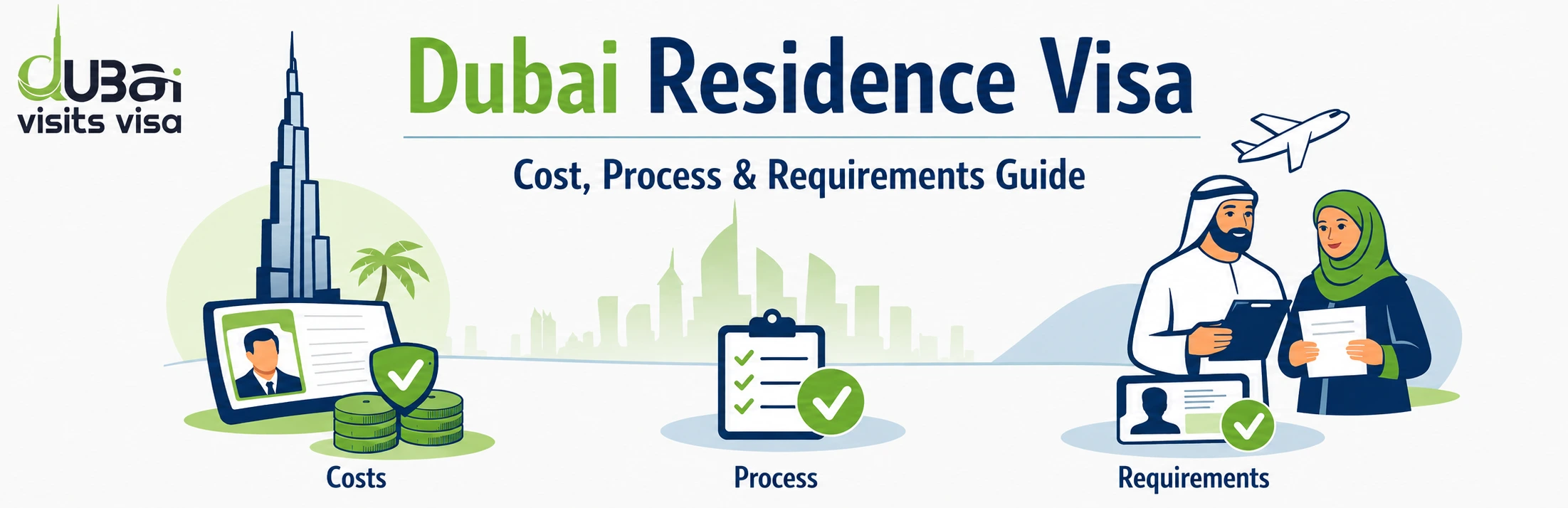
Quick Summary
- A Dubai residence visa lets you legally live, work, or study in the UAE — standard visas run 2 or 3 years, with 5- and 10-year Golden Visa options for qualifying investors, talent, and retirees.
- Total cost typically ranges from AED 2,500 – AED 8,500+ (USD 680 – USD 2,315+) depending on visa type — health insurance is a separate mandatory cost on top.
- Process involves entry permit → medical fitness test → Emirates ID → visa stamping.
- Health insurance is mandatory as of 2026 — no exceptions.
- You get a 60-day grace period after expiry before fines begin.
Most people land in Dubai on a visit visa and think that's the end of the story. But if you're planning to work, live, or build something here long-term, you'll need something more permanent — a visa to live in Dubai long-term, officially called a Dubai residence visa. Not sure which category fits you? The breakdown of Dubai residence visa types is worth a quick look before you continue. It's the document that separates a tourist from a resident, and getting it right from the first step saves you weeks of back-and-forth.
Whether you're being sponsored by an employer, starting a business, or joining a family member already settled in the UAE, understanding the Dubai residence visa process — the real costs, the mandatory medical test, the health insurance rule most people miss — is the difference between a smooth start and a stressful one.
What Is a Dubai Residence Visa?
A Dubai residence visa — also called a UAE Residence Permit — is a long-term visa that authorises a foreign national to live inside the UAE legally. Unlike a visit or tourist visa which has a fixed short-term validity, a residence visa is tied to a specific status: employment, business ownership, family sponsorship, or education. "Residence visa" and "residence permit" are used interchangeably throughout this guide — they refer to the same document.
Once issued, it's stamped into your passport and linked to your Emirates ID, which becomes your primary identification document for everything from opening a bank account to signing a tenancy contract. It's not just a travel document — it's your administrative identity inside the UAE.
There's an important distinction worth knowing early. An entry permit and a resident visa are not the same thing. An entry permit gets you into the country. The actual residence visa is issued after you've completed your medical test and Emirates ID registration inside the UAE. Many people confuse the two and are surprised by the additional steps after arrival.
2-Year vs 3-Year Dubai Residence Visa — What's the Difference?
The validity of your Dubai residence visa depends on your sponsorship type:
| Visa Validity | Typical Category | Renewable? |
|---|---|---|
| 2 Years | Employment-sponsored, family-sponsored dependants | Yes, before expiry |
| 3 Years | Investor visa, freelancer visa, certain free zone companies | Yes, before expiry |
| 5 Years (Golden Visa) | Investors, specialised talent, real estate owners | Yes, self-sponsored |
| 10 Years (Golden Visa) | Senior investors, researchers, outstanding students | Yes, self-sponsored |
Is there a 1-year Dubai residence visa ? Not as a general category — standard employment, investor, and family residence visas run 2, 3, 5, or 10 years as shown above. Shorter, 1-year validity has historically applied mainly to certain domestic worker sponsorships, which is a separate visa category with its own rules. If a 1-year term has come up for your specific situation, confirm the exact category and validity with your sponsor's PRO or directly through GDRFA/ICP, since terms can vary by nationality and free zone.
Who Can Apply for a Dubai Residence Visa ?
Not everyone qualifies through the same route. The UAE residence permit system is categorised by sponsorship — meaning someone or something (a company, a family member, or your own business) takes legal responsibility for your stay. To get a Dubai residence visa , you must first identify which category applies to you, because the documents, fees, and process vary significantly depending on your eligibility path. Here's how each category works in practice
Employed Workers
If a UAE-registered company offers you a job, they act as your sponsor. The employer initiates the Dubai residence visa application on your behalf, covers most fees, and is responsible for your legal status as long as you're employed. Most employment-based residency is a 2-year visa, renewable as long as the job contract is active.
Investors & Business Owners
If you own a mainland or free zone company in the UAE, you can sponsor your own residence visa. This is the route most entrepreneurs take. Some free zone packages include a 3-year visa as part of the business setup package. If you're looking at the investor route specifically, the Dubai investor visa guide has the detailed eligibility and property investment thresholds.
Family Sponsorship
UAE residents earning above a minimum salary threshold (generally AED 4,000/month, or AED 3,000 + accommodation allowance) can sponsor their spouse, children, and in some cases parents. Sponsored dependants get a residence visa tied to the primary sponsor's status. If the sponsor's visa expires or is cancelled, dependants must also leave or find a new sponsor.
Students
Students enrolled in accredited UAE educational institutions qualify for a student visa, which is a residence permit tied to the duration of their academic programme. The institution typically acts as the sponsor.
Retirees
The UAE offers a retirement visa for individuals aged 55 and above who meet certain financial thresholds — either savings, monthly income, or property ownership in the UAE. It's a 5-year renewable visa.
Who Is NOT Eligible?
- Individuals with a pending criminal case or deportation order in the UAE
- Those who have failed the medical fitness test without treatment clearance
- Passport holders from countries under active UAE travel bans (varies, check ICP)
- Anyone whose previous UAE visa was cancelled due to a violation
💬
Still have questions?
Our Dubai visa experts reply within 24 hours — no confusion, just clarity.
Documents Required for Dubai Residence Visa
Meeting the Dubai residence visa requirements starts with getting your paperwork right. Missing even one document can delay your Dubai residence visa application by days. The Dubai residence visa requirements differ slightly based on your sponsorship category — employee, investor, or family — but the core list stays the same. Here's the full checklist split by application type. Before you apply, make sure your passport has a minimum of 6 months validity — this is a hard requirement with no exceptions.
General Documents (All Applicants)
- Original passport with minimum 6 months validity
- Passport-size photographs (white background, 4×6 cm)
- Valid entry permit (if applying from inside UAE)
- Medical fitness test certificate (from an approved DHA/MOH centre)
- Emirates ID application receipt
- Health insurance proof (mandatory from 2026)
For Employer-Sponsored Applicants
- Offer letter or signed employment contract
- Company's valid trade licence copy
- Employer's authorisation letter
- Educational certificates (attested if role requires it)
For Family-Sponsored Dependants
- Sponsor's valid UAE residence visa copy
- Sponsor's Emirates ID copy
- Marriage certificate (attested for spouse) — must be UAE Ministry of Foreign Affairs attested
- Birth certificates for children (attested)
- Salary certificate or bank statement proving minimum income threshold
- Ejari-registered tenancy contract (proof of accommodation)
For Investor / Business Owner
- Valid trade licence (mainland or free zone)
- Memorandum of Association (MOA) or share certificate
- Office lease agreement (Ejari registered)
- Chamber of Commerce registration (mainland)
For a detailed breakdown of what each document needs to look like and how to get them attested, Dubai visa requirements and documentation covers the attestation process step by step.
Dubai Residence Visa Cost — Full AED & USD Breakdown (2026)
This is the section most websites skip or generalise with "fees vary." Here's the reality: the Dubai residence visa cost is made up of multiple components, not a single payment. You'll pay separately for the entry permit, medical test, Emirates ID, and the visa stamping itself — plus typing centre and minor admin charges. Understanding the full Dubai residence visa cost breakdown before you start prevents the most common shock — realising the total is higher than you initially budgeted.
Entry Permit Fees
| Entry Permit Type | Fee (AED) | Fee (USD approx.) |
|---|---|---|
| Employment Entry Permit | AED 500 – 700 | USD 136 – 190 |
| Investor / Business Entry Permit | AED 1,000 – 1,500 | USD 272 – 408 |
| Family Dependant Entry Permit | AED 500 – 800 | USD 136 – 218 |
Medical Fitness Test Fees
| Test Type | Fee (AED) | Fee (USD approx.) |
|---|---|---|
| Standard Medical Fitness Test | AED 300 – 350 | USD 82 – 95 |
| Priority / Urgent Test | AED 600 – 700 | USD 163 – 190 |
Emirates ID Fees
| Emirates ID Duration | Fee (AED) | Fee (USD approx.) |
|---|---|---|
| 2-Year Emirates ID | AED 370 | USD 101 |
| 3-Year Emirates ID | AED 520 | USD 142 |
| 5-Year Emirates ID (Golden Visa) | AED 770 | USD 210 |
Visa Stamping Fees in Dubai
Visa stamping is the final, official step that makes your residency legal — it's also one of the most-searched cost components on its own, so here's the breakdown by visa type:
| Visa Type | Stamping Fee (AED) | Stamping Fee (USD approx.) |
|---|---|---|
| 2-Year Employment Visa | AED 1,000 – 1,500 | USD 272 – 408 |
| 3-Year Investor / Free Zone Visa | AED 1,500 – 2,500 | USD 408 – 681 |
| 2-Year Family Dependant Visa | AED 1,000 – 1,200 | USD 272 – 327 |
Total Estimated Cost — Dubai Residence Visa (All-In)
| Applicant Type | Estimated Total (AED) | Estimated Total (USD) | Includes |
|---|---|---|---|
| Employee (Employer-Sponsored) | AED 3,000 – 4,500 | USD 820 – 1,225 | Entry permit + medical + EID + stamping + typing/admin fees |
| Investor / Business Owner (3-Year) | AED 5,000 – 8,500 | USD 1,360 – 2,315 | Entry permit + medical + EID + stamping + typing/admin fees |
| Family Dependant (Spouse) | AED 3,500 – 5,000 | USD 953 – 1,360 | Entry permit + medical + EID + stamping + typing/admin fees |
| Student Visa | AED 2,500 – 4,000 | USD 680 – 1,089 | Entry permit + medical + EID + stamping + typing/admin fees |
These totals include typing centre, courier, and minor administrative charges (typically AED 100–400) on top of the four itemised components above — which is why the total runs a little higher than simply adding the individual fee ranges. They do not include health insurance, which is a separate mandatory cost — see the Health Insurance section below for those figures.
Duration-Based Cost Comparison — Which Visa Length Costs What?
If you're comparing visa options by how long they last versus what they cost, here's the all-in picture across durations:
| Visa Duration | Est. Total (AED) | Est. Total (USD) | Best For |
|---|---|---|---|
| 2 Years | AED 3,000 – 5,000 | USD 820 – 1,360 | Employees, family dependants |
| 3 Years | AED 5,000 – 8,500 | USD 1,360 – 2,315 | Investors, business owners, freelancers |
| 5 Years (Golden Visa / Retirement) | AED 4,000 – 7,000 | USD 1,089 – 1,905 | Investors, retirees, specialised talent |
| 10 Years (Golden Visa) | AED 5,500 – 9,000+ | USD 1,497 – 2,450+ | Senior investors, researchers |
Disclaimer: These fees are estimates based on 2026 UAE government and GDRFA published rates. Actual costs may vary depending on nationality, processing centre, typing centre charges, and additional service fees. Always verify current fees through the official ICP or GDRFA portals before applying.
How to Apply for a Dubai Residence Visa — Step-by-Step Process
The Dubai residence visa process is not a single-window application. It happens in stages, and each stage must be completed in order. Skipping ahead or submitting incomplete paperwork at any stage resets the clock. The Dubai residence visa application journey unfolds across 6 steps — from entry permit to final Emirates ID delivery. Here's exactly what happens from the moment you decide to apply for Dubai residence visa approval:
- Obtain an entry permit
- Enter the UAE (or change status inside)
- Complete the medical fitness test
- Register for Emirates ID
- Visa stamping
- Collect your Emirates ID
Step 1: Obtain an Entry Permit
Before your Dubai residence visa application can begin, you need a valid entry permit for residence purposes. This is different from a tourist visit visa. Your sponsor (employer, family member, or your own company) submits the entry permit application through the GDRFA (General Directorate of Residency and Foreigners Affairs) or ICP portal. Processing takes 2–5 working days. Once approved, you'll receive an electronic entry permit.
Step 2: Enter the UAE (or Change Status Inside)
If you're applying from outside the UAE, you enter the country on your entry permit. If you're already in the UAE on a visit visa, a status change (inside country) may be possible depending on your visa type and nationality — your PRO or typing centre can advise on this.
Step 3: Complete the Medical Fitness Test
This is mandatory — no exceptions. Within a few days of arrival, you must visit a DHA-approved (Dubai Health Authority) or MOH-approved medical fitness centre to complete the test. Results typically come back within 24–48 hours. We've covered this in detail in the section below.
Step 4: Register for Emirates ID
Simultaneously with or immediately after the medical test, you submit your biometrics (fingerprints, photo) for Emirates ID registration at an ICP-approved typing centre or an EIDA centre directly. This step is often combined with the overall residence visa application typing.
Step 5: Visa Stamping
Once the medical test clears and the Emirates ID application is in process, your residence visa gets stamped into your passport. This is the step that makes your residency official. The stamp contains your visa number, validity dates, and sponsor information.
Step 6: Collect Your Emirates ID
Your Emirates ID is mailed to your registered address or collected from an EIDA service centre within 5–10 working days. This card is your primary ID for everything in the UAE — bank accounts, utilities, Ejari, healthcare, and more.
Start Your Application Today
Get Your Dubai Residence Visa in 2–4 Weeks
Submit your details once — we handle the entry permit, medical test, Emirates ID, and visa stamping. No back-and-forth, no missed steps.
Start My Visa Application →· Secure process · Expert support at every step
Medical Fitness Test — Mandatory Step Most People Underestimate
The medical fitness test is not optional. It's a legal requirement under UAE Federal Law, and no residence visa is issued without a cleared result. The test is conducted at DHA-approved centres in Dubai (or MOH-approved centres in other emirates).
What Does the Medical Test Include?
- Blood test — screens for HIV/AIDS and Hepatitis B & C
- Chest X-ray — screens for active tuberculosis (TB)
- Physical examination — general health check
What Happens If You Fail?
A "unfit" result for HIV or active TB typically results in visa rejection and deportation. For Hepatitis B/C, results are reviewed on a case-by-case basis, and some applicants may receive a conditional status with treatment requirements. If you're unsure about your health status before applying, it's worth getting a pre-screening done privately before initiating the official process.
Approved Medical Centres in Dubai
Tests must be done at DHA-approved centres — private hospitals or clinics not on the approved list will not be accepted. The DHA maintains an updated list on their official portal. Walk-ins are accepted at most centres; appointments can be booked online for faster service. Results are electronically linked to your visa file — no need to carry a physical report in most cases.
Disclaimer: Medical fitness requirements and approved centres may be updated by the DHA/MOH periodically. Verify the current list on the official DHA website before your appointment.
Health Insurance Is Mandatory — The 2026 Rule You Cannot Ignore
As of 2026, health insurance is a legal requirement for all Dubai residence visa holders — and this applies to dependants as well. A residence visa will not be issued or renewed if valid health insurance is not in place. This is not a grey area.
What Coverage Is Required?
- Minimum Essential Benefits (MEB) — the baseline plan mandated by DHA
- Coverage must be UAE-based insurance, not an international travel policy
- The plan must cover inpatient and outpatient treatment within the UAE
Who Provides the Insurance?
| Applicant Type | Who Covers Insurance? | Typical Annual Cost |
|---|---|---|
| Employee | Employer — mandatory by law | AED 700 – AED 3,000+ (USD 190–817) |
| Family Dependant | Sponsor (primary resident) — mandatory | AED 700 – AED 2,500 per person (USD 190–681) |
| Investor / Self-Employed | Self — must purchase independently | AED 1,000 – AED 5,000+ (USD 272–1,360) |
Disclaimer: Health insurance premiums vary based on age, coverage level, and the insurance provider. DHA may update minimum coverage requirements. Always verify current MEB standards on the official DHA website.
Dubai Residence Visa Processing Time — Realistic Expectations
Processing times are one of the most searched — and most vaguely answered — questions about the Dubai residence visa process. "A few working days" tells you nothing. Here are realistic timelines broken down by stage:
| Stage | Normal Processing | Priority / Urgent |
|---|---|---|
| Entry Permit Issuance | 3–5 working days | 1–2 working days |
| Medical Fitness Test Results | 1–3 working days | Same day (select centres) |
| Emirates ID Registration | 5–10 working days (delivery) | 2–5 working days |
| Visa Stamping | 3–7 working days | 1–3 working days |
| Total End-to-End | 2–4 weeks | 7–10 working days |
Delays most commonly happen because of incomplete documents at the typing centre, a hold on the medical result, or a discrepancy between passport and application details. Double-checking name spelling, date of birth, and passport number across all forms before submission saves significant time.
Common Mistakes That Lead to Residence Visa Rejection
Most residence visa rejections are not because of a fundamental eligibility problem — they're because of avoidable paperwork or procedural errors. Based on real-world patterns, here are the mistakes that create the most trouble:
Document Errors
- Name mismatch: Your name on the visa application must exactly match your passport. Middle names, initials, and transliteration differences cause rejections more than anything else.
- Unattested marriage or birth certificates: Documents from outside the UAE must be attested by the UAE Ministry of Foreign Affairs. A notarised copy from your home country is not enough.
- Expired trade licence: If the sponsor company's trade licence has expired, the visa application will be rejected. Many applicants don't check this before submitting.
Medical Failures
- Going to a non-approved medical centre — results from non-DHA/MOH centres are not accepted
- Failing the HIV or TB screening without prior awareness — applications are placed on hold immediately
Sponsor-Related Issues
- Sponsor's visa has expired or been cancelled
- Sponsor's salary doesn't meet the minimum threshold for family sponsorship
If a previous visa application was rejected, it's worth understanding the reason clearly before reapplying. The guide on common Dubai visa rejection reasons covers the most frequent grounds for rejection and what to do differently.
Conclusion
Getting a Dubai residence visa is a structured process — but it's not a complicated one if you know what to prepare and in what order. The biggest mistakes happen when people rush the document stage, miss the health insurance requirement, or don't start renewal until the last week. Whether you want to apply for a Dubai residence visa for the first time or get a Dubai residence visa renewed efficiently, the information in this guide gives you everything you need to approach the process with confidence.
If you're still in the early stages of deciding which residency route suits you — whether it's through employment, investment, family, or a freelance licence — the guide on UAE freelance visa options or the steps for reapplying after a rejection are both practical next steps depending on where you are in the process.
Comments
0No comments yet — be the first to share your thoughts.
Leave a Comment
Your email address will not be published. Required fields are marked *
Frequently asked questions
A UID (Unique Identification Number) is your permanent identifier in the UAE residency system. It's linked to your Emirates ID and stays the same regardless of employer changes, visa renewals, or moves between emirates. You can find your UID on your Emirates ID card and through the ICP app.
Yes. UAE residents earning a minimum of AED 4,000 per month (or AED 3,000 + accommodation allowance) can sponsor a spouse and children. Sponsoring parents has a higher income threshold. All dependants require their own health insurance and must complete the medical fitness test.
Yes. As of 2026, valid UAE-based health insurance is a legal requirement for all Dubai residence visa applications and renewals. Employers are legally required to provide insurance for employees. Investors and self-sponsored residents must purchase it independently. No insurance means no visa issuance.
The UAE grants a 60-day grace period after your Dubai residence visa expiry. During this window, you can renew, change status, or exit the UAE without overstay fines. After the 60 days, fines of AED 25 per day apply.
Parts of the process can be initiated online through the ICP Smart Services portal (icp.gov.ae) or the UAEICP mobile app. However, biometric registration (for Emirates ID) and the medical fitness test must be done in person inside the UAE.
End-to-end, the Dubai residence visa process typically takes 2–4 weeks under normal processing. With priority service at each stage, it can be completed in 7–10 working days. The most common delays come from missing documents at typing centres or a hold on medical fitness results.
The core documents required for a Dubai residence visa include a valid passport with 6+ months validity, passport photographs, entry permit, medical fitness test certificate, Emirates ID application, and valid health insurance proof. Additional documents vary by applicant type — employment contract for workers, marriage certificate for spouses, trade licence for investors.
The total cost of a Dubai residence visa ranges from approximately AED 3,000 to AED 8,500 (USD 820 – USD 2,315) depending on visa type and applicant category. This includes the entry permit, medical fitness test, Emirates ID registration, and visa stamping fees. Health insurance is an additional mandatory cost that varies by provider and coverage level.





Thanks! Your comment has been received and will appear after a quick review.