


Table of Contents
- What Is an eVisa for Dubai?
- Who Needs an eVisa for Dubai — And Who Doesn't
- eVisa vs Visit Visa vs Visa on Arrival
- Why a UAE Sponsor Is Required
- Dubai eVisa Requirements — Documents & Rules
- Dubai eVisa Fees 2026 (AED & USD)
- How to Apply — Step by Step
- Processing Time & What Affects It
- Benefits of Choosing a Dubai eVisa
- After Approval — Entry, Smart Gates & What to Carry
- Real Scenario: Overstay & Rejection Risk
- Common Mistakes to Avoid
- Myths vs Reality
- Dubai Travel Tips After Approval
- Why Trust This Guide?
- Conclusion
Quick Answer
As of July 2026, an eVisa for Dubai is a pre-arranged electronic entry permit issued by GDRFA Dubai through a UAE-based sponsor — you only need one if your nationality is not on the free 90-day visa-on-arrival list. A standard 30-day eVisa typically costs AED 350–700 (~USD 95–190) and approval usually takes 2–5 working days. If you hold a passport from the US, UK, EU, Australia, Canada, or one of roughly 60 other eligible countries, you likely don't need this visa at all — the eligibility section below tells you exactly where you stand.
Not every visitor to Dubai has to apply for a visa before landing — but a large share still do, and getting this one distinction wrong is the most common reason travelers either pay for something they never needed, or turn up at the airport without the paperwork immigration actually asks for. This guide walks through exactly who needs an eVisa for Dubai, who doesn't, what it costs in AED and USD, the sponsor rule almost no one explains properly, and the exact steps to apply without triggering a delay. For the full country-by-country breakdown of every entry category — visa-free, visa-on-arrival, and pre-arranged — our guide to Dubai visa eligible countries covers it nationality by nationality; here, we're focused specifically on the eVisa itself.
Quick Summary — eVisa for Dubai | |
| Issuing Authority | GDRFA Dubai (General Directorate of Residency and Foreigners Affairs) |
| Who Needs It | Nationalities not on the free visa-on-arrival list (see eligibility section) |
| Sponsor Required | Yes — UAE-based airline, hotel, or licensed travel agent (cannot self-apply) |
| Standard Fee (30-day) | AED 350–700 (~USD 95–190) |
| Processing Time | Typically 2–5 working days |
| Delivery | Emailed as a PDF entry permit — present at immigration on arrival |
| Visa-Free Alternative | Free 90-day visa on arrival for ~60+ eligible nationalities |
What Is an eVisa for Dubai?
An eVisa for Dubai is an electronic entry permit that lets an eligible traveler visit Dubai and the wider UAE for tourism, family visits, or short business trips — without stepping into an embassy or consulate.It is issued by GDRFA Dubai, arrives entirely by email as a PDF, and must be obtained before you travel, which is the key difference from a visa on arrival. You do not print a sticker or visit a visa office; you present the PDF (or a screenshot) at immigration when you land at Dubai International Airport (DXB) or Al Maktoum International Airport (DWC).
People sometimes confuse the term "e-visa" with a paper visa that's simply been scanned. It isn't — a dubai e visa online application produces a fully digital record linked to your passport number in GDRFA's system, and there's no separate physical document. If you're trying to work out whether the e-visa is even the right category for your trip, versus a traditional stamped visa, our paper visa vs e-visa comparison breaks that difference down on its own.
The important part most guides skip: not everyone reading this actually needs one. Roughly 60+ nationalities get a free 90-day visa on arrival and can skip the entire eVisa process. The next section tells you which bucket you're in before you spend any money.
Who Needs an eVisa for Dubai — And Who Doesn't
This is the single most important question in this whole guide, and most eVisa content online skips straight past it. Your nationality decides everything — whether you need to apply at all, what you'll pay, and how far ahead you need to plan.
Nationalities With Free Visa on Arrival (No eVisa Needed)
If you hold a passport from one of the following, you generally receive a free 90-day visa on arrival and do not need a dubai electronic visa application at all:
- United States, United Kingdom, and most European Union countries
- Australia, New Zealand, and Canada
- Japan, South Korea, and Singapore
- Most GCC-neighboring and Schengen-area nationalities
This list runs to roughly 60+ countries in total. Indian passport holders sit in a separate, conditional category — you may qualify for visa on arrival only if you already hold a valid US visa, UK visa, or an EU residence permit; otherwise, a pre-arranged eVisa is required.
Nationalities That Must Apply for a Pre-Arranged eVisa
If your passport isn't on the visa-on-arrival list, you're required to complete a dubai e visa application before you fly. This applies to the majority of the world's travelers, including most nationalities across:
- South Asia (Pakistan, Bangladesh, Sri Lanka, and similar)
- Southeast Asia (Philippines, Indonesia, Vietnam, and similar)
- Most African nationalities (Nigeria, Ghana, Kenya, South Africa, and similar)
- India — unless you meet the US/UK visa or EU residence condition above
This list isn't exhaustive — if you don't see your nationality in either bucket, the safest assumption is that you need to apply, and a licensed agent can confirm your exact category in minutes.
Is a Dubai eVisa Easy to Get?
For most applicants with clean documents and no prior UAE immigration issues, approval is routine. It isn't automatic, though — GDRFA runs every application through standard security and document checks, and a mismatch between your passport and application details, a previous overstay, or an incomplete document set can all lead to delay or rejection regardless of nationality. We cover the specific patterns behind this in our common Dubai visa rejection reasons guide, and again further down this page.
eVisa vs Visit Visa vs Visa on Arrival
These three terms get used almost interchangeably online, which is exactly why so many travelers apply for the wrong one. Here's the actual difference in plain terms — and if you're comparing full visa categories rather than just entry method, our types of Dubai visit visa guide lays out every duration and entry option side by side.
| Category | Applied Before or After Arrival | Sponsor Needed | Typical Processing | Best For |
|---|---|---|---|---|
| eVisa (Pre-Arranged) | Before travel | Yes — airline, hotel, or licensed agent | 2–5 working days | Nationalities not eligible for visa on arrival |
| Visit Visa via Licensed Agent | Before travel | Yes — agent handles sponsorship | 2–5 working days | Longer stays (60/90-day), multiple-entry, or family sponsorship cases |
| Free Visa on Arrival | At the airport | No | Instant | Eligible nationalities (US, UK, EU, Australia, Canada, and similar) |
Processing times and fee structures can change without notice. Always confirm your specific category with a licensed visa agent or the official GDRFA/ICP portal before booking travel.
Which One Should You Actually Choose?
If your nationality qualifies for visa on arrival, there's rarely a reason to pay for anything in advance — it's the simplest and cheapest route. If you're not eligible, the dubai e visa process is your only legal way in for tourism or a short family visit. Travelers planning a longer stay, multiple entries within a year, or family sponsorship should compare against the fuller visit visa categories before committing to the standard 30-day eVisa.
Why a UAE Sponsor Is Required
This is the part of the dubai e visa process that most articles either skip entirely or mention in one throwaway line — and it's actually the most practical thing to understand before you apply. You cannot submit a Dubai eVisa application directly to GDRFA as an individual, the way you might apply for a US ESTA or an Indian e-visa. The application has to be submitted through a UAE-based sponsor: an airline, a hotel, or a licensed travel agent. There is no self-service government portal for tourists to file this themselves.
In practice, this means one of three routes: your airline sponsors it as part of a flight booking, your hotel sponsors it once you've booked a stay, or a UAE-licensed travel agent sponsors it on your behalf as a standalone service. The sponsor submits your documents to GDRFA, pays the government fee upfront, and receives the approved eVisa back to forward to you. For a full breakdown of exactly who can act as your sponsor and what each route involves, see our dedicated Dubai visa sponsor guide.
This is also, honestly, the reason licensed agents exist in this space at all: someone has to be the UAE-side party legally responsible for the application. A licensed agent handles the sponsorship, the document checks, and the submission, so you're not left guessing whether your airline or hotel will actually process it on time.
Dubai eVisa Requirements — Documents & Rules
The dubai e visa requirements are consistent across most nationalities that need a pre-arranged visa, with small variations depending on your sponsor and purpose of travel. Here's exactly what to prepare.
Passport Requirements
- Valid for a minimum of 6 months from your date of entry
- At least 2 blank pages
- No damage to the bio page — tears, water damage, or missing corners can trigger rejection
Photo Requirements
- Recent passport-size photo (taken within the last 6 months)
- Plain white background, no shadows
- No glasses, headwear (except for religious reasons), or filters/edits
Travel & Financial Documents
- Confirmed return or onward flight ticket
- Hotel booking confirmation or host's address and contact details
- Valid travel insurance covering your stay (our Dubai travel insurance guide for what's actually required vs recommended)
- Bank statement (last 3 months), requested for some nationalities or longer durations
Frequently Overlooked Requirements
These rarely get mentioned, but they're behind a disproportionate number of avoidable delays:
- Passport damage that looks minor to you but reads as "damaged" to an officer
- Low-resolution or blurry document scans
- Name spelling that doesn't exactly match your passport across every form
- Travel insurance dates that don't fully cover your intended stay
Validity, Stay Duration & Entry Window — What's the Difference
These three terms get confused constantly. Validity is the window during which you must enter the UAE (it starts from your visa's issue date, not your arrival date). Stay duration is how many consecutive days you're allowed to remain once you enter (30 or 60 days, depending on your visa type). The entry window is simply the deadline by which you must use the visa at all — miss it, and the visa expires unused, even if you never travelled. Planning a Dubai trip from Singapore? Explore the Dubai e-visa guide for Singapore citizens.
Dubai eVisa Fees 2026 (AED & USD)
A standard 30-day Dubai eVisa typically costs AED 350–700 (~USD 95–190), and a 60-day eVisa typically runs AED 580–950 (~USD 158–260). These figures already reflect the government fee, 5% UAE VAT, and standard service charge bundled together — which is exactly why you'll see different numbers on different websites depending on what they're including. Dubai e visa fees also vary by nationality, application channel, and processing speed, so treat every number on this page as a starting range, not a fixed quote.
| eVisa Type | Price (AED) | Price (USD) | Typical Processing |
|---|---|---|---|
| 30-Day Single Entry eVisa | AED 350 – 700 | USD 95 – 190 | 2–5 working days |
| 60-Day Single Entry eVisa | AED 580 – 950 | USD 158 – 260 | 2–5 working days |
| Urgent / Express Processing (Add-on) | +AED 300 – 750 | +USD 82 – 204 | 24–48 hours (subject to availability) |
| 96-Hour Transit Visa (for comparison) | AED 50 | ~USD 14 | 1–2 working days |
Prices are based on publicly available GDRFA and ICP-referenced pricing as of mid-2026 and are approximate. Dubai e visa fees are subject to change at any time and can vary by nationality, sponsor, and processing speed. Always confirm the exact current price with a licensed visa agent before paying.
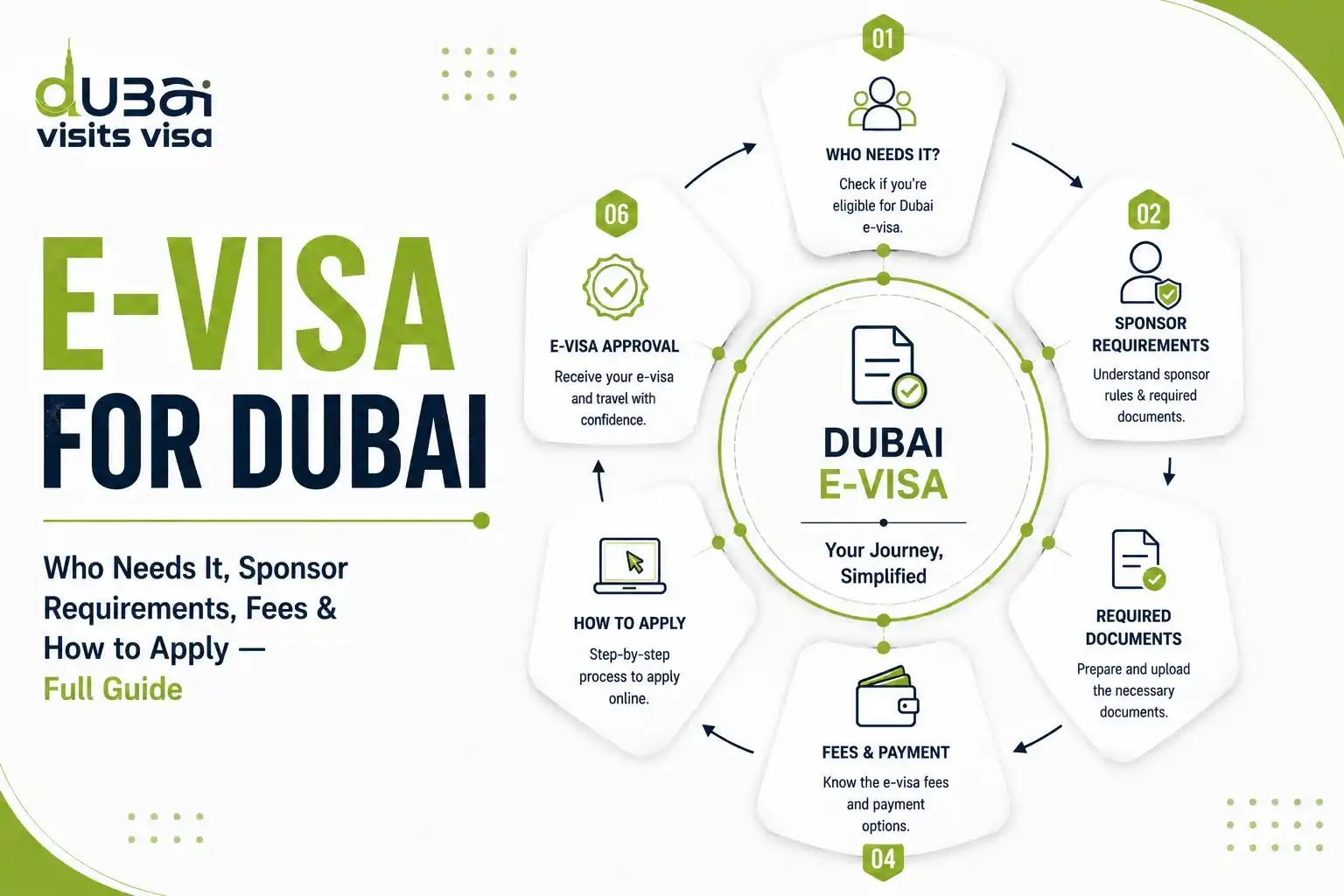
How to Apply for a Dubai eVisa — Step by Step
Before You Apply — Quick Checklist
- Passport valid 6+ months, in good physical condition
- Travel dates confirmed (or close to confirmed)
- Correct visa type selected for your trip length
- Photo and passport scans ready in clear, high-resolution format
Dubai eVisa Application Steps
- Choose your sponsor route — airline, hotel, or a licensed travel agent for a dubai e visa online application
- Submit your passport scan, photo, and travel details to your sponsor
- Sponsor reviews documents and files the application with GDRFA
- Government fee is paid by the sponsor as part of the submission
- Approval is emailed to your sponsor, who forwards your eVisa PDF to you
- Print or save a digital copy to present at check-in and immigration
How Many Days Before Travel Should You Apply?
As a working rule, apply at least 7 days before your flight. Standard processing runs 2–5 working days, but building in a buffer covers weekends, public holidays, or a request for additional documents. If you're inside the last 3 days before travel, ask your sponsor about express processing rather than submitting a standard application and hoping it clears in time.
Processing Time & What Affects It
Most Dubai e visa online applications clear in 2 to 5 working days, though this isn't fixed. A handful of factors genuinely move that number:
- Nationality — some passports go through additional verification by default
- UAE public holidays — GDRFA offices don't process on these days
- Application volume — peak travel seasons (December, Eid, summer) slow turnaround
- Additional verification — a flagged document or inconsistent detail adds review time
| Stage | What Happens | Typical Timing |
|---|---|---|
| Submission | Sponsor files your dubai e visa application with GDRFA | Day 1 |
| Review | Document and security checks | Day 1–3 |
| Approval | eVisa PDF issued and emailed to sponsor | Day 3–5 |
| Travel | Must enter before the visa's entry window closes | Before expiry |
Timelines are estimates based on standard 2026 processing patterns and can shift during peak periods. Always confirm current turnaround with your sponsor before booking non-refundable travel.
Benefits of Choosing a Dubai eVisa
For travelers who genuinely need a pre-arranged visa, the eVisa route beats the alternatives on almost every practical measure:
- No embassy visit — the entire dubai e visa online application happens by email
- Faster than embassy visas — days, not weeks
- Digital delivery — no waiting for a courier or physical stamp
- Pre-travel certainty — you know your status before you've paid for flights and hotels, unlike relying on a visa-on-arrival gamble if you're unsure of your eligibility
After Approval — Entry, Smart Gates & What to Carry
What You'll Receive by Email
Your sponsor forwards a PDF entry permit carrying your name, passport number, visa validity dates, and permitted stay duration. Carry both a printed copy and a digital copy on your phone — airlines typically check it at boarding, and immigration checks it again on arrival.
At Dubai Immigration — What Actually Happens
On arrival, you'll go through a manual immigration counter where an officer checks your passport against your eVisa and stamps your entry. Smart Gates — the automated e-gates you may have heard about — are reserved primarily for UAE and GCC nationals, UAE residents, and visa-on-arrival travelers with biometric passports; eVisa holders are generally not included in that eligibility list, though rules have shifted before and can shift again. If you're unsure, the reliable way to check is GDRFA's own Smart Gate eligibility lookup rather than assuming either way. For a broader walkthrough of what to expect at the terminal,our Dubai airport guide cover every thing in detail
Can You Use One eVisa Across All 7 Emirates?
Yes. A Dubai eVisa is a UAE-wide entry permit, not a Dubai-only pass. Once you've entered through Dubai (or Abu Dhabi), you can travel freely to Abu Dhabi, Sharjah, Ajman, Ras Al Khaimah, Fujairah, and Umm Al Quwain on the same visa for the duration of your stay.
Real Scenario: What Overstay or Rejection Risk Actually Looks Like
Illustrative Example — Based on Current 2026 Rules
Say a traveler's 30-day eVisa expires while they're still in Dubai and they leave the country 4 days late, without applying for an extension first. Under the UAE's current unified overstay policy, GDRFA and ICP now apply a flat AED 50 per day overstay fine across all visa types and emirates — so a 4-day overstay adds roughly AED 200 (~USD 54) before they can exit, with fines starting from the first day after expiry rather than after a grace period. The fix in this situation is simple and inexpensive if caught early: apply for a visa extension before the expiry date, not after it. Our UAE visa overstay rules guide walk through exactly how to fix each situation.
This is the kind of cost that never shows up in a "dubai e visa fees" table, but it's the one that actually catches travelers off guard — not the visa fee itself, but what happens if the paperwork around it is mismanaged.
Common Mistakes That Delay or Reject a Dubai eVisa Application
Most rejections aren't about being "denied" in a dramatic sense — they're small, fixable errors that get flagged during document review. The most frequent ones:
- Passport photo pages that are blurry, dark, or cropped
- Name spelling that doesn't match exactly across passport, ticket, and application
- Applying for the wrong duration (30-day for a trip that's actually 45+ days)
- Skipping travel insurance when your nationality requires it
- A previous UAE overstay or cancelled visa that wasn't disclosed
If your application has already been rejected, it usually isn't permanent — our Dubai visa rejection reasons guide covers what to fix before you reapply.
Honest disclaimer: Some specific figures on this page (fees, processing times) are drawn from publicly available GDRFA/ICP-referenced pricing and may not reflect every current promotional rate. UAE visa policy can change without notice. Nothing on this page should be treated as a guarantee of approval, entry, or a fixed price — always verify current rules with ICP, GDRFA, or a certified visa agent before booking non-refundable travel.
Dubai eVisa Myths vs Reality
| Myth | Reality |
|---|---|
| Approval is guaranteed once you submit documents | GDRFA runs every application through security and document checks; approval is common but never guaranteed |
| An approved eVisa guarantees entry into Dubai | The immigration officer at the airport makes the final call at the border, even with a valid eVisa |
| Every visitor to Dubai needs to pay for an eVisa | Roughly 60+ nationalities get a free 90-day visa on arrival and need no eVisa at all |
| You can apply directly yourself, like an online government form | A UAE-based sponsor — airline, hotel, or licensed agent — must submit it on your behalf |
| The cheapest visa service online is always the best deal | Unusually low prices often mean missing insurance, no support if something's rejected, or an unlicensed operator |
Dubai Travel Tips After Your eVisa Is Approved
Getting the eVisa sorted is only step one. A few practical things make the actual trip smoother once you land. Dubai runs hot for most of the year — if you're arriving between May and September, plan outdoor activities for early morning or after sunset, and lean on indoor attractions during peak afternoon heat. Currency-wise, the UAE Dirham (AED) is used everywhere; cards are widely accepted, but keep some cash for taxis, small vendors, and tips.
Getting a local SIM or eSIM at the airport takes minutes and is worth doing immediately — ride-hailing apps, maps, and hotel check-ins all lean on data. Dress codes are relaxed in tourist areas like malls and beaches but more conservative near mosques and government buildings; carrying a light layer for shoulders/knees is an easy way to avoid an awkward moment. If your trip lands during Ramadan, expect shorter restaurant hours during daylight and adjusted attraction timings — it's still a great time to visit, just worth planning around.
On transport: the Dubai Metro is clean, cheap, and covers most major tourist areas, while ride-hailing apps (Careem, Uber) are the easiest way to reach attractions off the metro line. If sightseeing is the main goal, plan your route in advance — Dubai's landmarks are spread out, and back-to-back bookings without buffer time is one of the most common regrets first-time visitors mention. For a full breakdown of what to actually do once you're there, our best places to visit in Dubai guide covers the full list by area and budget.
Why Trust This Guide?
This guide is maintained and reviewed by the DubaiVisitsVisa editorial and licensed visa advisory team, who process eVisa and visit-visa applications directly, rather than being written purely from other websites' content. Fee ranges, sponsor rules, and processing timelines here are cross-checked against publicly available GDRFA and ICP fee references rather than a single source, and are reviewed for accuracy as UAE immigration policy updates. Where a specific number or rule couldn't be independently confirmed, we've said so directly instead of presenting it as fact — the disclaimer box above this section is part of that, not boilerplate.
We link out to the official GDRFA and ICP portals throughout this guide because we'd rather send you to the source than ask you to take our word for a government fee. Where we can't verify a claim independently, we don't publish it as confirmed fact.
Conclusion
The dubai e visa process isn't complicated once you know which bucket you fall into — the confusion almost always comes from not checking eligibility first. If you're one of the 60+ nationalities with free visa-on-arrival access, you can skip this entirely. If you're not, the sponsor requirement, accurate documents, and a realistic timeline are what actually determine whether your application clears smoothly. Once you've applied, you can track your submission through our Dubai visa status check guide rather than waiting in the dark.
Need Help With Your Dubai eVisa Application?
Our licensed team can confirm your eligibility, prepare your documents, and sponsor your application end to end.
📧 support@dubaivisitsvisa.com | 💬 WhatsApp: +971 58 885 0205


Comments
0No comments yet — be the first to share your thoughts.
Leave a Comment
Your email address will not be published. Required fields are marked *
Frequently asked questions
At least 7 days before travel is a safe buffer, even though standard processing is faster. This accounts for weekends, holidays, or a request for additional documents.
A rejection usually isn't permanent. Most rejections trace back to a document issue, a name mismatch, or an undisclosed prior overstay, and can be corrected before reapplying.
Standard processing is typically 2–5 working days from complete document submission. Express options exist but aren't guaranteed to be available for every nationality.
A standard 30-day eVisa typically costs AED 350–700 (~USD 95–190), and a 60-day eVisa typically costs AED 580–950 (~USD 158–260). Exact pricing varies by nationality and sponsor.
No. The application must be submitted through a UAE-based sponsor — an airline, a hotel, or a licensed travel agent. There is no direct self-service application route for tourists.
It depends entirely on your nationality. Roughly 60+ countries, including the US, UK, most of the EU, Australia, and Canada, receive a free 90-day visa on arrival. If your country isn't on that list, you need a pre-arranged eVisa.
An eVisa for Dubai is a pre-arranged electronic entry permit issued by GDRFA Dubai, sent entirely by email, that lets eligible travelers enter the UAE for tourism, family visits, or short business trips without visiting an embassy.
An eVisa is one type of visit visa — specifically the electronic, pre-arranged version. "Visit visa" is the broader category that also includes longer durations, multiple-entry options, and family-sponsored visas.
Yes. It's a UAE-wide entry permit, not a Dubai-only visa, so you can travel to any of the seven Emirates for the duration of your stay.
A passport valid 6+ months, a recent passport-size photo, a confirmed return ticket, hotel or host details, and valid travel insurance. Some nationalities may also need a recent bank statement.
Validity is the entry window and starts from the issue date, not your arrival date. Your allowed stay duration only begins counting once you actually enter the UAE.






Thanks! Your comment has been received and will appear after a quick review.