


Table of Contents
- What Actually Makes a Country "Safe" in the Middle East?
- Current Regional Situation — What You Need to Know in 2026
- Safest Middle East Countries, Ranked by Real Data
- Country-by-Country Breakdown
- Safety for Women in the Middle East
- Safety for Expats and Tourists
- Quality of Life: Beyond Just Crime Rates
- Common Myths vs Reality
Most people picture the Middle East through a single lens — the news cycle. Headlines about conflict zones get attention; everyday life in Doha, Muscat, or Abu Dhabi does not. That gap between perception and reality is exactly where confusion starts when someone searches for safe Middle East countries and gets a mix of outdated blog posts and conflicting advice. The honest answer is more nuanced than a yes or no, and it depends on which country, which city, and which kind of safety you mean. If you're trying to figure out which parts of the region are genuinely low-risk for travel, this guide breaks down the safe middle east countries one by one, with real crime data, a transparent look at the current regional situation, and no inflated claims.
This is not a generic "Middle East is safe" or "Middle East is dangerous" piece. The region holds both extremes at once. Some of the lowest crime rates on the planet exist a few hundred kilometers from active conflict zones, which is exactly why a single label rarely fits the safe middle east countries discussion. This guide covers what actually makes a country safe, how the UAE safety ranking compares to its neighbors, what the middle east peace index shows for 2026, which middle eastern countries safe to visit consistently top independent lists, and where women, solo travelers, and expats tend to feel most comfortable — backed by named sources, not assumptions.
Quick Summary — Safest Middle East Countries 2026
| Lowest Crime Index Globally | UAE — 14.0 (Numbeo, 2026), lowest of any country worldwide |
| Other Very Low Crime Countries | Qatar (15.2), Oman (18.4), Bahrain (22.3) |
| Highest Global Peace Index Rank in Region | Qatar — #21 globally out of 163 countries (pre-conflict baseline) |
| Current Regional Status | A ceasefire framework between Iran, Israel and the US is being formalized through mid-2026; check live travel advisories before booking |
| Safest for Solo Women | Oman and UAE consistently rated highest for solo female travel in the Gulf |
| Key Trade-Off | Low physical crime risk vs. social/legal restrictions — not the same thing as Western-style personal freedom |
What Actually Makes a Country "Safe" in the Middle East?
"Safe" gets used as a single word for what is actually several separate things. A country can have almost zero street crime and still carry real political risk. Another can have strict laws that make street crime rare while still requiring visitors to understand local customs to avoid legal trouble. Before looking at rankings, it helps to separate what's actually being measured.
The Three Layers of Safety
Everyday crime safety: theft, mugging, assault, scams — this is what most people actually mean when they ask if somewhere is safe to walk around. This is measured by indices like the Numbeo Crime Index.
Geopolitical and conflict safety: war, terrorism risk, political instability. This is what the middle east peace index (Global Peace Index) measures, and it can shift quickly — sometimes within days.
Quality of life and social safety: healthcare access, legal protections, infrastructure, and how comfortable specific groups — women, LGBTQ+ travelers, religious minorities — feel day to day. A country can score well on the first two layers and still require real cultural awareness on the third.
Treating these three as one number is where most generic "safest countries" lists go wrong, and it's the most common reason rankings of safe middle east countries disagree with each other so much. A reader planning a trip to the Gulf region needs all three, not just a single composite score.
Current Regional Situation — What You Need to Know in 2026
This section exists because skipping it would make the rest of this guide misleading. Between late February and April 2026, the broader region experienced a direct military conflict involving Iran, Israel, and the United States, and several Gulf states — including the UAE, Bahrain, Kuwait, and Qatar — intercepted missile and drone attacks during that period. A ceasefire framework has been in place since April, and as of mid-June 2026, mediators have been finalizing a longer-term agreement intended to bring the conflict to a formal close.
Why This Matters Before You Book
Everyday crime statistics and geopolitical conflict are two different risk categories. A country can have an extremely low crime index and still be affected by regional tensions that change week to week. Always check your government's current travel advisory for the Middle East before finalizing travel dates — this is the single most reliable source for live risk status, more current than any blog or ranking article, including this one.
What this means practically: the crime and safety data discussed below reflects the underlying, everyday safety environment in these countries — the kind of risk relevant to theft, scams, and street safety. It does not override or replace a live check of conflict-related travel advisories, which can change faster than any article can be updated. Tourism and flights into Dubai and other Gulf hubs have continued operating through this period, and infrastructure has remained largely functional. Travelers double-checking practical do's and don'ts before a Dubai trip will find most of that advice is unaffected by the regional situation, but treating "low crime" and "no regional tension" as the same thing would be inaccurate.
Safest Middle East Countries, Ranked by Real Data
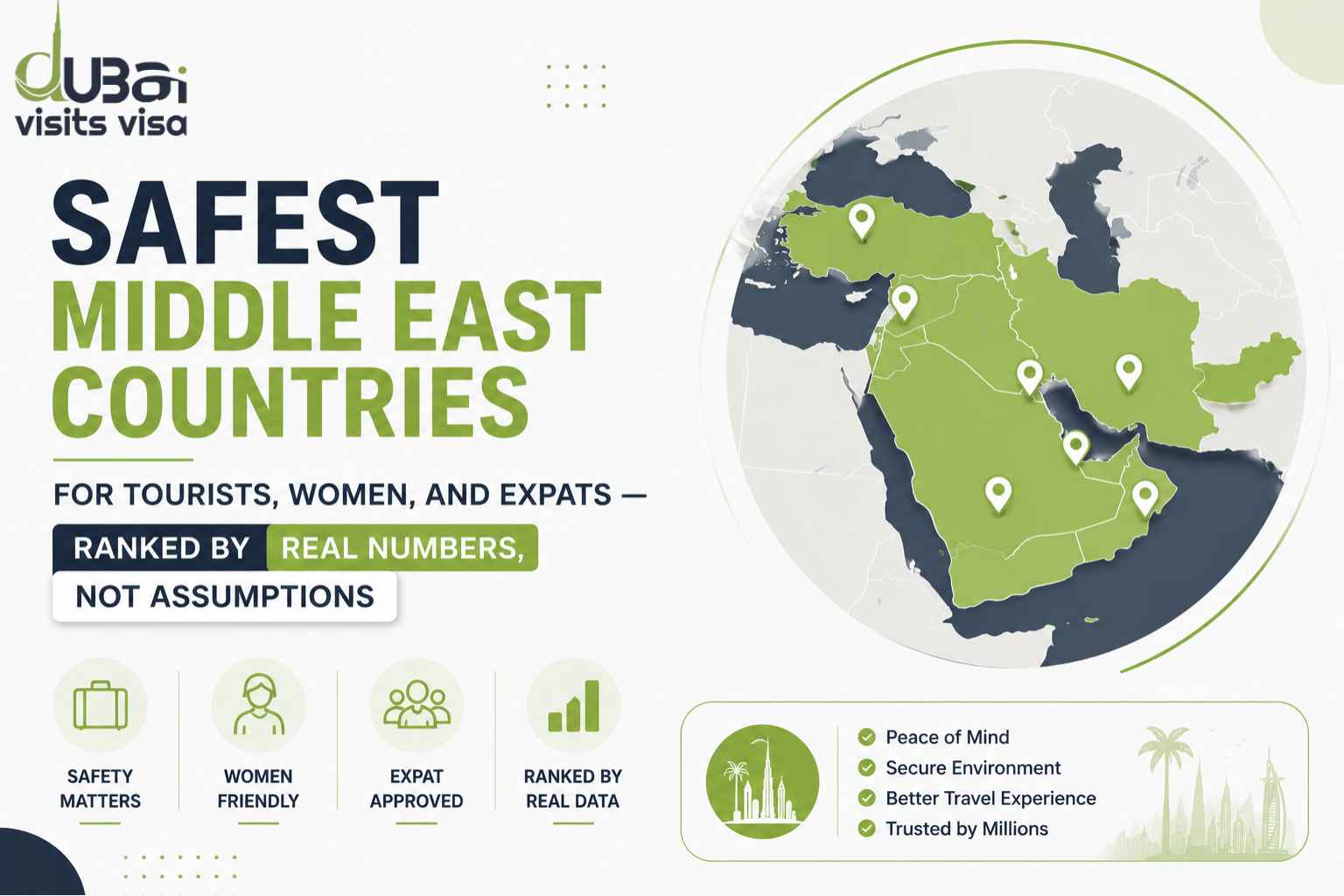
Numbeo's 2026 Crime Index rates countries on a 0–100 scale, where anything below 20 is classified as "very low" crime. On that scale, the UAE currently holds the lowest crime index of any country in the world — not just the region. This single fact reshapes how most rankings of safe middle east countries should actually look. Here's how the main safest countries for tourists in the middle east compare side by side.
| Country | Numbeo Crime Index (2026) | Crime Level | GPI Rank (Pre-Conflict Baseline) | Best For |
|---|---|---|---|---|
| United Arab Emirates | 14.0 | Very Low | #51 of 163 | First-time visitors, families |
| Qatar | 15.2 | Very Low | #21 of 163 | Highest regional peace ranking |
| Oman | 18.4 | Very Low | #39 of 163 | Solo female travelers, nature |
| Bahrain | 22.3 | Low | Not separately ranked above | Short stopovers, island hopping |
| Saudi Arabia | 23.3 | Low | Not separately ranked above | Heritage and religious tourism |
Crime Index data via Numbeo (2026 user-reported survey data). Global Peace Index figures reflect pre-2026-conflict baseline data, since the current edition does not fully capture the February–April 2026 events. Figures are point-in-time estimates and may shift as new survey cycles are published — always cross-check with the latest published index before relying on a specific number.
A pattern worth noticing: every country in this table sits in the "Low" or "Very Low" crime band globally, including ones rarely associated with the word "safe" in casual conversation. Low crime countries in the middle east are far more common than the region's media coverage suggests — the gap is between perception and the underlying numbers, not between the numbers themselves.
Country-by-Country Breakdown
Numbers tell part of the story. Here's what each of these middle eastern countries safe to visit actually feels like on the ground, based on how each one is typically experienced by tourists and expats. Anyone comparing safe middle east countries for a first trip will notice the same four or five names repeating across nearly every list of safest countries for tourists in the middle east.
United Arab Emirates
The UAE's UAE safety ranking position — lowest crime index of any country tracked by Numbeo in 2026 — is consistent with how the country is typically described by visitors: heavy CCTV coverage, strict enforcement of laws, and a low tolerance for petty crime. For travelers from India planning a UAE trip, this combination of low crime and a well-developed tourism infrastructure is one of the more consistent draws, and it's a major reason the UAE so often tops lists of safe middle east countries.
Qatar
Qatar holds the highest pre-conflict Global Peace Index position among Gulf states, and its crime index (15.2) sits among the lowest worldwide. Surveillance infrastructure expanded significantly ahead of the 2022 FIFA World Cup and has remained in place, contributing to consistently low reported violent crime.
Oman
Oman is frequently singled out by solo and female travelers as the most consistently comfortable Gulf country, helped by a more socially relaxed culture rooted in Ibadi Islam and a long-standing reputation for hospitality. The U.S. State Department has rated Oman at its lowest risk advisory level in recent years, reflecting this.
Bahrain and Saudi Arabia
Both sit in the "Low" crime band rather than "Very Low," but both remain far safer on everyday crime metrics than most Western capital cities. Saudi Arabia's tourism sector is newer, which means infrastructure for independent travelers is still catching up in smaller cities, even though personal safety from crime is rarely the concern visitors report.
Safety for Women in the Middle East
Among the safest countries for women in the middle east, Oman and the UAE consistently come up first in independent solo-female-travel guides, and not just because of low crime statistics. Reported harassment rates are low, public infrastructure is well-lit and monitored, and ride-hailing apps like Careem and Uber operate reliably in most cities. When people specifically search for the safest countries for women in the middle east, these two destinations appear in nearly every credible result.
"There are so many hidden gems waiting to be discovered, from beautiful natural landscapes and mountains to beaches, deserts and off-the-beaten-path destinations."
— Alya Alshamsi, UAE-based solo travel advocate, speaking to Gulf Today
Alshamsi, a real solo traveler based in the UAE, has publicly encouraged other women to travel independently within the country, citing both its safety record and its often-overlooked natural attractions. Her experience echoes a broader pattern reported across multiple independent travel guides focused on safe middle east countries for women: physical safety from crime is rarely the issue Gulf-region female travelers raise. The more common adjustment is around dress and social norms, not personal security. Modest clothing is generally expected in public spaces, and for visitors arriving via the UAE, reviewing which neighborhoods and attractions suit a first solo trip beforehand goes further than any safety app or precaution.
Safety for Expats and Tourists
The safest countries for expats in the middle east overlap heavily with the tourist-safety list, for a simple reason: low crime and strong rule-of-law enforcement benefit both groups equally. The UAE alone hosts one of the largest expat populations in the world relative to its citizen population, and that scale of long-term foreign residency is itself a signal — people don't relocate their families to places they consider unsafe. It's also why so many guides to the safest countries for expats in the middle east keep naming the same three or four Gulf states.
For first-time visitors specifically, the practical safety concerns tend to be administrative rather than physical: making sure travel documentation is in order, understanding local laws around things like alcohol and public behavior, and knowing which areas suit a first trip. Anyone working through the visa process for a UAE visit will find that the bureaucratic side of travel here is generally more predictable than the safety side is risky. For a broader sense of where is it safe to travel in the middle east beyond just the UAE, Oman and Qatar round out the shortlist most consular and travel advisory sources point to first.
Where to Begin If This Is Your First Gulf Trip
Dubai, Abu Dhabi, and Doha are generally considered the most "first-trip friendly" cities — widely used English, established tourist infrastructure, and large expat communities that make navigating day-to-day life straightforward. A quick look at general trip-planning essentials for Dubai alongside this safety data covers most of what a first-timer needs before booking.
Muscat (Oman) is a strong second step for travelers who want a quieter, less commercialized experience without sacrificing safety.
Quality of Life: Beyond Just Crime Rates
A discussion of quality of life in middle east countries has to include more than crime statistics. Healthcare access, transport infrastructure, and overall cost of comfortable living all factor into how safe a place actually feels to live or travel in day to day. Rankings that measure quality of life in middle east countries tend to favor the same Gulf states that also score well on crime and peace data — the overlap is not a coincidence.
| Factor | UAE / Qatar (Strong) | Region-Wide Variation |
|---|---|---|
| Healthcare access | Modern private hospitals, fast emergency response | Quality drops outside major cities in some countries |
| Public transport | Metro systems, widespread ride-hailing apps | Car rental often necessary outside Gulf capitals |
| Cost of comfortable travel | Mid-range meal: AED 50–80 (~USD 14–22)* | Varies widely by country and city tier |
Prices in AED and USD are approximate and subject to change based on exchange rates, season, and venue — always confirm current pricing before booking.
Common Myths vs Reality
A few assumptions come up repeatedly when people first research where is it safe to travel in the middle east. Here's how they hold up against the data covered above.
Myth: "The whole Middle East is one conflict zone." Reality: Crime and conflict risk vary enormously by country — the UAE's crime index is lower than most of Western Europe, while other countries in the same region carry genuine "do not travel" advisories. Lumping every nation together is exactly why so many people get the "where is it safe to travel in the middle east" question wrong, and it obscures more than it reveals.
Myth: "Low crime means no rules to worry about." Reality: Gulf countries enforce strict laws around public behavior, dress, and substances. Low crime countries in the middle east are not the same as countries with relaxed legal enforcement — in fact, the opposite is usually true for the low crime countries in the middle east covered in this guide.
Myth: "Solo women shouldn't travel there at all." Reality: Multiple independent solo-female-travel sources and named local advocates describe the UAE and Oman as genuinely comfortable for solo women, with cultural awareness around dress being the main adjustment rather than physical danger. Anyone planning a trip and looking at local customs and etiquette to be aware of in Dubai will find the adjustments are mostly about dress and conduct, not safety risk.
Final Take
The data doesn't support a blanket label in either direction. Several safe middle east countries — the UAE, Qatar, and Oman in particular — post crime numbers that beat most of Europe and North America, and consistently rank among the safest countries for tourists in the middle east, while the wider region simultaneously carries real geopolitical risk that shifts independently of those numbers. The smart approach is checking both layers separately: everyday crime data for day-to-day comfort, and live government advisories for anything conflict-related, right up until departure. If your trip is taking shape around the UAE specifically, it's worth reviewing the current entry requirements for a Dubai visit alongside the safety picture covered here, so both the paperwork and the planning are sorted before you book anything.
Once the safety side of the decision feels settled, the next practical step is usually the paperwork itself. Our team at dubaivisitsvisa.com processes UAE visit visa applications directly as a licensed agent, so you're not left figuring out the entry process alone after deciding the destination is right for you — you can start your Dubai visit visa application here whenever you're ready.
Crime index and peace index figures sourced from Numbeo (2026) and the Global Peace Index/Institute for Economics and Peace; figures and regional conditions are subject to change — verify current data and travel advisories before finalizing travel plans.
Comments
0No comments yet — be the first to share your thoughts.
Leave a Comment
Your email address will not be published. Required fields are marked *
Frequently asked questions
Among safe middle east countries, the UAE holds the lowest Numbeo Crime Index of any country globally (14.0 in 2026) by everyday crime data. By the pre-conflict Global Peace Index, Qatar ranks highest regionally at #21 of 163 countries worldwide.
A ceasefire framework has been in place since April 2026 and is being formalized further. Day-to-day crime risk in countries like the UAE and Qatar remains very low, but travelers should check their government's current advisory for the latest regional status before booking, since geopolitical conditions can change faster than crime statistics.
Oman and the UAE are the two most consistently recommended Gulf destinations for solo women, based on low reported harassment, strong infrastructure, and accounts from both independent travel writers and local female travel advocates.
Crime indices measure theft, assault, and similar everyday risks. Political stability and conflict risk are tracked separately by indices like the Global Peace Index, and a country can score very differently on each.
The UAE is often considered the safest option for expatriates due to its low crime rates, large international community, stable economy, and extensive public services. Qatar and Oman are also popular choices among foreign residents.
In many Gulf countries, including the UAE, Qatar, and Oman, tourists commonly report feeling safe while walking in major urban areas at night. Standard travel precautions are still recommended, as they would be in any destination.
Safety rankings typically consider factors such as crime rates, political stability, law enforcement effectiveness, terrorism risk, healthcare quality, infrastructure, and traveler experiences. Different rankings may weigh these factors differently.








Thanks! Your comment has been received and will appear after a quick review.