


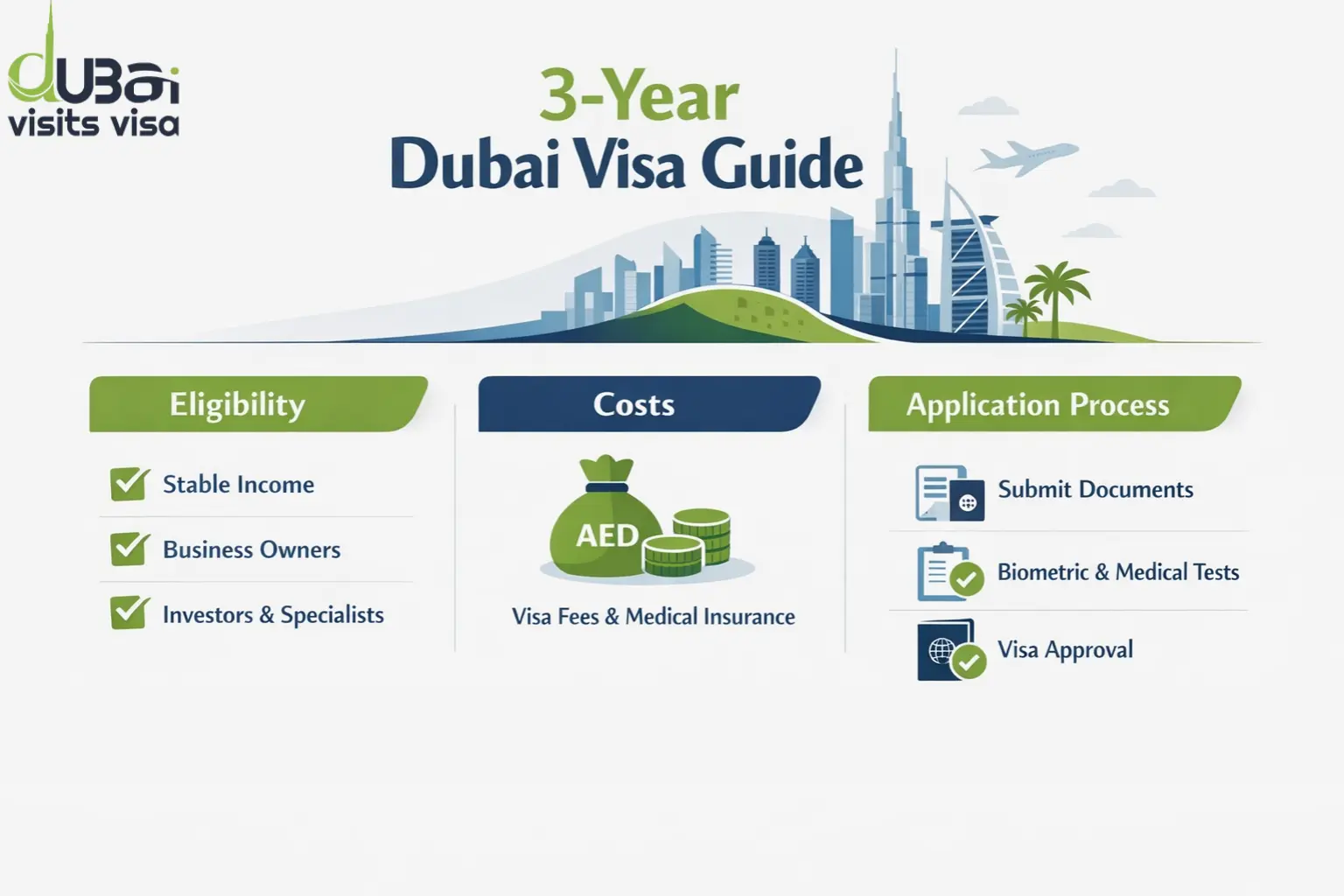
Most people who move to Dubai for work, business, or family do not realise there are different residency routes — and the right one depends entirely on your situation. A dubai 3 years visa is not a single product. It is an umbrella term for a long-term UAE residence permit issued for a three-year duration, available under employment, investment, property ownership, or family sponsorship.
If you have been comparing visa options and wondering whether a tourist extension or a full 3 year residence visa dubai makes more sense for your goals, you are in the right place. Before you get into fees and applications, understanding the difference between a visit visa and a residence visa is the single most important step — and it is one most people skip. If you are still figuring out the types of Dubai visit visas available and how they compare to residency options, that is a good starting point.
This guide covers everything in one place: eligibility, required documents, real AED and USD fees, step-by-step application, processing timelines, and what actually causes rejections in 2026.The difference between a visit visa and residence visa — legal status, banking access, and work rights — is covered in the Dubai residence visa guide.
Tourist Visa vs 3 Year Residence Visa Dubai — What Is the Real Difference?
This is the question most people searching for a "dubai 3 years visa" are actually asking. They have heard about long-term Dubai residency but are not sure whether they need a residence visa or whether extending a tourist visa is enough. The answer matters because the two are completely different in legal status, cost, and what they allow you to do in the UAE.
| Factor | Tourist / Visit Visa | 3 Year Residence Visa Dubai |
|---|---|---|
| Duration | 30 to 90 days | 3 years (renewable) |
| Work Rights | Not permitted | Permitted (under sponsoring authority) |
| Emirates ID | Not issued | Mandatory and issued |
| Bank Account | Very limited | Full access |
| Family Sponsorship | Not eligible | Eligible (conditions apply) |
| Health Insurance | Optional | Mandatory by law since 2014 |
| Property Lease | Difficult | Straightforward with Emirates ID |
| 6-Month Absence Rule | Does not apply | Visa cancels if you stay outside UAE for 6+ months continuously |
Who Should Choose Which Option
A visit visa works if you are coming to Dubai for tourism, short-term business meetings, or to attend an event. A 3 year residence visa dubai is the right route if you are relocating, working, investing, buying property, or bringing your family. There is no middle ground — you cannot legally work or sign long-term contracts on a visit visa.
Who Is Eligible for a Dubai 3 Years Visa
Eligibility depends entirely on the route you are applying through. There is no single "3-year visa" application — it is the duration of a residence visa that is determined by your sponsoring category. Here are the main qualifying pathways.
Employment-Based 3 Year Visa in Dubai
The most common route. If you have a job offer from a UAE-registered company, your employer sponsors your residence visa. Both mainland companies (registered with DED) and free zone companies (DMCC, DAFZA, Dubai South, Dubai Internet City, Dubai Media City, and others) can sponsor employees. The visa is typically issued for 2 or 3 years depending on the employer's licence and your employment contract duration.
- Valid employment contract from a UAE-licensed company
- Minimum salary requirements depend on role and employer category
- Free zone employment visa is limited to working within that free zone or with approved clients
- Important: Under UAE federal law, employers are legally required to cover all employment visa and work permit costs. If your employer asks you to pay these fees yourself, that is a legal violation — report it to MOHRE at mohre.gov.ae or call 800-60.
Note: Free zone vs mainland makes a real difference here. A DMCC-sponsored employee, for example, is technically restricted from working directly for mainland clients without a dual licensing arrangement. This is one of the most commonly misunderstood points and causes issues during renewals.
3 Year Property Visa Dubai
If you own property in Dubai valued at AED 750,000 (approximately USD 204,000) or more, you may be eligible for a property investor residence visa. This falls under the investor visa route and gives you 3-year renewable residency tied to your property ownership.
- Property must be fully paid (not under mortgage, or at a minimum threshold completed)
- Property must be in an approved freehold zone
- The visa is not transferable — each owner applies individually
- A 3 year property visa dubai does not grant work rights automatically
3 Year Partner Visa Dubai
A 3 year partner visa dubai refers to residency obtained through family sponsorship — typically a spouse sponsoring their partner. To sponsor a spouse or family member in the UAE, the primary visa holder must meet minimum salary requirements (generally AED 4,000 per month or AED 3,000 with free accommodation) and provide valid housing proof.
- Sponsor must hold a valid UAE residence visa
- Minimum monthly salary: AED 4,000 (approx. USD 1,090) or AED 3,000 with accommodation
- Valid marriage certificate (attested) required
- Children under 18 can also be sponsored; daughters above 18 may qualify under certain conditions
- The dependent's visa matches the sponsor's visa duration — so if the sponsor has 3-year residency, the partner visa is also issued for 3 years
If you are planning to bring a family member to the UAE and want to understand what the sponsorship process involves, how to sponsor someone in Dubai covers salary thresholds, required documents, and common approval conditions in detail.
Investor and Business Route
Business owners, company shareholders, and investors in UAE mainland or free zone entities can obtain a 3-year residence visa through their business licence. This is separate from the freelance licence route (which already has its own dedicated page on this site). Investors must demonstrate active business operations and meet minimum investment thresholds set by the relevant authority.
Documents Required for 3 Year Residence Visa Dubai
One of the most searched questions — and one of the most poorly answered by most sites. Here is a complete checklist. Missing even one document delays your entire application.
- Valid passport with at least 6 months remaining validity
- Recent passport-size photograph (white background, UAE specification)
- Emirates ID application form (submitted during biometrics)
- Medical fitness certificate from an approved UAE health centre
- Health insurance policy — this is a legal requirement for all UAE residence visa applicants since 2014, not optional
- Employment contract or investor/shareholder documents (depending on route)
- Tenancy contract or proof of accommodation (Ejari-registered)
- For property visa: Title deed, proof of property value
- For partner visa: Attested marriage certificate, sponsor's salary certificate, accommodation proof
- Entry permit (if applying from outside UAE) or current visa copy (if applying from inside UAE)
- No Objection Certificate if you are currently employed elsewhere in the UAE
Important: Health insurance without a gap in coverage is checked during processing. If your policy lapses mid-process, your application stalls. Arrange this before submitting any documents.
Dubai 3 Years Visa Cost — Full AED & USD Fee Breakdown
Costs for a dubai 3 years visa vary depending on the route (employment, property, family, investor), the free zone or authority involved, and whether you are applying from inside or outside the UAE. Below is a realistic breakdown of what the full process typically costs in government fees.
Note for employees: The government fees below are the legal responsibility of your employer — not yours. UAE federal law prohibits employers from passing visa costs onto employees. If you are being asked to self-fund your employment visa, report it to MOHRE.
| Fee Component | AED (Approx.) | USD (Approx.) | Notes |
|---|---|---|---|
| Entry Permit (from outside UAE) | AED 500 – 750 | USD 136 – 204 | Not required if status change inside UAE |
| Visa Stamping / Residency Activation | AED 500 – 700 | USD 136 – 190 | Government fee, varies by authority |
| Medical Fitness Test | AED 250 – 350 | USD 68 – 95 | Done at approved health centres only |
| Emirates ID Registration | AED 370 – 420 | USD 101 – 114 | ICA fee per 3-year issuance |
| Health Insurance (mandatory) | AED 600 – 2,500+ | USD 163 – 681+ | Basic to comprehensive plans vary widely |
| Status Change (inside UAE, if applicable) | AED 600 – 1,000 | USD 163 – 272 | Converts visit visa to residence visa |
| Estimated Total (Employment Route) | AED 2,500 – 5,000 | USD 681 – 1,362 | Government fees only, excludes service charges |
| Estimated Total (Property / Investor Route) | AED 3,000 – 7,000+ | USD 817 – 1,906+ | Includes additional authority fees |
Price Disclaimer: All fees listed above are approximate government fee estimates based on 2026 data. Fees are subject to change without notice. Always verify the latest applicable fees through the official UAE government portal before submitting your application.
How to Apply for a Dubai 3 Years Visa — Step by Step
The process differs depending on whether you are currently inside the UAE or applying from your home country. This is one of the most overlooked distinctions and it affects your entry permit requirement, fee structure, and total timeline.
Applying from Outside the UAE
This is the standard route for new applicants who have not yet entered the UAE.
- Entry Permit Issued — Your employer, sponsor, or free zone authority applies for your entry permit. This typically takes 3 to 5 working days. You will receive the permit electronically.
- Travel to UAE — Enter the UAE using your entry permit. The permit is usually valid for 60 days from issuance.
- Medical Fitness Test — Visit an approved medical centre within the UAE. Results come in 1 to 2 working days.
- Emirates ID Biometrics — Book an appointment through the ICA smart services portal. Biometrics are collected at an approved typing or service centre. This takes 1 to 5 working days depending on slot availability.
- Visa Stamping — Once medical and biometrics are cleared, your residence visa is stamped in your passport. This typically takes 3 to 5 working days.
- Emirates ID Delivery — Your Emirates ID card is delivered within 5 to 7 working days after visa activation.
Applying from Inside the UAE (Status Change)
If you are currently on a visit visa or tourist visa inside the UAE and you have received a job offer or meet investor/property eligibility, you do not need to exit and re-enter. You can apply for a status change directly.
- Status change is processed through GDRFA (Dubai) or ICA depending on your emirate
- You must have a valid visa status — you cannot apply during an overstay
- An entry permit is not required; your current visit visa is converted
- All remaining steps (medical, biometrics, stamping) follow the same process as above
- Status change processing typically adds 2 to 4 extra working days compared to fresh applications from outside
Ready to Start Your Dubai 3-Year Visa Application?
Whether applying from outside the UAE or doing a status change from inside — delays in medical, biometrics, or entry permit can cost you time and money.
Check visa requirements, track your application status, and get expert guidance before you begin.
→ Apply for Your Dubai 3-Year Visa Today
Processing Time — Realistic Estimates for 2026
A 3 years residence visa dubai does not get processed in a single day. Here is an honest timeline broken down by each stage so you know exactly what to expect.
| Stage | Estimated Time | What Can Delay It |
|---|---|---|
| Entry Permit Issuance | 3 – 5 working days | Document errors, background checks |
| Medical Fitness Test | 1 – 2 working days | Centre queues, additional tests requested |
| Emirates ID Biometrics | 1 – 5 working days | Appointment availability |
| Visa Stamping | 3 – 5 working days | High application volume periods |
| Emirates ID Delivery | 5 – 7 working days | Address verification, courier delays |
| Total (Clean Application) | 2 – 4 weeks | Depends on route and authority |
If you are applying through a free zone like DMCC or DAFZA, the licensing authority also has its own internal processing timeline that runs parallel to the immigration steps. Factor that in when planning your move.
2026 Updates You Need to Know About Dubai Residency Visa
Two significant changes affect the dubai 3 years visa process in 2026 and most applicants are not aware of them.
Traffic Fines Linked to Visa Renewal
Starting in 2026, GDRFA officially integrated its immigration services with the Dubai Police system. This means outstanding traffic fines are now flagged during residence visa renewal processing. If you have unpaid fines registered against your vehicle or your Emirates ID, your renewal application will be held until those fines are settled. This applies to the primary visa holder. It does not directly affect dependents, but it does block the sponsor from renewing, which cascades to all dependent visas.
E-Stamping System
The UAE has fully transitioned to an e-stamping system for residence visas. Physical passport stamps are being phased out for many visa types. Your visa is now digitally linked to your Emirates ID and passport number in the GDRFA / ICA system. The visa page in your passport may look different or show a simplified digital stamp. For travel, immigration officers verify your status electronically, so the physical stamp is no longer the primary proof. Keep your Emirates ID on you at all times — that is your live residency proof.
GDRFA Salama AI Platform
GDRFA launched the Salama AI platform for tracking and managing residency applications. Through Salama, applicants can check real-time application status, receive automated notifications on each processing stage, and book medical and biometric appointments. If you are applying in Dubai emirate, registering on Salama cuts down on unnecessary follow-up and gives you accurate stage-by-stage updates.
The 6-Month Rule — A Risk Most Residents Ignore
This is one of the least-discussed aspects of a 3 year residence visa dubai and it catches people off guard every year. If you hold a UAE residence visa and you stay outside the UAE continuously for more than 6 months, your residence visa is automatically cancelled.
This does not mean you cannot travel. It means you cannot stay away without re-entering for more than 180 consecutive days. If your work takes you abroad for extended periods or you return to your home country for several months, keep track of this. Once the visa is cancelled due to the 6-month rule, you need to restart the full residency process.
3 Year Visa in Dubai vs Other Residency Options — Quick Comparison
Not sure if a 3-year residency is the right fit? Here is how it stacks up against other UAE residence options.
| Visa Type | Duration | Best For | Key Limitation |
|---|---|---|---|
| 2-Year Employment Visa | 2 years | Short-term job contracts | Frequent renewal needed |
| 3 Year Residence Visa Dubai | 3 years | Employees, investors, property owners, families | 6-month absence rule applies |
| 5-Year Retirement Visa | 5 years | Retirees with savings/property/income | Strict financial eligibility criteria |
| Golden Visa (10 years) | 10 years | Investors, professionals, exceptional talent | High investment/qualification threshold |
For most working professionals and families relocating to Dubai, the 3 year in dubai visa route through employment remains the most accessible and straightforward option in 2026.
Common Mistakes That Lead to Dubai 3 Years Visa Rejection
Understanding what goes wrong helps you avoid it. These are the most common reasons applications get rejected or significantly delayed.
- Missing health insurance: The single most frequent reason for rejection that people don't anticipate. Health insurance is mandatory from day one. Arriving without a valid policy in place means your application cannot proceed.
- Passport validity under 6 months: Even 5 months and 29 days is a rejection trigger. Renew before applying.
- Document attestation issues: Marriage certificates, educational qualifications, and foreign documents need to be properly attested. A document attested in the wrong order or missing an apostille will be rejected.
- Previous overstay on record: If you have an unresolved overstay from a previous UAE visit, it will block your new application. UAE overstay fines are AED 50 per day from day one of overstay — no grace period exists.
- Applying during an overstay: You cannot submit a status change application if your current visa has already expired.
- Outstanding traffic fines (2026 update): As noted above, unpaid fines now flag during immigration processing.
- Medical test failure: Certain communicable diseases cause automatic rejection. Results are non-negotiable.
Benefits of a 3 Years Residence Visa Dubai — Beyond the Basics
Most articles list the surface-level benefits. Here is what a dubai 3 year residence visa actually gives you in practical, day-to-day terms that make a real difference.
- Emirates ID — your master key in the UAE: Bank accounts, SIM cards, Ejari registration, school admissions, healthcare — everything in the UAE runs through your Emirates ID. Without it, daily life becomes a logistical challenge.
- Smart Gates at UAE airports: Emirates ID holders can use e-gates at Dubai International and other UAE airports, saving significant time on arrival and departure.
- Tax-free income: The UAE has no personal income tax. Your salary is your salary — no deductions at source.
- Family sponsorship eligibility: Once your residence visa is active and you meet the salary threshold, you can bring your spouse, children, and in some cases parents to live with you.
- Access to UAE's healthcare system: With mandatory health insurance in place, you have access to Dubai's internationally recognised private healthcare network.
- Ability to open UAE bank accounts: UAE bank accounts give you access to local and international transfers, credit facilities, and investment products that are not available to visit visa holders.
- Long-term rental contracts: Landlords require Emirates ID. With a 3-year visa, you can sign multi-year Ejari-registered leases and negotiate better rental terms.
If you are relocating for work and want to understand how your visa connects to what you can do and see in the city, reading a Dubai travel guide first gives you a grounded view of living and moving around Dubai as a resident.
Renewal, Cancellation, and What Happens at the End of 3 Years
A 3 years residence visa dubai does not expire and disappear quietly. There are specific steps, timelines, and consequences to understand well before your visa date approaches.
Renewal Process
Renewal should be initiated at least 30 days before your visa expiry date. The process mirrors the original application: updated medical test, new Emirates ID registration, and visa stamping. Your employer, free zone authority, or property authority sponsors the renewal just as they did the original.
From 2026, remember to clear any outstanding Dubai Police traffic fines before submitting your renewal — this is now a hard requirement linked through the GDRFA system.
Visa Cancellation
If you are leaving the UAE permanently, your residence visa must be formally cancelled through GDRFA or ICA. Leaving without cancellation does not automatically cancel the visa and can cause complications for future UAE applications. Your Emirates ID must be returned upon cancellation.
Visa cancellation rules also apply if you leave employment — your employer typically has 30 days from your last working day to initiate cancellation or transfer sponsorship. During this period, a grace period applies, usually allowing 30 days to either find a new sponsor or exit the country. Understanding UAE visa overstay rules in this transition period is important — the rules are strict and fines begin immediately after the grace period ends.
Final Thoughts — Getting a Dubai 3 Years Visa Right the First Time
A dubai 3 years visa is one of the most practical decisions you can make if you are planning to live, work, or invest in the UAE for the medium to long term. The process is well-structured, but it requires complete documentation, the right route selection, and awareness of 2026-specific changes — particularly the traffic fine integration and the e-stamping shift.
The most common errors — missing health insurance, wrong document attestation, overstay history — are all entirely avoidable with the right preparation. Whether you are applying through employment, a 3 year property visa dubai, a 3 year partner visa dubai, or an investor route, the fundamentals are the same: accurate documents, valid insurance, and a clean immigration record.
Apply with full documentation. Verify fees before paying. And if anything in your immigration history is unclear, resolve it before submitting — not after.
Disclaimer: Visa regulations, government fees, and processing timelines are subject to change. All information in this article reflects publicly available data as of April 2026. Always verify current requirements and fees through the official UAE government portal before initiating your application.
Comments
0No comments yet — be the first to share your thoughts.
Leave a Comment
Your email address will not be published. Required fields are marked *
Frequently asked questions
You arrange health insurance separately before submitting your residency application. It is not included in any government fee. Employers in Dubai are legally required to provide health insurance to their employees — so if your route is employment-based, your employer covers this. For investor, property, or family routes, you purchase a policy independently. Basic plans start from around AED 600 (USD 163) per year, though comprehensive plans for families cost significantly more.
The partner visa is a residence visa issued to a spouse under the sponsorship of their UAE-resident partner. The sponsoring spouse must earn at least AED 4,000 per month (or AED 3,000 with employer-provided accommodation) and hold a valid UAE residence visa. The partner visa duration matches the sponsor's visa — so if the sponsor has a 3-year visa, the partner gets a 3-year visa as well. An attested marriage certificate is mandatory.
Yes. If you receive a job offer, qualify for a property visa, or are being sponsored by a family member while inside the UAE, you can apply for a status change without exiting. The status change converts your existing visit visa to a residence visa. You must have a valid visa (not expired) to apply. This route avoids the need for an entry permit and can slightly reduce the overall cost.
The standard 3 year property visa requires a minimum property value of AED 750,000. The Golden Visa for property investors requires AED 2 million or more in property value (fully paid, not under mortgage). The Golden Visa gives 10-year residency and is not subject to the 6-month absence rule. The 3-year property visa gives shorter residency and is subject to standard rules.
Your UAE residence visa is automatically cancelled if you are absent from the UAE for more than 6 consecutive months. This applies to the 3-year visa. To avoid this, you must re-enter the UAE at least once before the 6-month period elapses. Golden Visa holders are exempt from this rule.
For a clean application with complete documents, the total process takes approximately 2 to 4 weeks. Entry permit issuance takes 3 to 5 working days, medical takes 1 to 2 days, Emirates ID biometrics 1 to 5 days, visa stamping 3 to 5 days, and ID delivery 5 to 7 days. Incomplete documents, peak seasons, or background checks can extend this to 6 to 8 weeks.
Yes, subject to conditions. Parent sponsorship requires proof that the parent has no other means of financial support and the sponsor meets income requirements. Parent visas are typically issued as one-year renewable visas, not 3 years, even if the sponsor holds a 3-year residence visa. The sponsored parent must also pass a medical fitness test and hold valid health insurance.





Thanks! Your comment has been received and will appear after a quick review.