


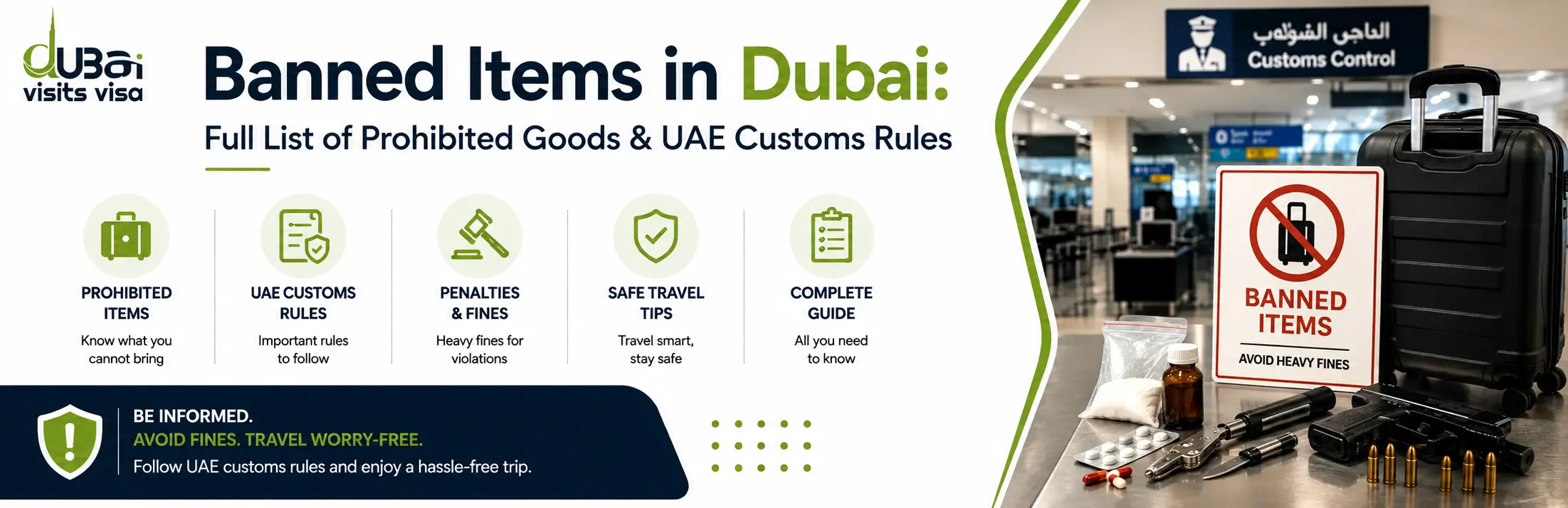
The banned items in Dubai list covers narcotics, pork and non-Halal meat, poppy seeds, paan and betel products, counterfeit goods and explicit material. Prescription drugs including Tramadol and Codeine need Ministry of Health approval before you travel. Duty-free limits are 200 cigarettes, 4 litres of alcohol, gifts under AED 3,000, and cash over AED 60,000 must be declared.
The banned items in Dubai are strict, specific and non-negotiable. Some items on the list will genuinely surprise you, and the middle tier — restricted rather than banned — is where most real-world mistakes happen. If you are packing now and building your Dubai travel guide checklist, five minutes here could save you a fine or a confiscation.
Key limits at a glance: 200 cigarettes or 50 cigars or 500g tobacco · 4 litres alcohol or 2 cartons of beer (non-Muslim adults, 18+) · gifts up to AED 3,000 · declare cash over AED 60,000 · 100ml maximum per liquid container in cabin baggage.
Verify before you pack: the banned items in Dubai list and its allowances change.
How Banned Items in Dubai Are Classified: The Three-Tier System
The banned items in Dubai list is not black and white. Every item falls into one of three categories, and most travellers only know about the first one.
| Category | What it means | Examples |
|---|---|---|
| Prohibited | Absolutely banned. No permit, no exception | Narcotics, pork, obscene material, counterfeit goods |
| Restricted | Allowed only with a permit, approval, or within quantity limits | Prescription medicines, alcohol, e-cigarettes, drones |
| Allowed | Freely imported within personal use limits | Personal electronics, clothing, gifts under AED 3,000 |
That middle tier is the risk zone. Travellers assume an item is fine because it is legal at home or because they have passed through before. That assumption is what causes problems at DXB.
Which Banned Items in Dubai Cannot Go in Your Cabin Bag?
Your carry-on is screened before boarding. Under ICAO aviation rules and airport security policy, these are banned from the cabin at Dubai International Airport.
| Item | Status in cabin | Notes |
|---|---|---|
| Sharp objects, blades over 6cm | Banned | Scissors, pocket knives and utility knives are all prohibited |
| Power banks | Carry only, cannot use | Emirates banned onboard power bank use from 1 October 2025. You may carry it, you may not plug it in |
| Firearms and replica weapons | Banned | Includes toy guns, BB guns and any realistic-looking replica |
| Flammable aerosols and liquids | Banned | Lighter fluid, aerosol paint, flammable hairspray |
| Liquids over 100ml | Banned | See the liquid rules section below |
| Hoverboards and lithium scooters | Banned | Not allowed in cabin, and most airlines restrict them in the hold too |
| E-cigarettes and vapes | Personal use only | Permitted for personal use. Final decision rests with the customs inspector |
Checked Baggage Limits and Exact Quantities
Alongside the banned items in Dubai, these are the official duty-free allowances published in the Dubai Customs Passenger Guide. Exceed them and you pay duty, or the excess is confiscated.
| Item | Maximum limit | Status |
|---|---|---|
| Cigarettes and tobacco | 200 cigarettes, or 50 cigars, or 500g tobacco | Limit applies |
| Alcohol (non-Muslim adults, 18+) | 4 litres, or 2 cartons of beer (24 cans of up to 355ml each) | Restricted |
| Duty-free gifts | Up to AED 3,000 (about USD 820) in total value | Allowed |
| Cash and financial instruments | Declare if over AED 60,000 (about USD 16,340) | Declaration required |
| Prescription medicines | Personal supply with prescription. MoHAP permit for controlled drugs | Permit may be required |
| Pork and non-Halal meat | Zero quantity permitted | Prohibited |
| Poppy seeds (khaskhas) | Zero, even in food form | Prohibited |
| Betel leaves, paan, naswar, gutka | Zero, complete ban | Prohibited |
Customs duty on quantities above these limits is 5% of the goods value plus cost, freight and insurance, rising to 50% on alcohol and 100% on cigarettes.
Which Medicines Are on the Banned Items in Dubai List?
This section matters more than any other. The banned items in Dubai include medicines that are legal and routinely prescribed in India, Pakistan, the UK and the US. UAE law does not recognise a foreign prescription on its own. If a medicine is on the controlled substances list and you have no Ministry of Health and Prevention approval, carrying it is a criminal offence.
Travellers have been detained at DXB over Tramadol prescribed by a licensed doctor at home. This is not a grey area.
Narcotics: Zero Tolerance, No Permit Possible
- Cannabis and CBD oil — banned regardless of THC content or legality at home
- Heroin, cocaine, methamphetamine — listed for completeness
- Etorphine and thiofentanyl
Controlled Medicines: Permit Required Before Travel
These are not automatically banned, but carrying them without prior MoHAP approval is treated as a narcotics offence.
- Tramadol — one of the most commonly prescribed painkillers in South Asia
- Codeine — including cough syrups sold over the counter in India, Pakistan and the UK
- Morphine and other opioid analgesics
- Diazepam and other benzodiazepines
- Methylphenidate (ADHD medication)
- Risperidone and other antipsychotics
- Testosterone injections or supplements
- Strong sedatives and sleeping pills
How to Get MoHAP Approval
- Check your exact medication against the official controlled substances list published by the Ministry of Health and Prevention.
- Obtain a prescription from your treating doctor, in English or Arabic, showing dosage and duration.
- Submit the application through the MoHAP portal with your passport copy, prescription and a medical report where required.
- Allow several working days for the approval to be issued before your departure date.
- Carry the approval letter, the original prescription and the medicine in its original labelled packaging.
- Keep all three in your hand luggage, never in checked baggage.
If you are travelling for health reasons or carry regular medication, read our guide on medical tips for visiting Dubai, which covers the approval process in detail.
Which Foods Are on the Banned Items in Dubai List?
Food is where travellers from South Asia and Southeast Asia get caught most often, because these banned items in Dubai are everyday staples at home. Enforcement is strict.
All imported meat must come from Halal-certified sources. Non-Halal meat, including pork, bacon, ham, lard and products containing pork gelatin, is prohibited regardless of quantity or packaging.
| Food item | Status | Important detail |
|---|---|---|
| Pork, bacon, ham, lard, pork gelatin | Prohibited | Non-Halal meat is banned. No exception for quantity or packaging |
| Poppy seeds (khaskhas) | Prohibited | Classified as a narcotic source. Banned in every form, including bread, pastries and achaar |
| Betel leaves, paan, naswar, gutka, supari | Prohibited | Complete ban, heavily enforced on flights from India, Pakistan, Bangladesh and Sri Lanka |
| Non-Halal slaughtered meat, any type | Prohibited | All imported meat must carry official Halal certification |
| Seeds, soil, organic fertiliser | Restricted | Ministry of Climate Change and Environment approval required |
| Home-cooked food | Proceed with caution | Not banned if Halal, but subject to inspection. Clear packaging helps |
Note for Indian and Pakistani travellers: paan, naswar, gutka, supari and betel nut in any form are completely banned, and a small personal packet is not treated as a minor violation. These items are specifically flagged on high-volume South Asian routes.
Electronics, Drones and Power Banks
Two electronics updates have changed the banned items in Dubai picture recently, and older guides have not caught up.
Power Banks on Emirates Flights
From 1 October 2025, Emirates prohibited the use of power banks onboard. You can still carry one in your cabin bag, but charging or using it during the flight is not permitted. Other UAE carriers have introduced similar restrictions, so check your specific airline before packing.
Drones and GCAA Registration
Drones must be registered with the General Civil Aviation Authority before you can legally operate one in the UAE. An unregistered drone can be confiscated at customs even if you never intended to fly it.
Other Restricted Electronics
- Walkie-talkies and two-way radios — require telecom regulator approval before import
- Satellite phones — require a special permit and cannot be freely imported
- GPS trackers — require prior authorisation
- VPNs — the device is not banned, but using a VPN to bypass UAE telecom restrictions is illegal
- Hoverboards, Segways, electric scooters — banned in cabin, restricted in the hold under lithium battery rules
If you are arriving on a remote work visa with professional equipment, confirm the import rules first. What is fine in a laptop bag is very different from what counts as commercial equipment.
Red Channel or Green Channel: Which Do You Use?
After baggage collection you will see two lanes at the customs exit.
| Green channel: nothing to declare | Red channel: must declare |
|---|---|
| No prohibited items in your bags | Cash or valuables over AED 60,000 |
| Alcohol within the 4 litre limit | Commercial quantities of any goods |
| Tobacco within the 200 cigarette limit | Controlled medicines, even with a permit |
| Cash under AED 60,000 | Gifts above AED 3,000 |
| Gifts under AED 3,000 | Commercial samples or business equipment |
| Personal medicines, no controlled drugs | Unaccompanied baggage or freight |
Carrying any of the banned items in Dubai through the green channel is not treated as a mistake. It is treated as an attempt to evade customs, and spot checks happen in both lanes. When in doubt, use the red channel. Our guide to the dos and don'ts for your Dubai trip covers the wider etiquette.
What Happens If You Get Caught?
Consequences for carrying banned items in Dubai fall into three tiers, and the gap between them is enormous.
Minor: Confiscation and Administrative Fine
Excess cigarettes, alcohol slightly over the limit or a banned food item is typically confiscated, and you proceed. A written warning or an administrative fine may follow.
Moderate: Fines and Possible Detainment
Undeclared cash, commercial quantities of restricted goods, counterfeit products or banned electronics attract significantly higher fines. Temporary detainment for investigation is possible, particularly for undeclared cash.
Serious: Criminal Prosecution
Narcotics, including controlled medicines carried without MoHAP approval, fall under UAE federal drug law rather than customs regulations. Possession can carry a mandatory custodial sentence, and trafficking carries the most severe penalties available under UAE law. This applies even when the medicine was prescribed by a licensed doctor abroad.
There is no "I didn't know" defence for drug-related offences. Courts have consistently held that unfamiliarity with local law does not mitigate a narcotics charge.
How Do You Pre-Declare With the iDeclare App?
Dubai Customs operates the iDeclare mobile app for advance declaration, available on iOS and Android. It lets you check allowances, declare goods before arrival and receive a reference that officers can verify.
- Download iDeclare before you fly and create your traveller profile.
- Select the declaration type that matches what you are carrying.
- Enter the items, quantities and values, and upload any permit or approval letter.
- Submit and save the reference number generated by the app.
- Use the red channel on arrival and present the reference to the officer.
Pre-declaring is most useful if you are carrying controlled medicines with a MoHAP letter, cash above AED 60,000, commercial samples or high-value gifts. It also signals transparency, which customs officers respond to well. If you are visiting on a temporary work permit with professional equipment, it is worth downloading before you fly.
Final Word
The banned items in Dubai list sounds strict, and it is. But they are entirely navigable for anyone who checks before packing. The travellers who get into trouble are almost always the ones who assumed something was fine without looking.Every item on the banned items in Dubai list is published, every limit is documented, and the permits for restricted items are all obtainable before you fly. Ten minutes of checking is the whole job.
Need help with a Dubai visa before you travel?
Our team can walk you through the visa route that fits your trip, so the only thing left to check is your luggage against the banned items in Dubai list.
Comments
0No comments yet — be the first to share your thoughts.
Leave a Comment
Your email address will not be published. Required fields are marked *
Frequently asked questions
Non-Muslim adults over 18 can bring a maximum of 4 litres of alcohol or 2 cartons of beer (24 cans × 355ml). Muslim travellers: zero alcohol permitted under any circumstance.
Yes, poppy seeds (khus khus) are restricted in the UAE because they are linked to narcotics laws. Dubai customs may confiscate them if found in your luggage.
You can carry it in your hand luggage. As of October 1, 2025, you cannot use it or charge devices with it during the flight. Using a power bank onboard Emirates is now a violation of their safety rules.
No. Betel leaves, paan, naswar, gutka, and supari are all fully banned. This is one of the most actively enforced bans on South Asian routes at DXB. There is no leniency for personal quantities.
Yes, completely. This includes poppy seeds in bread, pastries, spice mixes, and achaar. They are classified as narcotic-related even in food form. Carry zero.
No — not without prior MoHAP approval obtained before you travel. A prescription from your doctor does not override UAE drug law. Apply for a MoHAP permit at mohap.gov.ae at least two weeks before your departure date.
You must declare at the red channel if you are carrying cash or financial instruments worth more than AED 60,000 (approximately USD 16,340). Not declaring is a prosecutable offence.
Yes. Products labelled "Made in Israel" are prohibited from import into Dubai. Remove them from your luggage before departure.





Thanks! Your comment has been received and will appear after a quick review.