


- Heat Stroke & Heat Exhaustion — Symptoms, First Aid & When to Call 999
- Medicines to Carry When Visiting Dubai — Full OTC Kit
- Banned Medicines in Dubai & MOHAP e-Permit Process (Step-by-Step)
- Vaccinations Before Visiting Dubai — Specific Vaccines Named
- Dubai Pharmacy for Tourists — 24/7 Options & Chains
- Dubai Hospital Walk-In for Tourists — Which Accept You
- Desert Safari, Beach & Water Activity Health Risks
- Flight Health — DVT, Jet Lag & Long-Haul Tips
- Ramadan Health Rules — What the Law Actually Says
- Health Tips — Pregnant Travellers, Kids & Elderly
- Tap Water Safety, Food Hygiene & Traveller's Diarrhea
- Sandstorm & Respiratory Health in Dubai
- Dubai Travel Health Insurance — Mandatory in 2026?
- AC Shock, Mental Health & Best Time to Visit for Health
- UAE Emergency Contacts — Save Before You Land
- Final Word — Staying Healthy in Dubai Starts Before You Board
You've booked the flights. You've sorted your Dubai visit visa requirements. You've packed for the heat. But here's what most travellers skip entirely — understanding how Dubai's climate, legal system, and healthcare infrastructure actually affect your health while you're there.
A tourist ending up in a Dubai hospital because of heat stroke, or getting detained at the airport because their prescription medicine was classified as a controlled substance — these aren't rare horror stories. They happen every season. These medical tips for visiting Dubai are written to make sure none of that happens to you.
Whether you're travelling from India, the UK, or the US, this guide covers everything — from what medicines to carry when visiting Dubai, to finding a Dubai pharmacy for tourists in an emergency, to which Dubai hospital walk-in accepts tourists without an appointment. And yes — this means covering what vaccinations before visiting Dubai you actually need, not just a vague "ask your doctor" answer. Think of this as the health layer on top of your Dubai travel plan — the part most guides forget.
Quick Summary — Medical Tips for Visiting Dubai- Dubai's summer temperature exceeds 45°C — heat illness is a real, emergency-level risk
- Controlled medicines (codeine, diazepam, ADHD meds) require a free MOHAP e-permit before travel
- Recommended vaccines: Hepatitis A, Typhoid, MMR, Meningococcal — consult a doctor 4–8 weeks before departure
- UAE Emergency: 999 | Ambulance: 998
- Travel health insurance is mandatory for Dubai tourists in 2026
- Eating, drinking, or taking medicine publicly during Ramadan daylight hours can result in a fine
Heat Stroke & Heat Exhaustion in Dubai — Symptoms, First Aid & When to Call 999
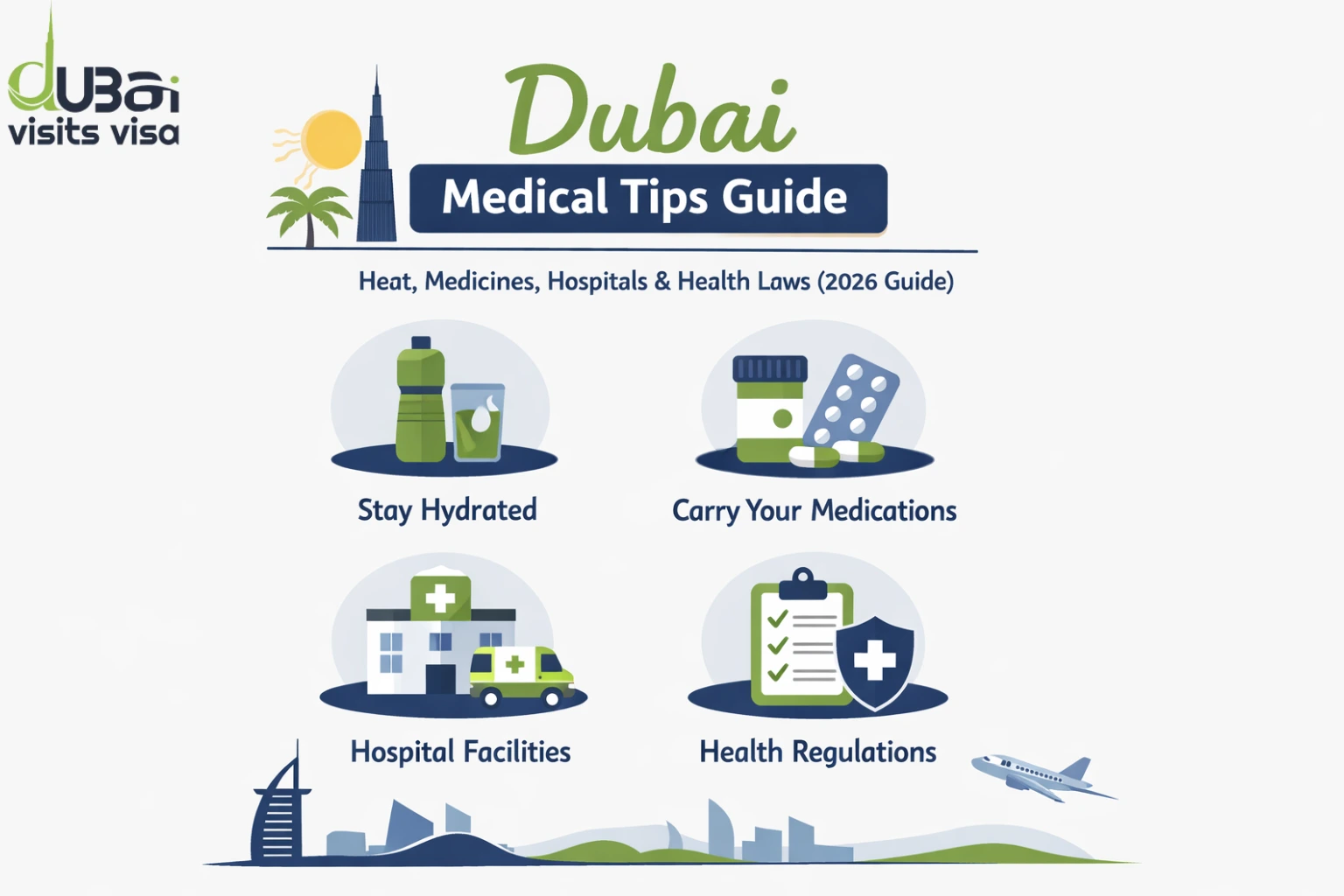
Dubai's average summer temperature sits between 40°C–48°C (104°F–118°F), with humidity pushing past 80% in July and August. For tourists arriving from cooler climates, staying healthy in Dubai on a summer vacation depends heavily on how well you understand heat-related illness — and how fast you act when symptoms appear. These are some of the most critical medical tips for visiting Dubai that can genuinely be the difference between a hospital visit and a great afternoon.
This isn't just a "drink more water" conversation. Heat stroke is a medical emergency that can cause organ failure within minutes if untreated.
Heat Stroke vs Heat Exhaustion — How to Tell Them Apart
| Condition | Key Symptoms | Action Required |
|---|---|---|
| Heat Exhaustion | Heavy sweating, cold/clammy skin, weak pulse, nausea, dizziness, fatigue | Move to shade/AC immediately, drink cool water, rest — monitor for worsening |
| Heat Stroke | No sweating, hot/red/dry skin, rapid pulse, confusion, loss of consciousness | Call 999 immediately — this is a medical emergency |
Step-by-Step First Aid for Heat Stroke (While Waiting for Ambulance)
- Move the person to air-conditioned space immediately
- Remove excess clothing
- Apply cool (not ice cold) wet cloths to neck, armpits, and groin
- Fan the person continuously
- Do NOT give water if the person is unconscious or confused
- Call 999 — Dubai Ambulance responds rapidly across the city
Prevention tip: The UAE Labour Ministry officially advises against outdoor activity between 10am–4pm during summer months (June–September). This applies to tourists too — schedule sightseeing for early morning or after sunset.
Medicines to Carry When Visiting Dubai — What Goes in Your Kit
Packing the right medicines is one of the most practical health tips for Dubai tourists that most travel blogs skip. Dubai pharmacies are excellent and well-stocked, but getting to one when you're already unwell in 45°C heat is a different challenge. The medicines to carry when visiting Dubai depend partly on your activities — beach, desert safari, city-only — but the base kit below covers every Dubai tourist. Keep in mind that some items you carry from home may also overlap with items that are restricted or banned in Dubai — so double-checking before you pack is worth five minutes of your time.
Recommended OTC Kit for Dubai Tourists
| Medicine / Item | Why You Need It | Approx. Dubai Price (AED / USD) |
|---|---|---|
| ORS sachets (Oral Rehydration Salts) | Heat dehydration, traveller's diarrhea | AED 8–15 / USD 2–4 |
| Paracetamol / Ibuprofen | Fever, headaches, general pain | AED 10–25 / USD 3–7 |
| Loperamide (Imodium) | Traveller's diarrhea — quick symptom control | AED 15–30 / USD 4–8 |
| Antihistamine (Cetirizine / Loratadine) | Sandstorm allergies, dust reactions | AED 12–25 / USD 3–7 |
| Sunscreen SPF 50+ | UV index in Dubai regularly hits 10–11 (extreme) | AED 40–90 / USD 11–25 |
| Antacids / Omeprazole | Rich food, new cuisine, travel stress | AED 15–35 / USD 4–10 |
| Eye drops (preservative-free) | Sandstorm dust, pool chlorine irritation | AED 20–45 / USD 5–12 |
| Insect repellent (DEET-based) | Desert safari, outdoor evenings | AED 20–40 / USD 5–11 |
| Inhaler (if asthmatic) | Sandstorms can trigger severe attacks | Bring from home (prescription required) |
Disclaimer: Prices listed are approximate market estimates as of early 2026 and may vary by pharmacy and location. Always verify current prices at the point of purchase.
Prescription Medicines — UAE Quantity Rules
If you're carrying prescription medicines, UAE law sets clear limits you must follow:
- Uncontrolled prescription medicines: Maximum 3-month supply allowed
- Controlled prescription medicines: Maximum 30-day supply only — and you must have a valid MOHAP e-permit (see next section)
- Always carry the original pharmacy-labeled packaging
- Keep a copy of your prescription and a letter from your doctor in English
Banned Medicines in Dubai for Tourists — The MOHAP e-Permit Process
This is the section most travel articles completely skip — and it's the one that can get you detained at Dubai airport before your vacation even begins. Understanding which medicines are classified as banned medicines in Dubai for tourists isn't about paranoia; it's about protecting a legitimate medical need with a simple pre-travel step.
The UAE classifies certain medicines as "controlled substances." What's a routine prescription in your home country — codeine cough syrup, ADHD medication, sleeping pills, certain antidepressants — may be a controlled or outright banned substance under UAE law.
Reality Check: Possession of a controlled substance without prior MOHAP approval can result in confiscation, detention, or prosecution under UAE drug laws — even if you have a valid prescription from your home country.
Common Medicines That Require a MOHAP Permit
- Codeine-based cough syrups or painkillers
- Tramadol, Morphine, and other opioid-based painkillers
- Diazepam (Valium) and other benzodiazepines
- Methylphenidate (Ritalin) and Amphetamine salts (Adderall) — ADHD medications
- Pseudoephedrine (found in some decongestants)
- Certain antidepressants and antipsychotics
- Testosterone and anabolic steroids
- Zolpidem (Ambien) and other sleep aids
This list is not exhaustive. When in doubt, check the UAE Ministry of Health (MOHAP) official portal before you travel — the portal is free to use and the permit is free to apply for.
How to Apply for a MOHAP e-Permit (Step-by-Step)
- Visit the UAE MOHAP website — look for "Permits" section
- Create a free account using your passport details
- Select "Import Medicine for Personal Use"
- Upload your valid prescription (in English or with certified translation)
- Upload your passport copy
- Submit — processing is typically 3–5 working days
- Download and print your approved e-permit
- Carry the permit, original prescription, and medicine in original packaging at all times
Apply at least 2 weeks before your travel date to allow processing time. The permit is free of charge.
"Travellers carrying controlled medicines without prior UAE Ministry of Health approval face serious legal consequences at entry — even with a valid home-country prescription. The MOHAP e-permit process exists precisely to protect legal medicine users, and it is completely free."
— Guidance aligned with UAE MOHAP controlled medicine import guidelines
Vaccinations Before Visiting Dubai — Specific Vaccines You Should Know
One of the most searched health tips for Dubai tourists is vaccination advice — and most articles give a useless generic answer: "consult your doctor." Here's what your doctor will actually recommend, and why. Getting vaccinations before visiting Dubai sorted early is one of those travel health steps that protects you without adding any real burden to your preparation.
The UAE does not mandate vaccinations for tourist entry (except Yellow Fever if arriving from endemic countries). But recommended vaccinations before visiting Dubai depend on your origin country, travel duration, and planned activities. Indian and South Asian travellers specifically should pay attention to Hepatitis A and Typhoid — both transmitted through contaminated food and water, which is a real risk when eating outside major hotels.
Recommended Vaccines for Dubai Tourists
| Vaccine | Why Relevant for Dubai | Priority Level |
|---|---|---|
| Hepatitis A | Food and water contamination risk, especially with street food | Highly Recommended |
| Typhoid | Relevant for travellers from South Asia eating local food | Recommended |
| MMR (Measles, Mumps, Rubella) | Active CDC global alert — Dubai is a high-transit international hub | Highly Recommended |
| Meningococcal | Recommended for travellers from meningitis belt countries | Situational |
| Chickenpox (Varicella) | If not previously vaccinated or had the disease | Recommended |
| Rabies | Only if planning desert safari with camel/animal contact | Activity-based |
| COVID-19 | Up-to-date doses recommended per your country's guidance | Recommended |
Timing matters: See a travel medicine doctor or your GP at least 4–8 weeks before your Dubai departure — some vaccines require multiple doses over weeks to be effective.
Dubai Pharmacy for Tourists — Where to Go and What to Expect
Finding a Dubai pharmacy for tourists is genuinely easy — Dubai has one of the highest pharmacy-per-capita ratios in the region. You will not struggle to find one. What you need to know is where the 24/7 options are and what to expect. For any tourist focused on staying healthy in Dubai throughout their trip, knowing the pharmacy network is as important as knowing which hospital to go to.
Key Facts for Tourists
- All pharmacies in Dubai are regulated by the Dubai Health Authority (DHA)
- English-speaking staff are standard across all major pharmacies
- Pharmacists can dispense many medicines OTC that require prescriptions in Western countries
- Airport pharmacies (Terminals 1, 2, and 3 at DXB) are open 24/7
- Major mall pharmacies (Dubai Mall, Mall of the Emirates, City Centre Deira) operate extended hours, typically 10am–12am
Major Pharmacy Chains in Dubai
- Aster Pharmacy — Largest network, many 24/7 locations
- Life Pharmacy — Widespread across malls and residential areas
- Boots UAE — UK-style pharmacy, familiar for British tourists
- Bin Sina Pharmacy — Community-focused, strong Arabic-language support
For non-emergency medical queries, Aster and Mediclinic both offer telehealth consultations via their apps — you can speak to a doctor within minutes without leaving your hotel room. This is especially useful late at night or when you're too unwell to travel.
Dubai Hospital Walk-In for Tourists — Which Ones Accept You Without an Appointment
Medical treatment in Dubai is excellent — but it is expensive. A standard Dubai hospital walk-in consultation for tourists costs between AED 300–600 (USD 82–163) before any tests or treatment. Travel insurance is not optional here. If you land at DXB and need urgent care immediately on arrival, the Dubai airport guide covers where the airport medical clinic is located across terminals.
Major Hospitals That Accept Tourist Walk-Ins
| Hospital | Type | 24/7 Emergency | Walk-In Accepted |
|---|---|---|---|
| American Hospital Dubai | Private | Yes | Yes |
| Mediclinic City Hospital | Private | Yes | Yes |
| Rashid Hospital | Government | Yes | Yes (emergencies) |
| NMC Healthcare | Private | Yes | Yes |
| Aster Hospital Mankhool | Private | Yes | Yes |
Disclaimer: Hospital walk-in policies and consultation fees change periodically. Always call ahead or check the hospital's website to confirm current pricing and walk-in availability.
All major private hospitals in Dubai have English-speaking staff. Government hospitals like Rashid prioritise emergencies — for routine illness, private facilities are faster for tourists.
Desert Safari, Beach & Water Activity Health Risks in Dubai
Dubai's most popular tourist activities — desert safaris, beach clubs, pool days, water parks — come with health risks that most travellers don't prepare for. Staying healthy in Dubai on vacation means thinking beyond just the heat. If you're planning a budget Dubai trip, knowing which activities carry higher health risk helps you plan smarter too.
Desert Safari Health Risks
Desert safari is Dubai's #1 tourist activity. The open desert has no shade, temperatures regularly hit 47°C+, and the terrain generates constant fine sand particles. Specific risks include:
- Extreme heat and rapid dehydration — carry at least 2 litres of water per person
- Sand in eyes — bring preservative-free eye drops and avoid removing contact lenses outdoors
- Respiratory irritation — fine sand particles trigger asthma; carry your inhaler
- MERS-CoV risk from camel contact — the CDC specifically flags UAE camel exposure as a risk factor for Middle East Respiratory Syndrome. Avoid touching your face after camel contact; wash hands thoroughly
- Dune buggy and activity injuries — check if your travel insurance covers adventure sports before booking
Beach, Pool & Water Park Health Risks
- Swimmer's ear (otitis externa) — very common in hotel pools; tip your head after swimming to drain water
- Chlorine eye irritation and conjunctivitis — wear swimming goggles in pools
- Skin rashes from over-chlorinated pools — rinse off immediately after swimming
- Gastrointestinal illness — avoid swallowing pool or sea water
- Jellyfish stings — check beach flag colours (red = no swim) and ask hotel staff about seasonal jellyfish warnings
- Sunburn — Dubai's UV index regularly reaches 10–11 (extreme); reapply SPF 50+ every 90 minutes even in water
Flight Health — DVT, Jet Lag & Long-Haul Travel Tips
Depending on where you're flying from, your journey to Dubai ranges from 3 hours (India) to 14 hours (US West Coast). These are practical health tips for Dubai tourists that start before you even land.
Deep Vein Thrombosis (DVT) on Long-Haul Flights
DVT — the formation of blood clots in leg veins — is a documented risk on flights over 4 hours. The risk increases with dehydration, immobility, and cramped seating. For Dubai-bound flights from the UK, US, or Southeast Asia, take it seriously.
- Wear compression socks (available at most airports pre-flight)
- Get up and walk the aisle every 1–2 hours on flights over 4 hours
- Do ankle rotation exercises in your seat
- Stay hydrated — avoid alcohol and excess caffeine mid-flight
- Those with previous clots, recent surgery, or clotting disorders should consult their doctor before flying
Jet Lag — Practical Tips That Actually Work
- Adjust your sleep schedule 2–3 days before departure toward Dubai time (UTC+4)
- Avoid screens for 1 hour before sleeping on arrival night
- Get natural light exposure in the morning on Day 1 in Dubai
- Melatonin (0.5–3mg) taken 30 minutes before your target bedtime can help — available OTC in UAE pharmacies
- Avoid heavy meals and alcohol on arrival day
Ramadan Health Rules for Tourists — What the Law Actually Says
Eating, drinking, or taking medicines visibly in public during Ramadan daylight hours is a legal offence in the UAE. For non-Muslims unfamiliar with local law, this is one of the most overlooked medical tips for visiting Dubai during the holy month. Understanding this is also part of the broader set of dos and don'ts for a Dubai trip that all tourists should review before arrival.
What This Means Practically
- You cannot eat, drink water, or take medicine in public during daylight Ramadan hours — this includes streets, parks, malls, and public transport
- Hotels, restaurants, and dedicated areas provide screened spaces for non-fasting individuals to eat and drink
- Take your medication in your hotel room, a restaurant, or a screened eating area
- Water bottles should be consumed out of public view
- Violating this can result in a fine — ignorance of the law is not typically accepted as a defence in UAE courts
If you're visiting during Ramadan, check the dates before you travel and plan your medicine schedule accordingly — especially for medicines that require food, or for diabetics managing insulin timing.
Health Tips for Pregnant Travellers, Children & Elderly Visitors
These three groups face amplified versions of Dubai's standard health risks. A few targeted precautions make the difference between a comfortable trip and an emergency hospital visit.
Pregnant Travellers
- Most airlines restrict travel after 28–36 weeks of pregnancy — check your airline's policy before booking
- Dubai's heat significantly increases dehydration risk — pregnant travellers should drink 3–4 litres of water daily
- Avoid outdoor activity during peak heat hours (10am–4pm)
- Ensure your travel insurance covers adventure activities if you plan any — coverage for pregnancy-related medical complications in Dubai must be explicitly confirmed
- Carry your antenatal records and a letter from your OB/GYN in English
- American Hospital Dubai and Mediclinic have well-regarded maternity departments if you need care
Travelling with Children
- Children are more vulnerable to heat exhaustion than adults — limit outdoor time strictly
- Keep a child-specific OTC kit: paediatric paracetamol, ORS sachets, child-safe insect repellent, SPF 50+ sunscreen
- Age-appropriate vaccine schedules should be up to date — see the vaccinations section above
- Schedule beach and outdoor activities before 9am or after 5pm
- Children's Emergency departments are available at Latifa Hospital (government) and most private hospitals
Elderly Travellers
- Dehydration risk is significantly higher — the thirst mechanism weakens with age
- Heat exacerbates existing cardiovascular conditions; consult your cardiologist before summer travel
- Bring a complete list of current medications with dosages — translated to English if needed
- Stick to air-conditioned environments during midday hours
Tap Water, Food Safety & Traveller's Diarrhea in Dubai
Is Dubai Tap Water Safe to Drink?
Technically, yes — Dubai's tap water meets WHO standards for safety. It is desalinated seawater that undergoes thorough treatment. However, the majority of residents and tourists prefer bottled water because the taste is noticeably different, and building pipes in older properties can affect quality. Bottled water in Dubai costs AED 1–3 (USD 0.27–0.82) per 1.5L bottle — it's widely available everywhere.
Food Safety Tips for Tourists
- Dubai has strict DHA food safety regulations — major restaurants maintain high standards
- Choose busy restaurants over quiet ones — high turnover means fresher food
- Avoid raw shellfish and raw salads at smaller street-level eateries
- Be cautious with buffets left out in the heat — particularly at outdoor events
- Wash hands before every meal, or use alcohol-based hand sanitiser (min. 60% alcohol)
Traveller's Diarrhea — What To Do If It Happens
The Middle East is classified by health authorities as a medium-to-high risk zone for traveller's diarrhea (TD). Dubai's major hotels and restaurants are lower risk, but unfamiliar cuisine and new water sources can still trigger it.
If it happens:
- Start ORS (oral rehydration salts) immediately — dehydration is the real danger
- Take Loperamide (Imodium) for symptom control on travel days — it does not cure, just slows
- Avoid dairy, fatty foods, and alcohol until symptoms resolve
- See a doctor if: diarrhea lasts more than 48 hours, fever above 39°C, blood in stool, or severe abdominal pain
- Most cases resolve in 2–3 days with good hydration
Sandstorm & Respiratory Health in Dubai — What Tourists Need to Know
Shamal sandstorms are a recurring, seasonal reality in Dubai — particularly between March and August. They reduce visibility to near-zero within minutes and significantly impact air quality. For asthma sufferers, this is one of the most important health tips for Dubai tourists to plan around. Staying healthy in Dubai during sandstorm season means having the right supplies and knowing exactly what to do when one hits.
During a Sandstorm
- Stay indoors and keep windows and doors closed
- If caught outside, cover your nose and mouth with a cloth or N95 mask
- Do not remove contact lenses outdoors — sand under lenses causes serious corneal abrasions
- Do not drive — visibility can drop to under 50 metres
- Asthma patients: keep rescue inhaler accessible at all times, not packed in checked luggage
- After the storm passes, air quality remains poor for several hours — continue precautions
Check Dubai's air quality index (AQI) on apps like IQAir or UAE Pass before outdoor plans.
Dubai Travel Health Insurance — Is It Mandatory in 2026?
Yes — as of 2026 visa rules, health insurance coverage is a mandatory requirement for Dubai tourists. This is a change from previous years when it was simply "highly recommended." When applying for any of the types of Dubai visit visa, valid travel health insurance is part of the documentation process. This is one of those medical tips for visiting Dubai that has moved from best-practice advice into a legal requirement — do not skip it.
Beyond legal requirements, the financial reality makes insurance non-negotiable:
- Standard A&E visit at a private Dubai hospital: AED 500–1,500 (USD 136–408)
- Hospital admission per day (private): AED 2,000–8,000+ (USD 544–2,178+)
- Medical evacuation to home country: AED 50,000–200,000+ (USD 13,600–54,450+)
Disclaimer: Medical costs listed are approximate estimates. Actual costs vary by hospital, treatment type, and insurance plan. Always verify current costs with your insurer and hospital before treatment.
Choose a policy that covers: emergency hospitalisation, ambulance services, trip cancellation, and repatriation. If you're pregnant or have pre-existing conditions, confirm these are explicitly covered.
AC Shock, Mental Health & The Best Time to Visit Dubai for Your Health
The AC Shock Problem
Moving repeatedly between 45°C outdoor heat and 18–20°C indoor air conditioning creates thermal shock on your respiratory and immune system. This "AC shock" is a real, commonly reported health tip for Dubai tourists that local doctors frequently treat — particularly sore throats, sinus congestion, and fatigue from repeated temperature swings.
Simple mitigation: carry a light layer (cardigan, scarf) for indoor spaces, and give your body a 5-minute transition time in shaded outdoor areas before entering fully air-conditioned spaces.
Mental Fatigue & Long-Haul Travel Stress
- Long-haul flights combined with time zone shifts create significant cognitive fatigue
- Plan a low-intensity first day in Dubai — pool, hotel, rest — before major sightseeing
- Stay socially connected with family back home; isolation in an unfamiliar city amplifies travel anxiety
- If you're managing a mental health condition, bring adequate medication (with documentation) and identify a local psychiatrist or GP in advance
Best Time to Visit Dubai for Health
| Month Range | Temperature Range | Health Risk Level | Outdoor Activity |
|---|---|---|---|
| November – March | 18°C – 28°C (64°F–82°F) | Low | Excellent — full day possible |
| April – May | 28°C – 38°C (82°F–100°F) | Moderate | Good — limit noon hours |
| June – September | 40°C – 48°C (104°F–118°F) | High | Avoid 10am–4pm strictly |
| October | 30°C – 38°C (86°F–100°F) | Moderate | Good — use morning/evening |
Best months overall for health and comfort: November through February. Perfect for desert safaris, beach days, and outdoor Dubai sightseeing without heat risk.
UAE Emergency Contacts — Save These Before You Land in Dubai
Save These Numbers in Your Phone Right Now| UAE Emergency (Police/Fire/Ambulance) | 999 |
| Dubai Ambulance Direct | 998 |
| Dubai Police Tourist Assistance | 901 |
| Dubai Health Authority (DHA) Hotline | 800 DHA (800 342) |
| MOHAP General Enquiries | 800 11111 |
These contacts are also important to have saved if you're reviewing your overall Dubai safety planning — especially for first-time visitors travelling alone.
Final Word — Staying Healthy in Dubai Starts Before You Board
Dubai is one of the safest and most medically well-equipped destinations in the world. Its hospitals are internationally accredited, its pharmacies are excellent, and its emergency response is fast. But the city's extreme heat, strict medicines laws, and cultural rules around health and public behaviour create a specific set of challenges that uninformed tourists consistently walk into. These medical tips for visiting Dubai are not scare tactics — they are the practical knowledge that separates a smooth trip from an avoidable disaster.
Every health tip for Dubai tourists in this guide is grounded in real UAE law and real Dubai healthcare reality — from the MOHAP permit process for banned medicines in Dubai to knowing which Dubai hospital walk-in accepts tourists without insurance hassle, to understanding how a Dubai pharmacy for tourists actually works at 2am when you need it most.
Start with your medicines list, run it against UAE controlled substances guidelines, get your MOHAP permit if needed, sort your vaccinations before visiting Dubai, and make sure your Dubai travel insurance actually covers medical emergencies. Once that's done, the city is yours. If you want to make the most of your time on the ground, the best places to visit in Dubai on a tourist visa is a good next read — plan the health-safe months first, then build your itinerary around them.
Stay hydrated. Carry your kit. Save 999 in your phone. Dubai will take care of the rest.
Comments
0No comments yet — be the first to share your thoughts.
Leave a Comment
Your email address will not be published. Required fields are marked *
Frequently asked questions
Heat stroke is a medical emergency. Call 999 immediately. While waiting for the ambulance: move the person to air-conditioned space, remove excess clothing, apply cool (not ice cold) cloths to neck and armpits, and fan continuously. Do not give water if the person is confused or unconscious.
Dubai tap water is technically safe by WHO standards — it is desalinated and treated. However, most tourists and residents drink bottled water due to taste differences and older building pipe concerns. Bottled water costs AED 1–3 (USD 0.27–0.82) per 1.5L and is available everywhere.
Dial 999 for all emergencies in Dubai — police, fire, or ambulance. The Dubai Ambulance direct line is 998. Save both before you travel. English-speaking operators are available on both lines.
Hepatitis A, Typhoid, and MMR are the three most commonly recommended vaccinations before visiting Dubai. Meningococcal and Chickenpox are situationally recommended. Desert safari travellers should consider a rabies pre-exposure vaccine given camel contact risk. Consult a travel doctor 4–8 weeks before departure.
Yes. As of 2026, health insurance is a mandatory requirement for Dubai tourist visa holders. It is no longer just recommended — proof of valid coverage is part of the visa documentation process. Ensure your policy covers emergency hospitalisation, ambulance, and medical repatriation.
Controlled medicines including codeine, tramadol, diazepam, ADHD medications (Ritalin, Adderall), certain antidepressants, sleeping pills, and anabolic steroids require a MOHAP e-permit before entry. Without this permit, possession — even with a home-country prescription — can result in confiscation or detention. The permit is free and applied for through the MOHAP website.
Yes — airport pharmacies (DXB Terminal 1, 2, 3) operate 24/7. Aster Pharmacy has multiple 24-hour locations across Dubai. Major mall pharmacies operate until midnight. English-speaking staff are standard across all major pharmacy chains.
No — consuming anything in public during Ramadan daylight hours is a legal offence in the UAE, including water and medicines. Take your medication in your hotel room, a restaurant, or a designated eating area. This applies to non-Muslims as well. Fines apply for violations.







Thanks! Your comment has been received and will appear after a quick review.