


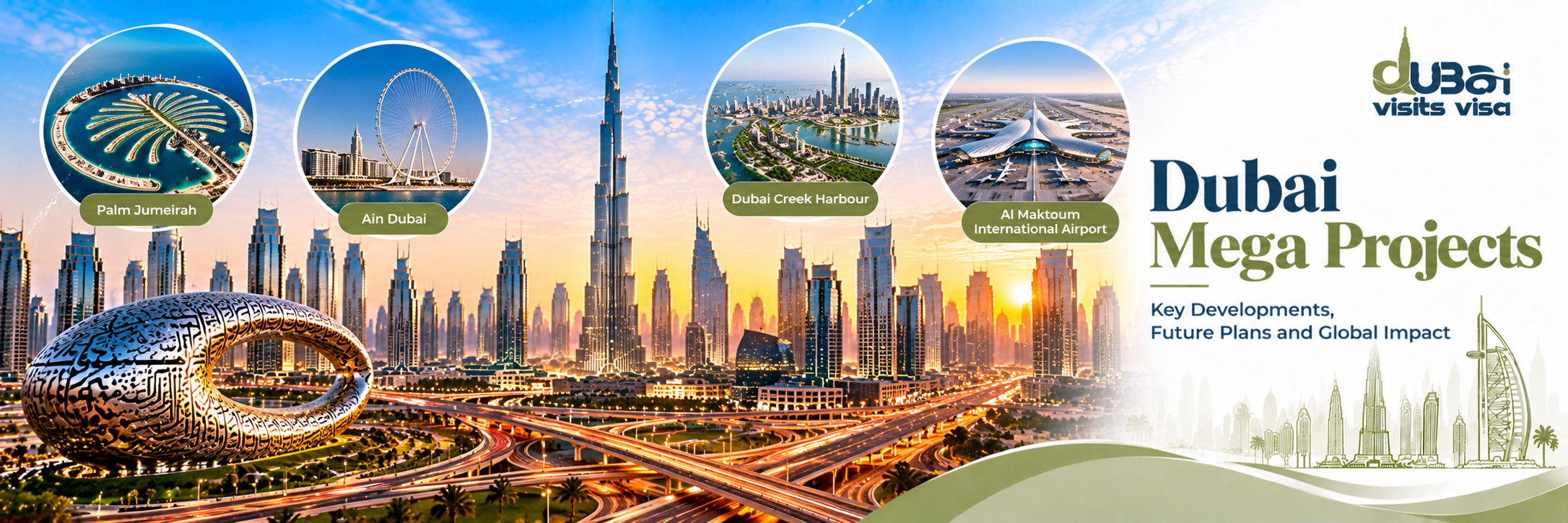
Dubai is not building for today. Every crane on the horizon, every tunnel being dug underground, every artificial island taking shape off the coast — it all points toward a city that is engineering its own future in real time. If you are planning a trip to Dubai or seriously considering investing in property here, understanding the scale of what is currently underway changes how you see everything.
In 2026 alone, Dubai has active construction worth over AED 500+ billion across real estate, transport, culture, and sustainability. These are not concept art renders. These are funded, government-backed, contractor-awarded Dubai mega projects that are reshaping the city neighbourhood by neighbourhood.
This guide covers every major category — from the world's tallest towers to underground tunnel networks, from off-plan villa communities to marine conservation cities floating in the Arabian Gulf. Each project comes with the numbers, the developer names, the locations, and the completion timelines that serious planners actually need.
Quick Summary
Dubai currently has 15+ major mega projects under construction or in active tender. Combined investment value exceeds AED 1 trillion. Projects span towers, airports, metro lines, artificial islands, solar parks, and floating museums — all tied to the Dubai 2040 Urban Master Plan.
What Makes Dubai Mega Projects Different from the Rest of the World
Most cities build reactively — roads come after congestion, hospitals after population growth. Dubai builds 20 years ahead. The projects being constructed right now are not responses to current problems. They are deliberate moves in a long-term strategy to position Dubai as a global capital of business, tourism, innovation, and sustainable living.
Several characteristics define how these Dubai development projects work:
- Government-backed financing — Entities like Emaar Properties, Nakheel, and DAMAC work closely with government mandates, ensuring projects rarely stall due to funding.
- Master-planned from day one — Most new construction projects in Dubai are part of larger master-planned communities with built-in transport, retail, green space, and school infrastructure.
- Freehold access for foreign buyers — Many new developments in Dubai are available as freehold property, meaning expats and overseas investors can own outright — a major driver of demand.
- ROI-focused design — Off-plan launches in areas like Business Bay, Creek Harbour, and Dubai South are priced strategically to attract early investors with strong projected returns.
- Smart mobility integration — New projects now factor in vertiport access (eVTOL air taxis), metro connectivity, and EV charging as baseline requirements, not optional extras.
In short, Dubai is not building skyscrapers for ego. It is building an aerotropolis — a city where the airport is the economic engine, surrounded by world-class residential, commercial, and leisure developments that justify AED billions in investment every year.
Dubai Upcoming Projects: Tallest Towers & Iconic Skyscrapers (2026–2030)
For many people, Dubai mega projects means record-breaking height. That instinct is not wrong. Several of the world's most ambitious vertical structures are actively under construction in Dubai right now. Here is what is confirmed, funded, and breaking ground.
1. Dubai Creek Tower — The World's Tallest Structure
Developer: Emaar Properties | Location: Dubai Creek Harbour | Architect: Santiago Calatrava
Dubai Creek Tower is the centrepiece of the entire Creek Harbour district. Designed by Swiss-Spanish architect Santiago Calatrava, the structure draws its form from the Arabian dhow sail, mosque minarets, and the lily flower. The tower is expected to stand between 928 and 1,400 metres upon completion — taller than Burj Khalifa by a significant margin.
After a pause for design revisions, Emaar confirmed in January 2026 that the tender for the redesigned tower would be reissued within the first three months of 2026. This formally revives the project after years of speculation. The tower will include ten observation decks shaped like lily buds, sky gardens, the world's highest mosque, twenty floors of hotels and residences, and a ground-level plaza with retail, a museum, and an auditorium.
Once complete, it will anchor Dubai's skyline the way Burj Khalifa has for the past 15 years — but at an entirely different scale.
| Detail | Information |
|---|---|
| Developer | Emaar Properties |
| Height | 928–1,400 metres (exact finalised design pending) |
| Location | Dubai Creek Harbour |
| Architect | Santiago Calatrava |
| Tender Status | Reissued Q1 2026 |
| Key Features | 10 observation decks, world's highest mosque, sky gardens, hotels, residences |
2. Burj Azizi — World's Second Tallest Building
Developer: Azizi Developments | Location: Sheikh Zayed Road | Completion: 2028
Standing at 725 metres with 131+ storeys, Burj Azizi is actively under construction on Sheikh Zayed Road and will become the world's second tallest building upon completion. It is also the only freehold property on Sheikh Zayed Road — a fact that makes it one of the most unique off-plan investment opportunities currently available in Dubai.
The tower will feature luxury residences, an all-suite seven-star hotel themed around seven world cultures, a vertical retail centre spanning seven floors, the world's highest hotel lobby (level 11), the world's highest nightclub (level 126), and the world's highest observation deck (level 130). Completion is scheduled for 2028.
3. Ciel Tower — World's Tallest Hotel
Developer: DMCC / The First Group | Location: Dubai Marina | Height: 360 metres
Ciel Tower, rising 360 metres in Dubai Marina, will be the world's tallest hotel upon completion. The building will have over 1,000 luxury suites, a helipad, and an observation deck, blending Japanese Wabi-Sabi aesthetics with Dubai's contemporary luxury style. This is one of the most visible new construction projects in Dubai Marina and will significantly change that district's visual identity.
4. Burj Binghatti — World's Tallest Residential Tower
Developer: Binghatti Developers × Jacob & Co. | Location: Business Bay | Height: 550+ metres | Completion: ~2026
Burj Binghatti exceeds 550 metres and is designed to be the world's tallest residential tower. Built by Binghatti Developers in collaboration with luxury watchmaker Jacob & Co., the tower's facade features diamond-shaped spires inspired by baguette-cut diamonds. It offers luxury 2 and 3-bedroom apartments — the Sapphire Collection and Emerald Collection — along with an infinity pool, spa, and private service concierge. The project is a "hypertower" targeting ultra-high-net-worth buyers in Business Bay's growing freehold residential market.
5. Franck Muller Aeternitas Tower — World's Tallest Residential Clock Tower
Developer: DAMAC Properties × Franck Muller | Location: Dubai Marina | Height: 450 metres
Piercing the Dubai Marina skyline at 450 metres, the Franck Muller Aeternitas Tower will be both the world's tallest branded residential tower and the world's tallest residential clock tower. It targets premium buyers who want an iconic address in Dubai Marina with Swiss luxury branding built into the architecture itself.
Ongoing Projects in Dubai: Infrastructure That's Changing How the City Moves
The most transformative of all ongoing projects in Dubai are not the towers people photograph. They are the roads, rail lines, tunnels, and airports that make a city of 4 million people actually function at scale. These are the projects that will determine Dubai's daily life for the next 50 years.
Al Maktoum International Airport (DWC) — The World's Largest Airport
Developer/Authority: Dubai Airports | Location: Dubai South / Jebel Ali | Target Capacity: 260 million passengers
Al Maktoum International Airport is arguably the single most important infrastructure project ever announced in Dubai. Phase one expansion work is already underway, with a plan to ultimately accommodate 260 million passengers annually — making it five times the size of the current Dubai International Airport (DXB).
The completed airport will feature more than 400 aircraft gates, five parallel runways, five passenger terminal buildings, and an underground train system. The plan also includes a dedicated aerotropolis around it — Dubai South — a master-planned community designed for the 1 million+ residents expected to live there. Full completion is projected for 2050 in phases, but meaningful operational capacity is expected well before that.
The Red Line Metro extension toward DWC is also planned, and the Airport Express Line — a 55km metro corridor connecting DXB and DWC with five stations — is currently in the consultancy and design stage as of 2026.
Dubai Metro Blue Line — AED 20.5 Billion Transport Project
Authority: Roads and Transport Authority (RTA) | Route Length: 30 kilometres | Stations: 14 | Opening: September 9, 2029
In May 2026, Sheikh Mohammed bin Rashid Al Maktoum inaugurated the main tunnelling works on the Dubai Metro Blue Line — a AED 20.5 billion project that will be the third metro line in the city. The line stretches 30 km and includes 14 stations, with seven elevated, four underground, and three interchange stations connecting to the existing Red and Green lines.
The Blue Line connects Ras Al Khor Industrial Area, Al Warqaa, Mirdif, Dubai Creek Harbour, Dubai Silicon Oasis, Dubai Academic City, and Dubai International Airport. It will enable a direct journey from DXB to key urban centres in just 20 minutes and is expected to serve a population of one million residents along its corridor by 2040.
Separately, the Dubai Metro Gold Line was also approved in April 2026 — spanning 42 km with 18 stations, running fully underground, targeted to open in 2032.
| Metro Line | Length | Stations | Cost (AED) | Opening Year |
|---|---|---|---|---|
| Blue Line | 30 km | 14 | AED 20.5 billion (~USD 5.6 billion) | September 2029 |
| Gold Line | 42 km | 18 | TBC | 2032 |
| Airport Express Line | 55 km | 5 (proposed) | In design stage | TBC |
Dubai Loop — Elon Musk's Boring Company Underground Tunnels
Developer: The Boring Company × RTA Dubai | Budget: AED 2.5 billion (~USD 680 million) | First Phase: DIFC & Dubai Mall
The Dubai Loop is one of the most talked-about ongoing projects in Dubai. Announced at the 2025 World Government Summit, the project will use Elon Musk's Boring Company tunnel technology to create underground transit connecting key city districts.
In its initial phase, the Loop will connect the Dubai International Financial Centre (DIFC) and Dubai Mall. The full network will eventually extend 22.2 km with 19 stations, connecting the Dubai World Trade Centre, Business Bay, and the wider financial district. Capacity is projected at up to 30,000 passengers per day. The first phase is expected to begin operating by mid-2026.
Dubai Flying Taxis (eVTOL / Vertiports)
Partners: Joby Aviation, Archer Aviation, Skyports Infrastructure | Initial Launch: 2026 (commercial operations)
Dubai's Roads and Transport Authority signed an agreement with California-based Joby Aviation in February 2024 to deploy electric vertical take-off and landing (eVTOL) aircraft — commonly called flying taxis — across the city. Sheikh Mohammed has already approved the vertiport designs, with four initial locations confirmed near Dubai International Airport, Palm Jumeirah, and key business districts.
Full commercial operations are targeted for 2026. Travel times across major city corridors are projected at 10–30 minutes, compared to 45–90 minutes by road during peak hours. Dubai is positioning itself as one of the first cities in the world with a functioning Advanced Air Mobility (AAM) network, and smart mobility is becoming a baseline expectation in all new master-planned communities.
New Developments in Dubai: Real Estate, Villas & Master-Planned Communities
Beyond the towers and the tunnels, the new developments in Dubai that attract the most investor interest are large-scale residential communities — particularly for those looking at the expat property market in the UAE. Several major projects are currently open for off-plan purchase.
Dubai Square — Emaar's Indoor City at Creek Harbour
Developer: Emaar Properties | Location: Dubai Creek Harbour | Area: 7.4 million sqm | Investment: AED 41+ billion
Dubai Square is being built as a self-contained indoor city inside the Creek Harbour district. Launched in late 2025, the development spans approximately 2.6 million sqm in its first retail-focused phase and will eventually cover 7.4 million sqm. It will include 10,000 homes, more than 1,500 hotel rooms, a wildlife sanctuary, a 7,500 sqm retail district, AI-enabled navigation, and a world-first drive-through retail concept. Expected opening is approximately three years from 2026.
Palm Jebel Ali — Dubai's Largest Artificial Island
Developer: Nakheel | Location: Jebel Ali coastline | Status: Active construction
Palm Jebel Ali is the largest of Dubai's palm-shaped artificial islands — significantly bigger than Palm Jumeirah. Originally announced years ago but redesigned and revived, the project is now in active construction phases. It will feature 80+ hotels and resorts, thousands of freehold villa plots, beach clubs, marinas, and retail destinations. The island is positioned as Dubai's next major waterfront living address, targeting both high-end residential buyers and tourism developers.
Dubai Islands (formerly Deira Islands)
Developer: Nakheel | Location: Deira coastline | Status: Ongoing phases
five islands off the Deira coastline — represent one of the most ambitious coastal developments in the region. The project will include luxury hotels, beach residences, marina communities, and a large entertainment district. Se the islands. For buyers interested in waterfront freehold living, this is one of the most actively marketed upcoming villa projects in Dubai.
Grand Club Resort — AED 41 Billion Community
Developer: Emaar Properties | Area: 60 million square feet | Value: AED 41 billion (~USD 11.2 billion)
Set against the Dubai skyline, this master-planned community will span 60 million square feet and integrate eco-friendly building practices, wellness centres, spa facilities, and smart city infrastructure. It is one of the largest single residential community announcements in Dubai's recent history and reflects the trend toward large-scale, amenity-rich developments over standalone tower projects.
Upcoming Villa Projects in Dubai: 2026 Off-Plan Highlights
For those specifically looking at upcoming villa projects in Dubai, these are the communities currently in active off-plan or early construction phase:
| Project Name | Developer | Location | Type | Handover (Est.) |
|---|---|---|---|---|
| Palm Jebel Ali Villas | Nakheel | Jebel Ali | Beachfront villas, freehold | 2026–2028 |
| Dubai Islands Residences | Nakheel | Deira coastline | Waterfront villas & apartments | 2027–2029 |
| Ghaf Woods | Majid Al Futtaim | Near Global Village | Forest living villas, Dubai's first | 2027 |
| Dubai South Villas | Multiple | Dubai South / DWC | Townhouses, villas, freehold | 2026–2028 |
| Grand Club Resort | Emaar | TBA | Mixed community | Multi-phase, post 2027 |
Disclaimer: All prices, handover dates, and project values listed in this article are based on publicly available data as of May 2026. These figures are subject to change. Always verify directly with the developer or official sales channels before making any investment or purchase decision.
Dubai Development Projects: Sustainability, Culture & Smart City Initiatives
Not every major Dubai development project is a skyscraper. Some of the most interesting new construction projects in Dubai are ecological, cultural, and infrastructural — and they tend to attract far less coverage than the towers, even though their long-term impact is arguably greater.
Mohammed bin Rashid Al Maktoum Solar Park
Authority: Dubai Electricity and Water Authority (DEWA) | Location: Seih Al Dahal, south of Dubai | Target: 5,000 MW by 2030
The Mohammed bin Rashid Al Maktoum Solar Park is the largest single-site solar energy project in the world. It sits at the centre of Dubai's Clean Energy Strategy 2050,These initiatives are also part of the UAE's broader approach to sustainable development and international cooperation, including its long-standing UAE foreign aid policy. which targets 75% of Dubai's energy from clean sources by that date. As of 2026, several phases are already operational, with the full 5,000 MW target set for 2030. The scale of this project — both in physical footprint and in its implications for Dubai's net zero commitments — makes it one of the most consequential Dubai development projects of this century.
Dubai Reefs — Floating Sustainable City for Marine Regeneration
Developer: URB | Area: 200 square kilometres | Focus: Marine research, ecotourism, reef restoration
Dubai Reefs is one of the most unconventional new developments in Dubai — a floating sustainable city dedicated to marine research, reef regeneration, and ecotourism. It aims to support over 1 billion corals and 100 million mangrove trees, covering 200 sq km of the Arabian Gulf. The project is being developed by urban innovation firm URB and represents Dubai's most explicit commitment to ocean sustainability in a region often criticised for its environmental footprint from land reclamation projects.
Dubai Museum of Art (DUMA) — Floating Over Dubai Creek
Developer: Al Futtaim Group | Architect: Tadao Ando (Pritzker Prize winner) | Location: Above Dubai Creek
Announced in October 2025 by Sheikh Mohammed, the Dubai Museum of Art — known as DUMA — is being designed by world-renowned Japanese architect Tadao Ando. The structure will literally rise above the waters of Dubai Creek, making the building itself an architectural masterpiece separate from the art it will house. The Pritzker Prize-winning designer is known for minimalist, material-focused work that responds to landscape and light. No confirmed timeline has been announced, but Al Futtaim Group's track record suggests active development is underway.
The Future Loop — Air-Conditioned Walking Bridge
Plans reviewed by Sheikh Hamdan in November 2025 reveal a 2km air-conditioned walking bridge connecting the Dubai World Trade Centre, Museum of the Future, Emirates Towers, DIFC, and nearby metro stations. The Future Loop is designed to enable year-round pedestrian connectivity in Dubai's harsh summer heat — a practical urban design solution that no major Middle Eastern city has implemented at this scale.
Marsa Al Arab — Two New Islands Next to Burj Al Arab
Developer: Meraas / Dubai Holding | Location: Adjacent to Burj Al Arab | Status: Under construction
Marsa Al Arab will create two man-made islands on either side of Burj Al Arab. The development will include a luxury resort, a theatre, a marine park, a private marina, a yacht club, and a helipad. The project extends the Jumeirah beachfront and adds significant hospitality inventory to one of Dubai's most premium coastal addresses.
Completed Mega Projects That Already Changed Dubai's Skyline
Understanding where Dubai is going requires knowing where it has already arrived. These are the completed mega projects that proved Dubai's ambition is not just promotional material — it gets built.
| Project | Developer | Completion | Why It Matters |
|---|---|---|---|
| Burj Khalifa | Emaar | 2010 | World's tallest building (828m), rebranded Dubai globally |
| Palm Jumeirah | Nakheel | 2006–2008 | World's largest artificial island at launch, added 78km of coastline |
| Museum of the Future | DWTC / Dubai Future Foundation | 2022 | Iconic architectural landmark, symbol of UAE innovation strategy |
| One Za'abeel | Ithra Dubai | 2026–2026 | World's largest cantilevered sky bridge (The Link) |
| Expo City Dubai (former Expo 2020 site) | Dubai Expo Authority | 2022 (legacy phase ongoing) | 438-hectare innovation district, now integrated into Dubai South |
| Dubai Frame | Dubai Municipality | 2018 | 150m frame connecting old and new Dubai visually |
Dubai 2040 Urban Master Plan: The Vision Behind All These Projects
None of these Dubai mega projects exist in isolation. They all connect back to one strategic document: the Dubai 2040 Urban Master Plan, launched by Sheikh Mohammed in 2021.
The plan is built around five urban centres — Deira and Bur Dubai (heritage zone), Downtown and Business Bay (business core), Dubai Marina and JBR (tourism and waterfront), Expo City Dubai and Al Maktoum Airport (future growth engine), and Al Barsha and Dubai Silicon Oasis (innovation and education hub). Each of the mega projects in this article maps to at least one of these zones.
Key targets by 2040 include doubling the urban green and recreational space to 60% of Dubai's total area, increasing the share of natural reserves to 33% of the emirate, and ensuring that no resident lives more than 20 minutes from essential services. The Blue Line Metro, Dubai Loop, flying taxis, and community master plans are all tools for reaching that "20-minute city" goal.
For anyone thinking about property investment or an investor visa in Dubai, understanding the 2040 Master Plan is not optional — it tells you exactly which zones are prioritised for growth and infrastructure spending over the next 15 years.
Did You Know?
The Dubai 2040 plan will double the city's population to 5.8 million by 2040. Every major Dubai development project currently underway is sized to serve that future population — not just the 3.5 million people who live there today.
Investment Angle: Why Dubai Mega Projects Matter for Property Buyers
For a lot of visitors who came to Dubai on a short visit, the property market feels like a world away. But the connection is direct — every mega project that opens creates tourism demand, which drives rental yields, which drives off-plan investment, which funds the next generation of construction. Understanding this cycle matters whether you are buying for lifestyle or for ROI.
Here is what the data shows about the areas most directly shaped by current Dubai development projects:
| Area | Key Mega Project Nearby | Avg. Off-Plan Price (AED/sqft) | Avg. Off-Plan Price (USD/sqft) | Why Investors Are Watching |
|---|---|---|---|---|
| Dubai Creek Harbour | Creek Tower, Dubai Square | AED 1,400 – 2,200 | USD 381 – 599 | New urban centre, master-planned, Emaar-backed |
| Business Bay | Burj Binghatti, Dubai Loop | AED 1,600 – 2,800 | USD 436 – 762 | High rental yield zone, strong demand from professionals |
| Sheikh Zayed Road | Burj Azizi | AED 2,500 – 4,500+ | USD 681 – 1,225+ | Only freehold on SZR — extreme scarcity value |
| Dubai South | Al Maktoum Airport, Expo City | AED 700 – 1,200 | USD 191 – 327 | Early-stage aerotropolis pricing, long-term growth play |
| Palm Jebel Ali | Palm Jebel Ali Island | AED 2,000 – 5,000+ | USD 545 – 1,362+ | Waterfront scarcity, premium Nakheel brand trust |
Disclaimer: Property price ranges are indicative averages based on publicly available market data as of May 2026. Prices are subject to change based on market conditions, developer pricing strategies, and unit specifications. This is not financial advice. Always conduct independent due diligence before investing.
If you are considering a longer stay or residency alongside your investment, understanding your Dubai residency visa options is a practical first step before committing to any off-plan purchase.
Myth vs. Reality: Common Misconceptions About Dubai Mega Projects
| Common Myth | Reality |
|---|---|
| "Dubai projects always get delayed" | Major government-backed projects — airports, metro lines — run to tight timelines. Developer projects have varied records. Research the developer's handover history before buying off-plan. |
| "Only residents can buy property" | False. Dubai has extensive freehold zones where any nationality can purchase property outright. Palm Jebel Ali, Business Bay, Creek Harbour, and Dubai Marina are all freehold. |
| "These projects are mostly vanity construction" | The Dubai 2040 Master Plan ties all projects to population, transport, and economic targets. Al Maktoum Airport and the Metro Blue Line have measurable capacity and connectivity goals — not PR goals. |
| "The property market is a bubble" | Rental yields in Dubai (5–8% in many areas) remain among the highest of any major global city. Population growth projections and government visa reforms continue to drive genuine occupier demand. |
How Dubai Mega Projects Impact Tourism
The connection between new construction projects in Dubai and the tourism economy is not abstract. Every major project that opens adds a reason for someone to buy a flight ticket. The surge in Dubai tourism numbers in recent years is directly linked to the pipeline of new openings — and that pipeline is the longest it has ever been.
Al Maktoum International Airport, when fully operational, will make Dubai accessible to over 260 million passengers annually. That figure is the entire population of Brazil moving through one airport. The flying taxis will make getting around the city faster than any road-based alternative. Dubai Square will add a new mega-attraction to the Creek Harbour district. The Museum of Art floating over the Creek will be a cultural destination unlike anything currently in the region.
For tourists, the practical implication is simple: Dubai in 2030 will offer a meaningfully different experience from Dubai in 2020. The projects currently under construction are not incremental upgrades — they are entirely new districts, transport modes, and cultural institutions.
Quick Reference: Dubai Mega Projects Status 2026
| Project | Category | Developer | Status (2026) | Completion Est. |
|---|---|---|---|---|
| Dubai Creek Tower | Tower | Emaar | Tender reissued Q1 2026 | TBD post-tender |
| Burj Azizi | Tower | Azizi Developments | Under construction | 2028 |
| Ciel Tower | Hotel | DMCC / The First Group | Near completion | 2026–2026 |
| Burj Binghatti | Residential | Binghatti × Jacob & Co. | Under construction | ~2026 |
| Al Maktoum Airport | Infrastructure | Dubai Airports | Phase 1 underway | Phase 1 by ~2033, full: 2050 |
| Metro Blue Line | Transport | RTA Dubai | Tunnelling underway (May 2026) | September 2029 |
| Dubai Loop | Transport | Boring Company × RTA | Phase 1 in development | Mid-2026 (Phase 1) |
| Flying Taxis (eVTOL) | Smart Mobility | Joby / Archer / RTA | Initial ops began 2026 | Full commercial: 2026 |
| Palm Jebel Ali | Island / Real Estate | Nakheel | Active construction | 2026–2028 (phases) |
| Dubai Square | Mixed-use | Emaar | Under construction | ~2029 |
| Dubai Islands | Island / Real Estate | Nakheel | Ongoing phases | 2027–2029 |
| MBR Solar Park | Sustainability | DEWA | Multiple phases active | 5,000 MW target: 2030 |
| Marsa Al Arab | Hospitality | Meraas / Dubai Holding | Under construction | 2026–2027 |
| Dubai Museum of Art (DUMA) | Culture | Al Futtaim | Announced Oct 2025 | Timeline TBC |
| Dubai Reefs | Sustainability | URB | Planning / early stage | Long-term |
Final Word: Dubai Is Not Waiting for the Future to Arrive
That is the most important thing to understand about Dubai mega projects. Other cities draft master plans and revise them every decade. Dubai anchors AED billions, appoints contractors, and starts digging. The Metro Blue Line tunnelling began in May 2026. Al Maktoum Airport's expansion is underway. Palm Jebel Ali has active construction across multiple phases. Dubai Loop Phase 1 is targeting mid-2026 operations.
For investors, the window on early-stage pricing in key growth corridors — Dubai South, Creek Harbour, Sheikh Zayed Road — is measured in months, not years. For travellers, every visit between now and 2030 will be different from the last as new openings change the city's texture.
If you are still working out the entry logistics, start with the Dubai visit visa requirements to make sure your documentation is ready before you travel.
Data sourced from RTA Dubai, Emaar Properties official statements, Dubai Media Office, Khaleej Times, Time Out Dubai, and property market research as of publication date. All project timelines, prices, and specifications are subject to change. This article does not constitute financial or investment advice.


Priyanshu is a travel and visa content specialist focused on visa requirements, travel procedures, and immigration information for international destinations. His work covers visa eligibility, documentation, application processes, entry requirements, transit rules, and practical travel guidance. He researches official updates and relevant industry information to create clear, accurate, and easy-to-understand content that helps travellers understand visa processes and plan their journeys with confidence.
Comments
0No comments yet — be the first to share your thoughts.
Leave a Comment
Your email address will not be published. Required fields are marked *
Frequently asked questions
Off-plan means purchasing a property before it is built, typically at a lower entry price than completed units. Dubai's off-plan market is regulated by RERA (Real Estate Regulatory Agency), which requires developers to escrow buyer payments. Off-plan purchases in master-planned communities near mega projects tend to offer the strongest early-investor pricing.
The Dubai 2040 Urban Master Plan is a government strategy launched in 2021 that maps the city's growth across five urban centres until 2040. It targets doubling green space, reaching a population of 5.8 million, and ensuring every resident is within 20 minutes of essential services. Every major Dubai mega project is directly or indirectly aligned to this plan.
In most cases, announcement of a major infrastructure project (metro line, airport expansion) causes surrounding property prices to rise as developers price in future accessibility improvements. Creek Harbour and Dubai South are current examples where long-term infrastructure anchors are directly driving off-plan demand.
Yes. Dubai has clearly demarcated freehold zones where foreign nationals can purchase property outright, with full ownership rights. Areas like Dubai Creek Harbour, Business Bay, Dubai Marina, Palm Jebel Ali, and Dubai South all offer freehold off-plan options. A dedicated investor visa is also available for qualifying property purchases.
Ciel Tower in Dubai Marina is nearest to completion, expected in 2026–2026. Burj Binghatti in Business Bay also targets completion around 2026. The Dubai Loop Phase 1 between DIFC and Dubai Mall is also expected by mid-2026.
By investment size and strategic importance, Al Maktoum International Airport is the largest single project — a multi-decade, multi-phase expansion targeting 260 million passengers annually. By construction activity in 2026, the Metro Blue Line (AED 20.5 billion) and Burj Azizi (Sheikh Zayed Road) are the most active sites.
Directly and significantly. New developments in Dubai that are open to the public — towers, islands, airports, museums — expand the city's tourism product and justify repeated visits. The pipeline of openings through 2026–2030 means Dubai's appeal as a destination continues to grow in parallel with its infrastructure.




Thanks! Your comment has been received and will appear after a quick review.