


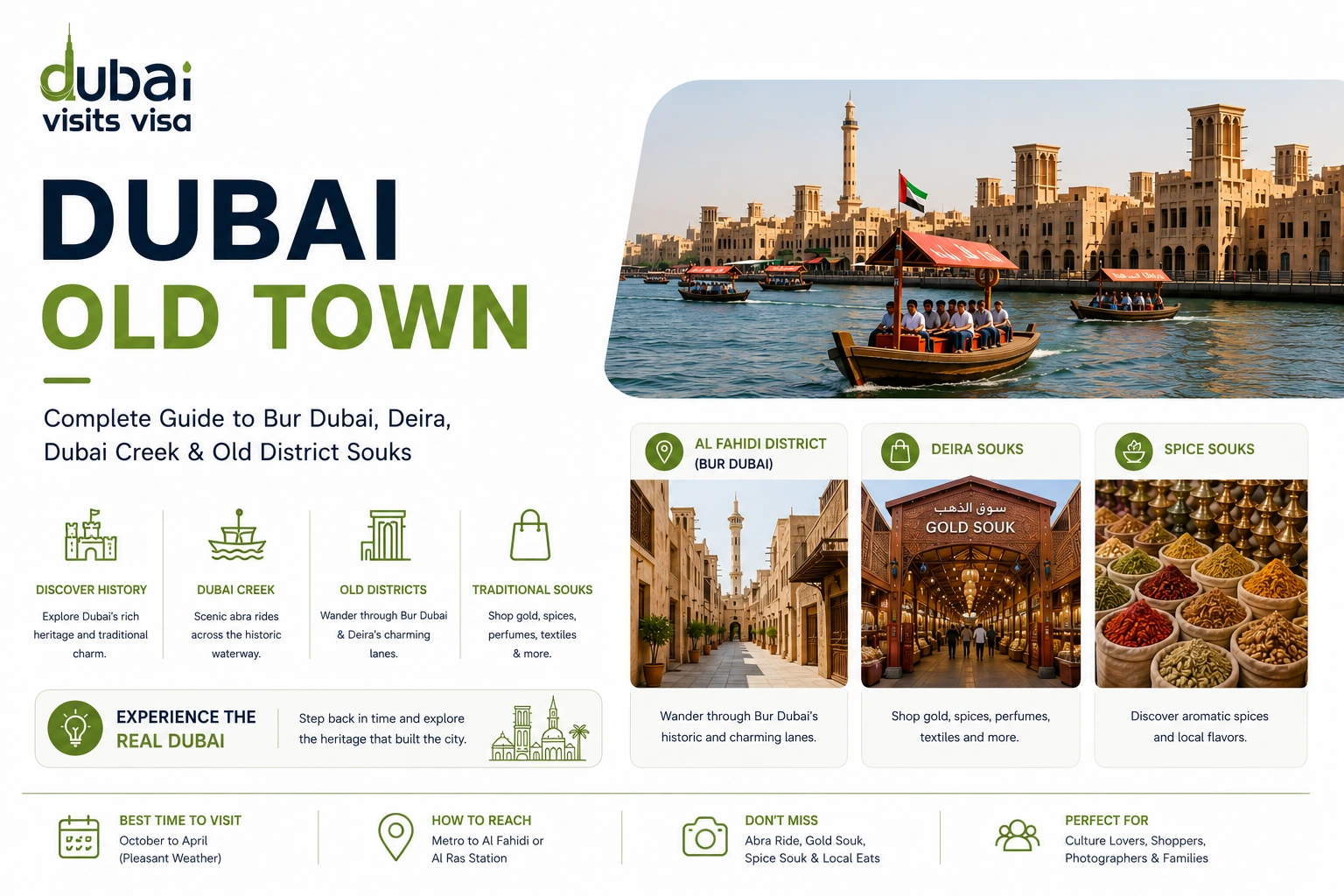
Most people arrive in Dubai and go straight to the Marina or Downtown. That's fine — but it's not the real city. The real Dubai, the one that existed before the skyscrapers, before the malls, before the artificial islands — that version is still standing. It's called Dubai Old Town, and it looks, smells, and feels completely different from the rest of the city.
Walk through the narrow lanes of Bur Dubai old town on a winter morning and you'll understand why thousands of travellers call this the best part of their entire trip. The scent of oud from a souk, the sound of abra boats on Dubai Creek, the mud-brick wind towers rising above Al Fahidi — it's a different world packed inside the same city. Many people who discover the best places to visit in Dubai end up ranking the old town area above everything else on their itinerary.
What Exactly Is Dubai Old Town?
Dubai Old Town is not a single street or a themed tourist zone. It's a collection of historic neighbourhoods that sit on both banks of Dubai Creek — the natural waterway that made this city possible. Before oil, before tourism, Dubai Creek was the economic heart of the entire region. Merchants from India, Persia, East Africa, and the rest of the Arab world traded here for centuries.
Today, the term dubai old town generally covers three main areas:
- Bur Dubai — the southern bank, home to Al Fahidi Historical Neighbourhood, the Dubai Museum, and the main textile and spice trading areas
- Deira — the northern bank, where the gold souk, spice souk, and covered markets have operated for over a hundred years
- Al Seef — a newer development along the creek that blends old architecture with modern restaurants and shops
Together, these areas form what locals and long-term residents call the dubai old district — a zone that tells you more about this city's identity than any luxury hotel ever could.
Bur Dubai Old Town vs Deira Old Town — What's the Difference?
Both areas are old and both sit on Dubai Creek, but they feel quite different on the ground.
| Feature | Bur Dubai Old Town | Deira Old Town |
|---|---|---|
| Character | Cultural, residential, heritage | Commercial, market-heavy, trading |
| Main Attraction | Al Fahidi, Dubai Museum, Grand Mosque | Gold Souk, Spice Souk, Covered Souk |
| Vibe | Quieter, walkable, photogenic | Busy, dense, sensory overload (good kind) |
| Best For | History, architecture, culture lovers | Shoppers, bargain hunters, food explorers |
| Metro Access | Al Fahidi Station (Green Line) | Al Ras Station (Green Line) |
You don't have to choose — they're connected by a 5-minute abra ride across the creek for just AED 1 (USD 0.27). Most visitors do both in a single day.
The Main Areas of Dubai's Old District — A Closer Look
Each neighbourhood in the dubai old district has its own personality. Here's what to expect before you walk in.
Bur Dubai — The Cultural Core of Dubai Old Town
Bur Dubai is where you feel the history most physically. The Al Fahidi Historical Neighbourhood (also called Al Bastakiya) is a preserved cluster of wind-tower houses — traditional Arabian architecture designed to capture airflow in the days before air conditioning. Walking through it feels genuinely different from anywhere else in the city.
Key things inside Bur Dubai old town:
- Dubai Museum — Located inside Al Fahidi Fort, the oldest building in Dubai (built 1787). Entry costs AED 3 (USD 0.82) for adults, AED 1 (USD 0.27) for children under 10. One of the most underrated museums in the city.
- Grand Mosque of Bur Dubai — One of the oldest mosques in Dubai, with a distinctive minaret visible across the area. Non-Muslim visitors cannot enter but can walk around and photograph.
- Al Seef Promenade — A waterfront development along the creek that blends old-style architecture with cafes, restaurants, and shops. Good for sunset walks.
- Textile Souk Bur Dubai — A covered market filled with fabric merchants. Good for buying fabric at lower-than-mall prices.
Deira Old Town — The Trading Heart of Dubai Creek
If Bur Dubai is the cultural side, Deira is the commercial soul. The deira old town area has been a trading hub since the late 1800s. Even today, it runs exactly the same way — merchants stacking goods in narrow covered lanes, buyers negotiating prices, and the constant movement of people from dozens of nationalities.
What you'll find in Deira:
- Gold Souk — Over 300 jewellery shops operating under one covered roof. Dubai law requires all gold sold here to be hallmarked. Prices are based on the daily global gold rate plus making charges. You can negotiate making charges but not the metal price.
- Spice Souk (Old Souk Dubai) — A short walk from the Gold Souk. Sacks of saffron, frankincense, cardamom, dried lemons, and dozens of other spices line the narrow lanes. Prices here are genuinely lower than supermarkets.
- Deira Covered Souk — A large, multi-lane covered market selling everything from clothes and textiles to electronics and household goods. This is where you see the real trading city, not the tourist version.
- Naif Souk — A smaller market area with lower-priced goods, popular with residents rather than tourists.
Dubai Creek Old Town — The Waterway That Built a City
You can't talk about dubai creek old town without talking about the water itself. Dubai Creek is approximately 14 kilometres long and has been the city's commercial artery since Dubai was nothing more than a fishing and pearl-diving village.
Today, the creek is still very much alive. You'll see wooden dhow boats — some carrying cargo, some carrying tourists — moving slowly across the water. The abra stations on both banks operate from early morning until late at night. It's one of the cheapest and most memorable experiences you can have in the entire city.
The visit dubai old town experience isn't complete without a creek crossing. Take an abra from the Bur Dubai abra station to the Deira Old Souk abra station. The ride takes about 5 minutes and gives you a view of both banks that you cannot get from land.
Old Town Dubai Souk Guide — What to Buy and What It Costs
The old town dubai souk experience spans several markets, each specialising in different goods. Understanding what each souk sells — and roughly what things should cost — saves you from paying tourist prices. If you want a broader picture of what to buy in Dubai across the whole city, the old town markets should be your starting point — not the malls.
Souk-by-Souk Price Guide (2026)
| Souk | What to Buy | Typical Price (AED) | Typical Price (USD) |
|---|---|---|---|
| Gold Souk Deira | 18k–22k gold jewellery, custom pieces | Varies by gold rate + AED 30–150 making charge per gram | USD 8–41 making charge per gram |
| Spice Souk | Saffron, cardamom, frankincense, dried fruits | AED 10–80 per 100g depending on spice | USD 2.70–21.80 per 100g |
| Textile Souk Bur Dubai | Fabric by the metre, ready-made garments | AED 5–40 per metre | USD 1.36–10.90 per metre |
| Perfume Souk (Deira) | Oud, Arabic perfume blends, attar | AED 50–500+ per bottle | USD 13.60–136+ |
| Deira Covered Souk | Clothing, accessories, household goods | AED 15–200 | USD 4–54 |
| Al Seef Souk | Souvenirs, handicrafts, regional art | AED 25–300 | USD 6.80–81.90 |
Note: All prices above are indicative estimates based on current market averages and may vary by shop, season, and negotiation. Prices can change without notice.
Bargaining in Dubai Old Town Souks — What's Acceptable
Bargaining is normal and expected in most souks — with some exceptions. In the Gold Souk, you cannot negotiate the gold price (it's tied to the daily global rate) but you can and should negotiate making charges. In the Spice Souk, prices are often flexible, especially if you're buying in larger quantities. In the Textile Souk, politely asking for a better price usually works.
One rule that applies everywhere: be respectful, stay calm, and don't walk away aggressively. These are working businesses, not performances for tourists.
How to Get to Dubai Old Town — Metro, Abra & Walking
Getting to the dubai old district is easier than most people expect, even for first-time visitors. The metro reaches both sides of the creek, and the abra network fills in the gaps.
Dubai Old Town Metro Stations
The Dubai Metro Green Line is your main option. It runs through the historic areas on both banks of the creek, making it easy to arrive, explore, and leave without needing a taxi.
| Station | Nearest Area | Walking Distance |
|---|---|---|
| Al Fahidi (Green Line) | Al Fahidi Historical Neighbourhood, Dubai Museum | 5–10 minutes walk |
| BurJuman (Red + Green Line) | Bur Dubai old town, Textile Souk | 10–15 minutes walk |
| Al Ghubaiba (Green Line) | Bur Dubai abra station, Al Seef | 5 minutes walk |
| Al Ras (Green Line) | Gold Souk, Deira old town | 3–5 minutes walk |
| Baniyas Square (Green Line) | Deira Covered Souk, Naif area | 5–8 minutes walk |
The dubai old town metro access via the Green Line is one of the most underused travel hacks in the city. A single metro ride from Downtown Dubai or Dubai Marina costs between AED 3–8 (USD 0.82–2.18) depending on the number of zones crossed.
Taking an Abra Across Dubai Creek
The abra is a traditional wooden water taxi. There are two types:
- Shared Abra — AED 1 (USD 0.27) per person. Crosses the creek between Bur Dubai and Deira in about 5 minutes. These run continuously from around 5:00 AM to midnight.
- Private Abra — AED 100–200 (USD 27–54) per hour for a private sightseeing ride. You can negotiate directly at the abra stations.
Note: Abra prices are subject to change. Confirm the fare directly with the operator before boarding.
Top Things to Do When You Visit Dubai Old Town
The visit dubai old town experience is best done slowly. This is not a rush-through destination. Here are the things worth spending actual time on.
Al Fahidi Historical Neighbourhood (Al Bastakiya)
This is the most intact example of pre-oil Dubai that still exists. The neighbourhood dates to the early 1900s and features courtyard houses built from gypsum and coral stone, with traditional wind towers (barjeels) designed to catch airflow from above. The lanes are narrow enough that two people walking side by side barely fit.
Inside the neighbourhood, you'll find:
- The Sheikh Mohammed Centre for Cultural Understanding — runs tours and breakfast/lunch events where you can ask anything about Emirati culture and religion. Breakfast costs around AED 100–120 (USD 27–33)
- Several small art galleries and independent coffee houses
- The Coffee Museum — free entry, worth 20 minutes
- Coin Museum — free entry
Dubai Museum — Most Underpriced Attraction in the City
Entry: AED 3 (USD 0.82) for adults. AED 1 (USD 0.27) for children under 10. Note: The museum is currently reported as under renovation — confirm current opening status at dubaiculture before visiting.
Housed in Al Fahidi Fort (built 1787, the oldest existing building in Dubai), the museum shows what life in this city looked like before oil changed everything. The underground section is particularly well done — recreated souk scenes, pearl diving exhibits, and a full recreation of a Bedouin camp. Allow 45–60 minutes.
Dhow Wharfage — A Working Port From Another Era
Walk along the Deira creek waterfront and you'll see large wooden dhow boats moored at the Dhow Wharfage. These are not tourist boats — they're actual cargo vessels still carrying goods across the Arabian Gulf to Iran, Pakistan, Somalia, and beyond. Boxes of electronics, fabric, car parts, and household goods are loaded and unloaded here every day. You can walk along the waterfront and photograph freely — it's a public space. This kind of layered experience is exactly why the old town shows up on so many must-visit Dubai attraction lists.
Evening Walk Along Al Seef
Al Seef is worth visiting in the evening when it comes alive. The promenade runs for about 1.5 kilometres along the Bur Dubai side of the creek and mixes old-style architecture with restaurants, cafes, a night souk, and regular cultural events. It connects seamlessly with the older parts of Bur Dubai old town and makes for a natural ending point after a full day in the dubai old downtown area.
Dubai Old Town Entry Fees — What's Free and What Costs Money
One of the things that surprises people about the dubai old village area is how much of it is completely free to walk around. Unlike theme parks or some heritage sites in other countries, most of the old town is open public space.
| Attraction | Entry Fee (AED) | Entry Fee (USD) | Notes |
|---|---|---|---|
| Al Fahidi Historical Neighbourhood | Free | Free | Open public area |
| Dubai Museum | AED 3 (adults) / AED 1 (children under 10) | USD 0.82 / USD 0.27 | Currently under renovation — confirm reopening status at dubaiculture before visiting |
| Gold Souk | Free to enter | Free to enter | Shopping is on your own budget |
| Spice Souk | Free to enter | Free to enter | Free to browse, buying is optional |
| Shared Abra Creek Crossing | AED 1 | USD 0.27 | Runs from ~5 AM to midnight |
| Sheikh Mohammed Centre Breakfast | AED 100–120 | USD 27–33 | Booking recommended in advance |
| Coffee Museum | Free | Free | Small but genuinely interesting |
| Al Seef Promenade | Free | Free | Dining options available separately |
Note: Entry fees and operating hours may change. Always confirm directly before visiting. Prices above reflect 2026 market information and are subject to change.
Best Time to Visit Dubai Old Town
Timing matters more in the old town than anywhere else in Dubai, because most of it is outdoors and the souks have specific operating hours.
Best Season
- November to March — Ideal weather. Temperatures between 18°C–28°C (64°F–82°F). You can walk the entire area comfortably, including midday.
- April to May — Getting warm (30°C–37°C / 86°F–99°F). Early morning visits still manageable.
- June to September — Very hot and humid (40°C+ / 104°F+). Not recommended for extended walking. If you must visit in summer, go between 7–10 AM or after 7 PM.
- October — Transitional. Comfortable by late October.
Best Time of Day
- Mornings (7–10 AM) — Quieter, cooler, better for photography
- Late afternoon (4–7 PM) — Souks are at their busiest but also most atmospheric
- Evening (7–10 PM) — Al Seef and creek waterfront come alive, great for dining
Souk Operating Hours
- Most souks: 9:00 AM – 1:00 PM, then 4:00 PM – 10:00 PM (Friday and Saturday may vary)
- Gold Souk: Saturday–Thursday 10 AM – 10 PM; Friday 4 PM – 10 PM
- Souks are largely closed during Friday midday prayers (approximately 12–2 PM)
Where to Eat Near Dubai Old Downtown
The dubai old downtown area near the creek has a food scene that's completely different from the restaurant strips in newer parts of the city. These are working-class restaurants, family-run cafes, and decades-old establishments — not Instagram spots.
Budget Eating (AED 15–45 / USD 4–12 per person)
- Pakistani and Indian restaurants in Bur Dubai — Some of the best biryani and roti in the entire city. Look for restaurants near the Textile Souk area. A full meal costs AED 15–30 (USD 4–8).
- Iranian bakeries and cafes — Fresh flatbread, cheese, and tea available for AED 10–20 (USD 2.70–5.40). Deira area, near the creek.
Mid-Range Eating (AED 50–150 / USD 13–41 per person)
- Al Seef restaurants — Mix of Arabic, international, and Asian options along the waterfront. The setting along the creek is worth the slightly higher prices.
- Bait Al Wakeel — One of the older waterfront restaurants in Bur Dubai, directly on the creek. Serves grilled fish and traditional Arabic dishes. Mains around AED 60–120 (USD 16–33).
If you're exploring the area as part of a broader Dubai budget trip, the old town eating options are genuinely some of the most affordable and authentic in the city.
Dubai Old Village — What People Get Wrong About This Place
A lot of travel content calls the old town a "hidden gem." It's not hidden. Thousands of people visit every day. But it is genuinely underrated compared to how much attention gets paid to the newer parts of the city.
Here are three things most visitors misunderstand:
Myth: The old town is just for tourists.
Reality: The areas around Deira old town and Bur Dubai are real working neighbourhoods. The people you see in the Gold Souk aren't extras in a show — they work there. The cargo dhows on the creek are carrying actual freight. This is a living district, not a preserved museum piece.
Myth: You need a full day minimum.
Reality: You can cover the highlights of Bur Dubai old town in 3–4 hours. A full day lets you go deeper — both sides of the creek, the museums, a proper meal — but the core experience doesn't require a full-day commitment.
Myth: Bargaining is aggressive and uncomfortable.
Reality: Most souk merchants are experienced traders who've negotiated thousands of times. A polite counter-offer is expected and respected. The conversations are usually friendly, not confrontational.
Practical Tips Before You Visit Dubai Old Town
Small details that make the experience better and save you from common mistakes. It's also worth reading about things to avoid in Dubai before you go — some rules in the old town area are enforced more strictly than in touristy zones.
- Dress modestly — Shoulders and knees covered is the standard expectation in this area. More conservative than Dubai Marina or Downtown. Keep a scarf or light layer in your bag.
- Carry small cash (AED) — Most souk shops don't accept cards. ATMs are available but sometimes have queues. Keep AED 50–200 in small notes ready.
- Don't book a flight on Friday afternoon — The abra stations and some souk sections close or reduce hours during Friday midday prayers. Plan arrival for early morning or late afternoon.
- Photography is generally welcomed — But always ask before photographing individuals, especially women. Most people are happy to be photographed if you ask first.
- Use the metro, not a taxi, to arrive — Traffic around the creek area can be unpredictable, especially in the evening. The Green Line gets you within walking distance of everything.
- Bring water — Even in winter, walking the old town area for a few hours requires hydration. Bottled water costs AED 1–2 (USD 0.27–0.54) in small shops throughout the area.
Also worth noting: if your trip to the old town is part of a broader Dubai itinerary, a complete Dubai travel guide can help you connect the old district with the rest of the city's major areas without wasting time backtracking.
Dubai Old Town vs Dubai Downtown — Two Different Cities
People often confuse "Old Town Dubai" with the "Old Town" neighbourhood inside Downtown Dubai near Burj Khalifa. These are completely different places.
| Feature | Dubai Old Town (Bur Dubai/Deira) | "Old Town" near Burj Khalifa |
|---|---|---|
| Age | 100+ years old, genuine heritage | Built in 2006, modern development |
| Character | Authentic trading district, living neighbourhood | Residential development with Arabic-style design |
| Price Level | Budget to mid-range | High-end residential, expensive cafes |
| What's There | Souks, museums, creek, dhow boats | Apartments, a few cafes, Souk Al Bahar mall |
| For Tourists | High value, rich cultural experience | Mainly useful for Burj Khalifa proximity |
When people search "dubai old town" and mean the historic creek district — this guide is for them. If you're near Burj Khalifa and see signs for "Old Town" — that's a different development entirely.
Is Dubai Old Town Safe for Tourists?
Yes. The old town areas — Bur Dubai old town, Deira old town, and the creek waterfront — are safe for tourists including solo female travellers. These are densely populated, commercially active areas with heavy foot traffic throughout the day and evening. For a broader look at how safe Dubai is for tourists overall, including specific guidance for solo female travellers and families, that covers the city-wide picture in detail.
The standard Dubai safety guidelines apply here:
- Normal street awareness, especially in crowded souk lanes where pickpocketing can occur
- Keeping bags in front of you in crowded market areas
- Not leaving valuables visible in parked cars
- Following local dress and behaviour expectations
As a YMYL note: if you have specific concerns about safety conditions at the time of your travel, always verify current travel advisories through your country's official government travel portal before departing. Conditions can change.
Final Word on Dubai Old Town
The dubai old town area doesn't advertise itself. There are no massive billboards directing you to it, no celebrity collaborations, no entry experience with LED screens at the gate. It's just a neighbourhood that's been doing the same thing for over a century — trading, living, and moving goods across a creek that made this city possible.
That's exactly why it's worth your time. Whether you're interested in the deira old town markets, the wind-tower architecture of bur dubai old town, the water crossing on Dubai Creek, or the evening atmosphere along Al Seef — this part of the city shows you something real. And in a city full of constructed experiences, that counts for a lot.
If you haven't sorted your entry into the UAE yet, checking the types of Dubai visit visa available for your nationality is a practical first step before you can plan any of this in person.
Disclaimer: All prices, fees, and operating hours mentioned in this article are based on available 2026 market information and are subject to change without notice. Always verify current information directly with the relevant venue or official UAE government portals before your visit. Visa rules and requirements are also subject to change — check official government sources for the latest guidance before applying.

Naurang is a travel and visa content writer specializing in Dubai and UAE visa requirements, travel procedures, and immigration updates. He researches visa rules, documentation, application processes, and the latest travel policies to create clear, practical guides that help international travelers navigate their Dubai journey with confidence.
Comments
0No comments yet — be the first to share your thoughts.
Leave a Comment
Your email address will not be published. Required fields are marked *
Frequently asked questions
Not exactly. "Dubai Old Town" is a broader term that covers both Bur Dubai and Deira, along with the Dubai Creek waterfront area connecting them. Bur Dubai sits on the southern bank of the creek; Deira sits on the northern bank. Both are part of the historical district, but each has a distinct character — Bur Dubai is more cultural and residential, Deira is more commercial and market-focused.
For the Bur Dubai side, Al Fahidi and Al Ghubaiba stations on the Green Line are closest. For the Deira side, Al Ras station on the Green Line puts you directly at the Gold Souk entrance. The dubai old town metro access is one of the easiest and cheapest ways to reach the area from anywhere in the city.
There are several. The most well-known are the Gold Souk and Spice Souk in Deira, and the Textile Souk in Bur Dubai. The area is also sometimes called the souk dubai old town district because so many different markets operate within a short walking distance of each other. The Deira Covered Souk and Naif Souk are additional markets in the same area.
A minimum of 3–4 hours covers the highlights on one side of the creek. A full day allows you to cross by abra to the other side, explore both Bur Dubai and Deira old town, visit Dubai Museum, and have a proper meal. Most visitors who enjoy the experience end up spending 5–7 hours without meaning to.
Almost entirely. Walking the streets, entering the souks, crossing by shared abra (AED 1), and exploring Al Fahidi Historical Neighbourhood are all free. Dubai Museum costs AED 3 for adults. You only pay for what you buy or eat.
Yes, but plan around Friday prayer times. Souks partially close between approximately 12 PM and 2 PM. The Gold Souk opens later on Fridays (typically from 4 PM). Arriving early in the morning or after 4 PM gives you the best experience. The abra service and outdoor areas remain accessible throughout.
It's one of the most photogenic areas in Dubai. The wind towers of Al Fahidi, the dhow boats on the creek at sunrise, the narrow souk lanes with coloured fabrics overhead, the abra crossing with both banks in frame — these are photographs that look nothing like the standard Dubai skyline imagery. A wide-angle lens and early morning light give the best results.








Thanks! Your comment has been received and will appear after a quick review.